
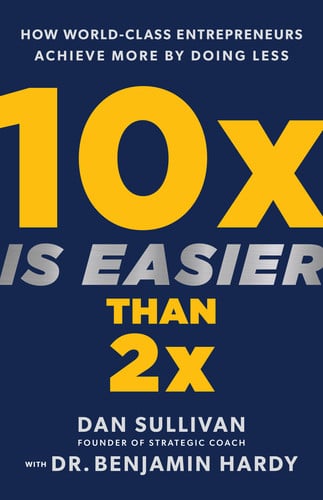
10x Is Easier Than 2x How World-Class Entrepreneurs Achieve More by Doing Less
by Dan Sullivan, Benjamin Hardy
8.38 / 10 5.7K ratings
- Language
- English
- Published
- 2023
- Publisher
- Hay House Inc.
- Pages
- 296
- ISBN
- 9781401969950
Many believe that achieving significant growth requires proportional effort. However, Dan Sullivan and Benjamin Hardy present a different perspective: aiming for 10x growth can be simpler and more effective than striving for a mere 2x improvement. This book challenges the conventional wisdom that incremental progress is the most straightforward path, revealing how truly ambitious goals can streamline your efforts and lead to transformative results.
"10x Is Easier Than 2x" guides entrepreneurs and ambitious individuals to redefine their approach to work and life. It emphasizes focusing on quality over quantity, leveraging unique strengths, and identifying the vital few actions that drive the majority of impact. By embracing a mindset that prioritizes exponential outcomes, readers will discover how to eliminate unnecessary tasks, cultivate greater freedom in time, money, relationships, and purpose, and ultimately achieve more by doing less.
"10x Is Easier Than 2x" guides entrepreneurs and ambitious individuals to redefine their approach to work and life. It emphasizes focusing on quality over quantity, leveraging unique strengths, and identifying the vital few actions that drive the majority of impact. By embracing a mindset that prioritizes exponential outcomes, readers will discover how to eliminate unnecessary tasks, cultivate greater freedom in time, money, relationships, and purpose, and ultimately achieve more by doing less.
Subjects
Other editions (2)

Listen to the summary Narrated summary
You stand at a crossroads, where the conventional path whispers of incremental gains, of working harder for modest, linear progress. This is the realm of "2x" thinking, a world where you tirelessly push for small improvements, adding more hours, chasing more clients, and often finding yourself exhausted and overwhelmed, with results that barely move the needle. You're caught in a hamster wheel, believing that more effort directly translates to more success, but it only leads to more complexity and less fulfillment.
Yet, there exists a powerfully counterintuitive truth: achieving "10x" growth is not merely about doing ten times more work; it's often *easier* and more liberating than striving for mere 2x growth. This seemingly impossible leap forces a complete transformation of your mindset and approach. When you aim for something so audacious, your mind cannot rely on existing strategies or simply "working harder." Instead, it's compelled to shed the non-essential, to simplify, and to innovate.
The secret lies in a radical shift from quantity to quality, from doing more to doing less, but doing it profoundly better. The "10x mindset" demands that you identify and ruthlessly eliminate the 80% of tasks, relationships, and even beliefs that drain your energy and yield minimal results. What remains - the vital 20% - is where your true leverage lies. By focusing intensely on these high-impact activities, you declutter your life and concentrate your most finite resource: your attention.
This focus is deeply intertwined with your "Unique Ability" - the specific activities you are exceptionally good at, that energize you, and that provide the most value. To pursue 10x growth, you must commit to operating primarily within this zone, delegating or eliminating everything else. This isn't about being selfish; it's about creating abundance, not just for yourself, but for those around you, by maximizing your distinct contribution.
Embracing 10x also means adopting an "abundance mindset," rejecting the scarcity thinking that keeps you in constant competition. When you aim for exponential growth, you are no longer trying to be slightly better than others in an existing market; you are creating a new category, a unique niche where competition becomes irrelevant. This qualitative leap allows you to define your own standards and pursue mastery, leading to exponential rewards.
Furthermore, the path to 10x success involves designing your life for maximum focus and regeneration. This includes structuring your time with "Focus Days" for high-value activities, "Buffer Days" for necessary but non-core tasks, and crucially, "Free Days" when you completely disengage from work. Paradoxically, these periods of rest and exploration are not a luxury but a necessity, fueling the creativity and strategic insight required for transformative growth.
The ultimate outcome of this 10x framework is not just greater achievement, but a profound expansion of your four most important freedoms: time, money, relationships, and purpose. As you consistently make 10x leaps, you discover a life that is simpler, more enjoyable, and deeply integrated with your highest aspirations, allowing you to achieve more by truly doing less.
Yet, there exists a powerfully counterintuitive truth: achieving "10x" growth is not merely about doing ten times more work; it's often *easier* and more liberating than striving for mere 2x growth. This seemingly impossible leap forces a complete transformation of your mindset and approach. When you aim for something so audacious, your mind cannot rely on existing strategies or simply "working harder." Instead, it's compelled to shed the non-essential, to simplify, and to innovate.
The secret lies in a radical shift from quantity to quality, from doing more to doing less, but doing it profoundly better. The "10x mindset" demands that you identify and ruthlessly eliminate the 80% of tasks, relationships, and even beliefs that drain your energy and yield minimal results. What remains - the vital 20% - is where your true leverage lies. By focusing intensely on these high-impact activities, you declutter your life and concentrate your most finite resource: your attention.
This focus is deeply intertwined with your "Unique Ability" - the specific activities you are exceptionally good at, that energize you, and that provide the most value. To pursue 10x growth, you must commit to operating primarily within this zone, delegating or eliminating everything else. This isn't about being selfish; it's about creating abundance, not just for yourself, but for those around you, by maximizing your distinct contribution.
Embracing 10x also means adopting an "abundance mindset," rejecting the scarcity thinking that keeps you in constant competition. When you aim for exponential growth, you are no longer trying to be slightly better than others in an existing market; you are creating a new category, a unique niche where competition becomes irrelevant. This qualitative leap allows you to define your own standards and pursue mastery, leading to exponential rewards.
Furthermore, the path to 10x success involves designing your life for maximum focus and regeneration. This includes structuring your time with "Focus Days" for high-value activities, "Buffer Days" for necessary but non-core tasks, and crucially, "Free Days" when you completely disengage from work. Paradoxically, these periods of rest and exploration are not a luxury but a necessity, fueling the creativity and strategic insight required for transformative growth.
The ultimate outcome of this 10x framework is not just greater achievement, but a profound expansion of your four most important freedoms: time, money, relationships, and purpose. As you consistently make 10x leaps, you discover a life that is simpler, more enjoyable, and deeply integrated with your highest aspirations, allowing you to achieve more by truly doing less.
What other readers say
Liked
The book presents a compelling central concept, encouraging readers to pursue exponential "10x" growth by focusing on quality over quantity and making a greater impact through less effort. Reviewers highlighted the value of identifying one's "unique ability" or the 20 percent of tasks that yield 80 percent of results, and then strategically delegating the rest. The emphasis on building effective teams, empowering assistants, and creating "Free Days" for deliberate rest and recovery resonated with many, offering a disruptive mindset shift for those seeking to break free from linear growth patterns. Concepts like measuring progress from a starting point, referred to as "the gain," were also appreciated for fostering a more positive and appreciative outlook, making the book a motivating read for entrepreneurs and those looking to overcome plateaus.
Disliked
However, the book also drew significant criticism, with a common complaint being its repetitive nature and excessive length, leading many to feel the core message could have been delivered more concisely. Some reviewers found the ideas to be less original and better articulated in other business literature. A notable concern for several readers was the perceived presence of male privilege, with examples provided in the book reportedly overlooking the realities of diverse household and family responsibilities, or presenting solutions that rely on readily available support staff. Additionally, some readers were put off by what they considered to be inappropriate religious and political references, while others interpreted certain aspects of the book as subtly promoting an exploitative approach to wealth creation.
In short
Despite these notable drawbacks, the book offers a powerful central premise that can be transformative for those open to its unconventional approach. Its strength lies in encouraging a radical re-evaluation of how one approaches work and personal growth, pushing for a sharp focus on high-leverage activities and aggressive delegation. This book would likely appeal most to entrepreneurs, business leaders, and individuals who are feeling stuck in traditional growth models and are seeking a significant mindset shift regarding productivity and the strategic use of their time. Conversely, readers who prefer concise, secular business advice, or who are sensitive to issues of privilege and ethical business practices, may find aspects of the book problematic or frustrating.
No reviews yet. Be the first.