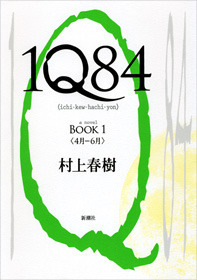
1Q84
- First published 2009
- 737 pages
- Spanish
Tokyo, 1984. Aomame, a young woman with a secret profession, begins to notice subtle, unsettling shifts in the world around her, starting with the police uniforms and the appearance of a second moon in the sky. She names this altered reality "1Q84," a world that bears a question mark. Meanwhile, Tengo, a mathematics teacher and aspiring writer, accepts a peculiar ghostwriting assignment to rewrite a mysterious manuscript titled "Air Chrysalis" by a reclusive teenage girl. As Aomame navigates her unsettling new reality and Tengo delves deeper into the enigmatic story, their seemingly separate lives begin to intertwine, drawing them into a complex web of religious cults, unexplained phenomena, and a past connection neither fully remembers. This compelling narrative explores the nature of reality, memory, and destiny, inviting readers to question the boundaries of their own perceptions.
What readers say
4.02
17K ratings across the web 8 in 10 readers loved it
Haruki Murakami's 1Q84 is lauded by many readers as an immersive and uniquely captivating experience. Reviewers frequently praise its readability, despite its substantial length, noting that the blend of mystery, fantasy, and intrigue keeps pages turning. The narrative, which intertwines the stories of Aomame and Tengo, is often described as a romantic and hopeful love story, exploring deep connections that transcend obstacles. Readers appreciate Murakami's distinctive style, which defies easy classification, weaving together elements of magical realism, dystopia, religious cults, and existential themes with superb clarity and elegant prose. The novel's ability to create a fascinating, albeit strange, world with its own peculiar logic and symbolism is a significant draw for many, leaving a lasting impression and prompting contemplation long after the final page.
However, the book also garners strong criticism, primarily concerning its length, pacing, and thematic execution. A common complaint is the repetitive nature of the prose and the inclusion of mundane details that slow the narrative considerably, leading some to find it tedious, boring, and even "nothing of a book." Many reviewers express frustration with the perceived lack of substantial plot development and character progression over its many pages. A significant point of contention is the portrayal of female characters and the frequent, often gratuitous, descriptions of their bodies, particularly breasts. Some readers found the depiction of women to be misogynistic, objectifying, and serving no clear purpose in the story, with instances of sexual content described as crude, meaningless, or even disturbing.
In conclusion, 1Q84 is a polarizing work that evokes strong reactions. It is a book that rewards readers who appreciate a slow, meditative pace and Murakami's signature blend of the mundane with the bizarre, especially those who enjoy exploring complex themes and subtle connections in a dreamlike narrative. Fans of the author's other works, particularly those comfortable with open-ended interpretations and philosophical musings over concrete plot resolution, are most likely to find it a profound and deeply moving experience. Conversely, readers seeking a tightly plotted, fast-paced story with conventional character development, or those sensitive to problematic gender portrayals, may find themselves frustrated and disappointed by its length and stylistic choices.
Reviews
No reviews yet. Be the first.
Details & editions
- This edition
- Random House Publishing Group, 2010
- ISBN
- 9780099526148
- Language
- Spanish
Original edition 村上春樹の『1Q84』を読み解く Originally published in 2009 · Japanese · データ・ハウス