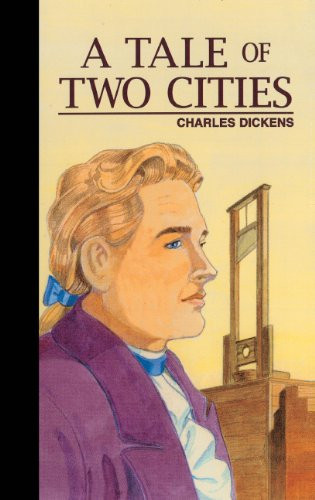
A Tale of Two Cities

Charles Dickens

  • First published 1874
  • 488 pages
  • English
  • Classic
In an age of radical extremes, set between the seeming peace of London and the revolutionary fury of Paris, a family's life is upended by a long-buried secret. After 18 years of unjust imprisonment in the Bastille, Dr. Manette is released, a man broken by his ordeal. Reunited with the daughter he never knew he had, the gentle Lucie Manette, they begin to build a quiet life in England. But the shadows of the past are long, and as the streets of Paris erupt in a violent struggle for freedom, their fragile peace is threatened by forces of history and vengeance they cannot escape.

The story follows a group of unforgettable characters whose fates are intricately bound together: a young French aristocrat who has renounced his heritage, a cynical lawyer who discovers his own capacity for greatness, and the vengeful revolutionaries who see justice only in the blade of the guillotine. Against the backdrop of one of history's most turbulent periods, this novel is a profound exploration of personal sacrifice, the potential for human resurrection, and the relentless clash between tyranny and revolution. It examines whether love and loyalty can survive in a world consumed by chaos and retribution.
3.88
1M ratings across the web
7 in 10 readers loved it, 1 didn't like it
Readers largely praise "A Tale of Two Cities" as a masterful and intricately plotted work, offering a suspenseful and dramatic narrative that keeps them engaged. Many highlight Dickens's genius in weaving together diverse characters and storylines, set against the tumultuous backdrop of the French Revolution. Reviewers frequently commend the novel for its rich thematic depth, exploring concepts like love, sacrifice, redemption, and social justice with profound impact. The book is lauded for its memorable characters, including compelling heroes and formidable villains, and for its iconic opening and powerful, emotionally resonant ending that provides satisfying closure. Despite a more somber tone than some of his other works, the novel is celebrated as a classic that offers a unique and absorbing historical perspective, filled with vivid descriptions and a strong moral core.

However, some readers found the novel challenging and expressed several criticisms. Common complaints include the demanding writing style, characterized by long, complicated sentences and verbosity that can hinder clarity and make the book a chore to read. Critics also point to an oversimplification of historical causes, a perceived lack of realism in character depth, and a tendency towards "black-and-white" characterization, with many protagonists seen as overly virtuous or villains as purely evil. Some felt the plot relied too heavily on coincidence, making it feel constructed rather than organic, and that Dickens recycled themes without sufficient fresh effort. For some, the initial sections were slow and difficult to connect with, leading to a lack of pace and suspense that could induce boredom.

Overall, "A Tale of Two Cities" stands as a perennially popular and impactful classic, though it may not appeal to all readers. Those who appreciate meticulously researched historical fiction, complex plots rich in symbolism, and powerful emotional narratives driven by themes of sacrifice and redemption will likely find it a rewarding experience. However, readers seeking a faster pace, simpler prose, or more nuanced character portrayals typical of modern literature might find its style and structure demanding. It is often recommended for those already familiar with Dickens's work or prepared to invest concentration into a dense, yet ultimately powerful, storytelling experience.

No reviews yet. Be the first.

This edition
1894
Language
English
Original edition Originally published in 1874 · English

Other editions (2829)

Romeo and Juliet
Cover of Romeo and Juliet
Free

Romeo and Juliet

William Shakespeare, Philip M. Parker, Erica Abbett, David Wardle, Ancient Ink Press