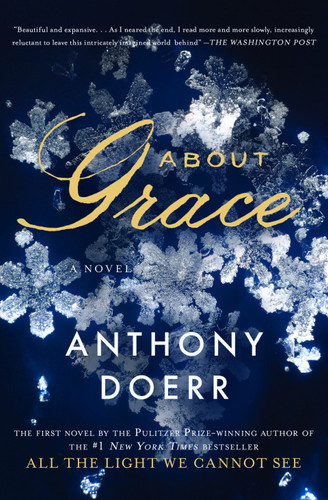
About Grace A Novel
6.9 / 10 28K ratings
Classic- Language
- English
- Published
- 2010
- Publisher
- Simon and Schuster
- Pages
- 416
- ISBN
- 9781439103784
Original edition
About GraceOriginally published in 2004 English Recorded Books
Other editions (19)


No summary for this edition yet.
What other readers say
Liked
Anthony Doerr's debut novel, About Grace, is widely praised for its exquisite and poetic prose. Reviewers consistently highlight the author's ability to craft beautiful, eloquent, and intricate language that creates vivid imagery, often described as graceful and astounding. Many found the detailed descriptions of nature, particularly water in its myriad forms like snow crystals, oceans, and floods, to be a significant strength, resonating especially with readers who appreciate scientific intricacies and the natural world. For some, the protagonist's journey of remorse, growth, and change was deeply compelling, and his interactions with children were particularly touching. The novel is also lauded for its profound exploration of themes such as love, family bonds, destiny, and the search for grace, offering a therapeutic and unique reading experience for those who connected with it.
Disliked
However, the book also elicits strong negative reactions, primarily concerning its pacing and characterization. Many reviewers found the narrative to be excessively long, slow-paced, and meandering, with numerous sections deemed superfluous and detracting from the plot. The protagonist, David Winkler, is a frequent source of frustration, often described as exasperating, unlikable, and emotionally incomprehensible due to his poor decisions and inability to communicate. This leads some to feel he functions more as a plot device than a believable character. While some enjoyed the descriptive writing, others found it self-indulgent, tedious, and overly detailed, particularly when it interrupted plot development. The story's reliance on coincidence and its perceived far-fetched nature also hindered believability for many. Compared to Doerr's later, more acclaimed work, many readers found About Grace to be an underwhelming and less spectacular read, struggling to form an emotional connection with its characters or central romance.
In short
Ultimately, About Grace proves to be a polarizing novel, showcasing Anthony Doerr's undeniable literary talent in its prose while struggling, for many, with consistent pacing, character motivation, and plot coherence. It is a book best suited for readers who prioritize lush, poetic writing and intricate language over a fast-moving plot. Those who revel in extensive, detailed descriptions of nature and appreciate introspective, character-driven narratives would likely find it rewarding. The novel may also appeal to individuals interested in deep explorations of themes like destiny, love, and the complexities of family life, particularly if they are patient with a slower narrative flow and open to a story where a protagonist makes deeply flawed, yet central, decisions.
No reviews yet. Be the first.