
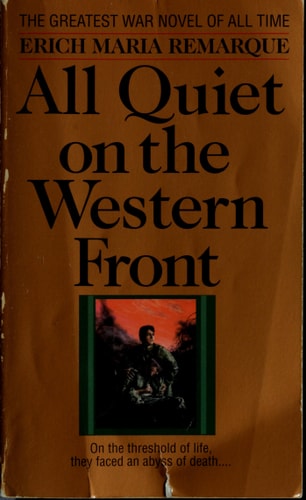
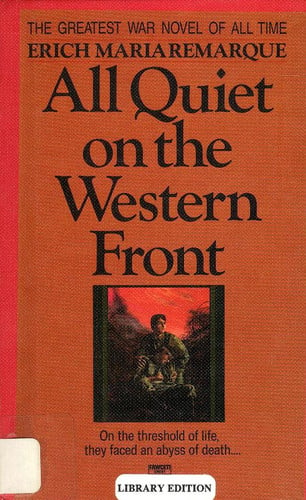
All Quiet on the Western Front
by Kiepenheuer & Witsch GmbH & Company KG
8.24 / 10 537K ratings
- Language
- English
- Published
- 2018
- Publisher
- Everyman's Library/Alfred A. Knopf
- Pages
- 296
- ISBN
- 9781841593869
Step into the trenches of World War I through the eyes of Paul Bäumer, a young German soldier thrust onto the Western Front. This narrative captures the stark reality of combat, revealing the physical and psychological toll exacted on a generation promised glory but delivered only brutality. As Paul and his comrades endure the relentless shelling, the constant threat of death, and the dehumanizing conditions of trench warfare, their youthful idealism erodes, replaced by a profound sense of disillusionment and a desperate bond forged in shared suffering.
Erich Maria Remarque's seminal work offers an unflinching portrayal of the war's futility and the lasting scars it leaves on those who survive. It explores the alienation soldiers feel upon returning to a home front that cannot comprehend their experiences, making it a powerful testament to the devastating impact of conflict on the human spirit.
Erich Maria Remarque's seminal work offers an unflinching portrayal of the war's futility and the lasting scars it leaves on those who survive. It explores the alienation soldiers feel upon returning to a home front that cannot comprehend their experiences, making it a powerful testament to the devastating impact of conflict on the human spirit.
Subjects
- Comics & Graphic Novels
- Reference
- Literature & Fiction
- Genre Fiction
- Europe
- Germany
- Subjects
- Literary
- Action & Adventure
- Science Fiction & Fantasy
- Historical
- Self Service
- History
- Biographies & Memoirs
- Leaders & Notable People
- Military
- Arborist Merchandising Root
- Education & Teaching
- Schools & Teaching
- Non-Classifiable
- Contemporary
- Studying & Workbooks
- Study Guides
- Science Fiction
- Foreign Language Study & Reference
- Fiction
- Juvenile Fiction
- Classics
- Expeditions & Discoveries
- Fiction, historical, general
- Literary Collections
- Children's fiction
- Juvenile fiction
- Fiction, war & military
- FICTION_HISTORICAL_GENERAL
- NATURE
- History & Criticism
- Instruction
- Modern fiction
- English as a Second Language
- Words, Language & Grammar
- Audio Adult: Books On Tape
- People & Places
- European
- Juvenile Nonfiction
- German
- Nonfiction - General
- FICTION_WAR & MILITARY
- Language Arts
- Study Skills
- Literary Criticism
- Study Aids
- 20th Century
- Subjects & Themes
- Young Adult Fiction
- British & Irish
- War & Military
- Adventurers & Explorers
- Fiction, historical
- Large type books
- World Literature
- Books & Reading
- Book Notes
- Wars & Conflicts
- Ecosystems & Habitats
- Readers
- War
- Romans, nouvelles
- FICTION
- World War I
- World War, 1914-1918
- Audiobooks
- Soldiers
- Alternate History
- BIOGRAPHY & AUTOBIOGRAPHY
- Language readers
- Military & Wars
- Unabridged Audio - Fiction/General
- CONTINENTAL EUROPEAN FICTION (FICTIONAL WORKS BY ONE AUTHOR)
- Chinese literature
- Translations into English
- Campaigns
- German language
- Children's Audio - 9-12
- Roman
- German literature
- Military campaigns
- Historical Events
- German fiction
Original edition
Erich Maria Remerque: in Westen Nichts NeuesOriginally published in 1900 German Kiepenheuer & Witsch GmbH KG
Other editions (90)



Listen to the summary Narrated summary
We were young, barely out of school, when the old men, our teachers, filled our heads with grand notions of patriotism and glory. Herr Kantorek, especially, with his fiery speeches, convinced us, a whole class of boys, to volunteer. We marched off, full of youthful fervor, to defend the Fatherland. But the moment we arrived at the training camp, under the brutal thumb of Himmelstoss, the illusion began to crack. The comfortable world we knew was gone, replaced by a harsh reality where our individuality was stripped away, and we learned quickly that survival depended on a different kind of cunning than any book could teach.
Then came the Western Front, a desolate landscape of mud, barbed wire, and incessant artillery fire. It stretched for hundreds of miles, a place where the earth itself seemed to writhe in agony. Here, we, the "iron youth," were thrown into the maw of a war that swallowed men whole. Our days were a monotonous cycle of fear, hunger, and the deafening roar of shells. We learned to distinguish the whistle of incoming fire, to press ourselves into the earth, to find a moment's solace in a dugout, only to be thrust back into the chaos. The camaraderie among us, my friends Albert Kropp, Müller, Leer, Tjaden, and the resourceful Katczinsky, became our lifeline, a silent pact against the madness.
We witnessed horrors that no words could truly convey. Franz Kemmerich, my schoolmate, lay dying in the hospital, his leg amputated, a stark reminder of the war's indifference to individual suffering. Müller, ever practical, asked for Kemmerich's boots even before he drew his last breath – a grim logic born of the trenches, where every usable item was a treasure. The staff, unburdened by sentiment, were more concerned with preparing the bed for the next casualty. Death was a constant companion, often swift and random, sometimes agonizingly slow. We saw men torn apart, choked by gas, or simply disappear into the churned-up earth.
A brief respite came when I was granted leave and returned home. The familiar streets, my old room, my books, my butterfly collection – they all felt alien. The people there, untouched by the true savagery of the front, spoke of strategy and advances, their questions naive and distressing. They couldn't comprehend the chasm that separated their world from ours. I found myself lying, unable to articulate the unspeakable truths, for fear they would not understand, or worse, that they would break. My mother, ill and fading, was the only one with whom I could share a tender, if restrained, connection, though even with her, the full weight of what I had endured remained unspoken.
Back on the front, the war continued its relentless consumption. Detering, a farmer who longed for his home and cherry trees, deserted, driven mad by the sight of blooming blossoms. He was caught, and we never saw him again. Katczinsky, our older, wiser mentor, who could always scrounge food from thin air, was hit by a splinter, a seemingly minor wound that proved fatal. He was the last of the old guard, and his death left a hollow ache, a profound sense of isolation. Each loss chipped away at our souls, leaving us increasingly numb, our youth stolen, our futures uncertain.
The war dragged on, a senseless slaughter. We were but expendable figures in a vast, indifferent machine. The peace talks, the rumors of an armistice, seemed distant, almost unbelievable. On a quiet, ordinary day, shortly before the war was officially declared over, I too fell. A random shot, a sudden darkness. The front was silent that day, the official report read: "All quiet on the Western Front." But for those of us who lived and died there, it was anything but quiet.
Then came the Western Front, a desolate landscape of mud, barbed wire, and incessant artillery fire. It stretched for hundreds of miles, a place where the earth itself seemed to writhe in agony. Here, we, the "iron youth," were thrown into the maw of a war that swallowed men whole. Our days were a monotonous cycle of fear, hunger, and the deafening roar of shells. We learned to distinguish the whistle of incoming fire, to press ourselves into the earth, to find a moment's solace in a dugout, only to be thrust back into the chaos. The camaraderie among us, my friends Albert Kropp, Müller, Leer, Tjaden, and the resourceful Katczinsky, became our lifeline, a silent pact against the madness.
We witnessed horrors that no words could truly convey. Franz Kemmerich, my schoolmate, lay dying in the hospital, his leg amputated, a stark reminder of the war's indifference to individual suffering. Müller, ever practical, asked for Kemmerich's boots even before he drew his last breath – a grim logic born of the trenches, where every usable item was a treasure. The staff, unburdened by sentiment, were more concerned with preparing the bed for the next casualty. Death was a constant companion, often swift and random, sometimes agonizingly slow. We saw men torn apart, choked by gas, or simply disappear into the churned-up earth.
A brief respite came when I was granted leave and returned home. The familiar streets, my old room, my books, my butterfly collection – they all felt alien. The people there, untouched by the true savagery of the front, spoke of strategy and advances, their questions naive and distressing. They couldn't comprehend the chasm that separated their world from ours. I found myself lying, unable to articulate the unspeakable truths, for fear they would not understand, or worse, that they would break. My mother, ill and fading, was the only one with whom I could share a tender, if restrained, connection, though even with her, the full weight of what I had endured remained unspoken.
Back on the front, the war continued its relentless consumption. Detering, a farmer who longed for his home and cherry trees, deserted, driven mad by the sight of blooming blossoms. He was caught, and we never saw him again. Katczinsky, our older, wiser mentor, who could always scrounge food from thin air, was hit by a splinter, a seemingly minor wound that proved fatal. He was the last of the old guard, and his death left a hollow ache, a profound sense of isolation. Each loss chipped away at our souls, leaving us increasingly numb, our youth stolen, our futures uncertain.
The war dragged on, a senseless slaughter. We were but expendable figures in a vast, indifferent machine. The peace talks, the rumors of an armistice, seemed distant, almost unbelievable. On a quiet, ordinary day, shortly before the war was officially declared over, I too fell. A random shot, a sudden darkness. The front was silent that day, the official report read: "All quiet on the Western Front." But for those of us who lived and died there, it was anything but quiet.
What other readers say
Liked
Readers overwhelmingly praise this book as a powerful, moving, and genuinely excellent portrayal of war, frequently calling it a masterpiece and a defining novel of World War I. Many highlight the author's remarkable ability to describe the horrors of conflict with vivid conviction and clarity, immersing the reader in the brutal reality of the trenches and leaving a lasting impression. Reviewers often commend the book's stark anti-war message, effectively conveying the futility and senseless waste of life, and its profound focus on the individual soldier's experience rather than glorifying battle. The writing style is frequently noted as simple, poignant, and unsettlingly effective, while the deep sense of camaraderie among the soldiers is lauded as one of the most moving aspects. Its enduring relevance, nearly a century after publication, is also a common theme.
Disliked
Despite the widespread acclaim, a few minor points were raised. One reviewer found the book to be "okay" and less engaging due to its character-driven nature and a somewhat detached narrator, preferring plot-focused narratives. Another mentioned difficulty getting through the initial chapters. While not strictly negatives, some reviewers also noted that the intense and brutal content, though praised for its realism, means the book is not for the squeamish or faint of heart, underscoring the challenging nature of its subject matter.
In short
Overall, this book is consistently hailed as a classic and essential reading for anyone seeking to understand the devastating human cost of war. It is highly recommended for those interested in World War I, military history, or powerful, emotional narratives that challenge romanticized notions of conflict. Reviewers particularly encourage readers to approach or revisit this book with maturity, as its profound themes resonate deeply and offer a timeless warning against blind patriotism and the senselessness of warfare.
No reviews yet. Be the first.