
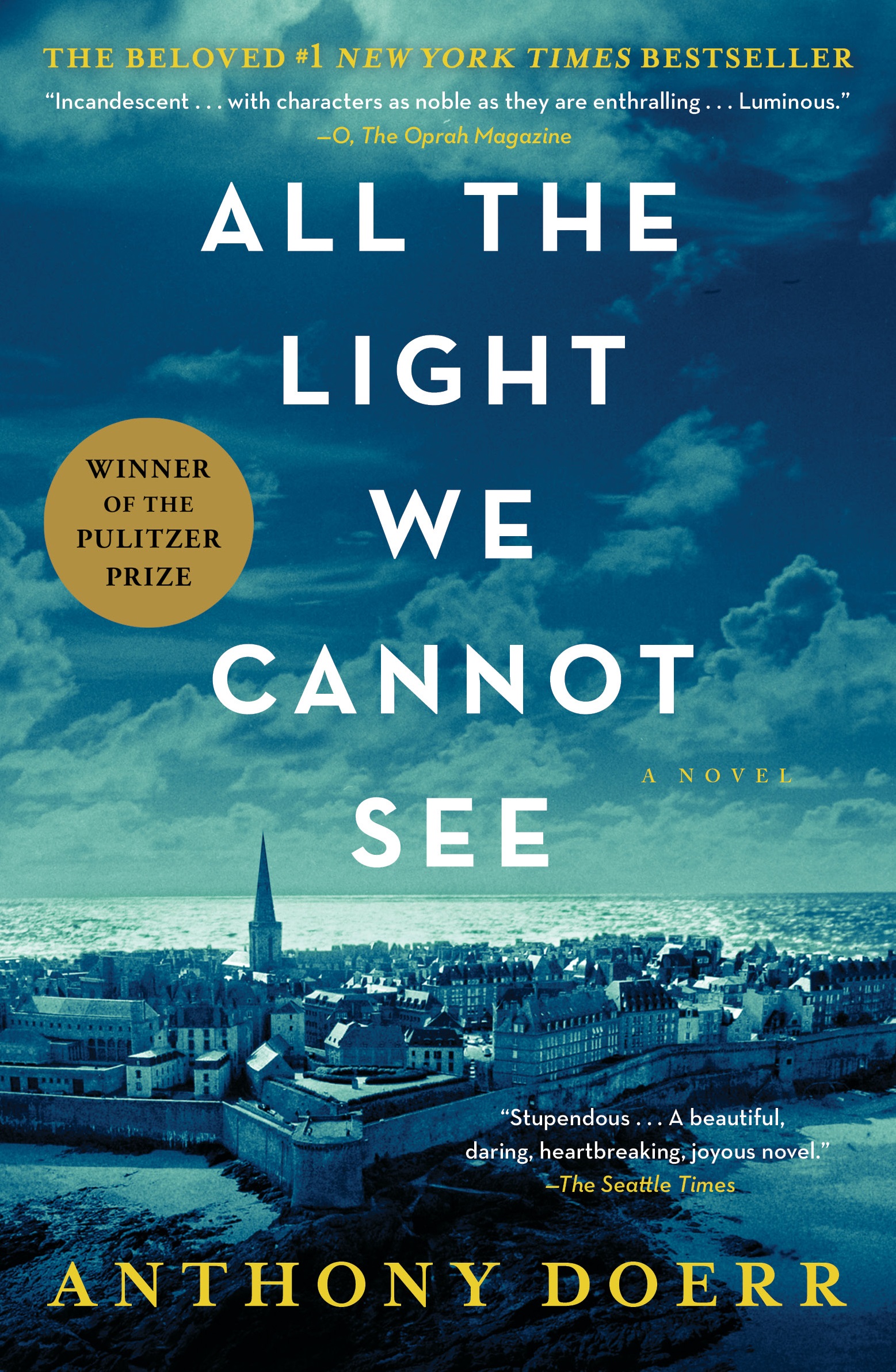
All the Light We Cannot See
8.6 / 10 2.1M ratings
- Language
- English
- Published
- 2017
- Publisher
- Simon & Schuster Audio
- ISBN
- 9781508239789
In the midst of a devastating war, the lives of two young people on opposing sides move toward an inevitable intersection. Marie-Laure lives in Paris with her father, a master locksmith at the Museum of Natural History. When she goes blind at the age of six, her father builds a perfect miniature of their neighborhood so she can navigate it by touch. As the Nazis occupy Paris, they are forced to flee to the walled citadel of Saint-Malo, carrying with them what might be the museum's most valuable and dangerous jewel. Hundreds of miles away in a German mining town, an orphan boy, Werner Pfennig, grows up enchanted by a crude radio he discovers. His rare talent for building and fixing these instruments earns him a place at a brutal academy for Hitler Youth, and soon he is assigned to track the resistance.
This story intricately weaves together the paths of Marie-Laure and Werner, exploring the ways people try to be good to one another against all odds. While Marie-Laure navigates the world through touch and sound, Werner moves through the heart of the war machine, becoming increasingly aware of the human cost of his work. Their separate journeys, one guided by a secret kept safe from the occupiers and the other by the invisible waves of the radio, highlight the unseen connections between people, the moral weight of our choices, and the enduring power of the human spirit in the face of darkness. It is an examination of survival, resilience, and the light we cannot always see.
This story intricately weaves together the paths of Marie-Laure and Werner, exploring the ways people try to be good to one another against all odds. While Marie-Laure navigates the world through touch and sound, Werner moves through the heart of the war machine, becoming increasingly aware of the human cost of his work. Their separate journeys, one guided by a secret kept safe from the occupiers and the other by the invisible waves of the radio, highlight the unseen connections between people, the moral weight of our choices, and the enduring power of the human spirit in the face of darkness. It is an examination of survival, resilience, and the light we cannot always see.
Subjects
- Reference
- Literature & Fiction
- Genre Fiction
- Germany
- Literary
- France
- Fiction
- Historical
- United States
- History
- Custom Stores
- Military
- World War II
- Romance
- Contemporary
- Friendship
- Classics
- Fiction, historical, general
- Fathers and Daughters
- Media Tie-In
- Historical Fiction
- People & Places
- Juvenile Nonfiction
- Adult
- Youth
- Fiction, historical
- Survival
- Histoire
- War
- Romans, nouvelles
- TV, Movie, Video Game Adaptations
- Historia
- New York Times reviewed
- Novela
- Roman
- War & Military
- Book Club
Original edition
All the Light We Cannot SeeOriginally published in 2014 English Simon & Schuster Audio
Other editions (168)



Listen to the summary Narrated summary
The world is plunged into the terrifying shadows of World War II, and two young lives, seemingly distant, begin to spin on converging paths. Marie-Laure LeBlanc, a blind French girl, lives in Paris, her world illuminated by the intricate wooden models her father, a master locksmith at the Museum of Natural History, painstakingly crafts for her. Through these miniature cities, she learns to navigate the streets, her fingertips tracing every alley and boulevard, building a vivid landscape in her mind. Her father also teaches her about the Sea of Flames, a legendary, cursed diamond hidden within the museum, rumored to grant its possessor immortality but at a terrible cost to those they love.
Hundreds of miles away, in a bleak German orphanage, Werner Pfennig and his younger sister, Jutta, find solace and wonder in a battered radio. Werner, a prodigy with electronics, can coax broadcasts from distant lands, filling their cramped quarters with music, news, and, most importantly, the voice of a French scientist who speaks of light and the unseen waves that traverse the air. This voice ignites a profound curiosity in Werner, a yearning for knowledge that transcends the grim destiny of the mines that await most orphans in his town.
As the Nazi regime tightens its grip, Werner's extraordinary talent with radios is noticed, leading him to an elite military academy. There, he is trained to track enemy transmissions, his keen ear a weapon in the escalating conflict. He witnesses brutality and indoctrination, struggling with the moral compromises demanded by his new path, yet his scientific mind remains captivated by the invisible currents of the airwaves. Meanwhile, Marie-Laure and her father flee Paris just ahead of the German occupation, carrying with them not just their memories, but also the real Sea of Flames, entrusted to them for safekeeping. They seek refuge with her eccentric great-uncle Etienne in the ancient, walled city of Saint-Malo, a place that will soon become a focal point of the war.
Life in Saint-Malo becomes a precarious dance between daily existence and acts of quiet defiance. Marie-Laure's father continues to build models, now of Saint-Malo itself, and hides the precious diamond within one of the replicas of Etienne's house. When her father is arrested and taken to a prison camp, Marie-Laure is left with Etienne, a reclusive man haunted by his past experiences in World War I. Together with Madame Manec, a fierce woman who organizes local resistance efforts, they begin to use Etienne's hidden radio transmitter to broadcast illegal messages for the Allied forces, a dangerous secret kept alive in the heart of the occupied city.
Years pass, and the paths of Marie-Laure and Werner draw ever closer. Werner, now a young soldier, finds himself part of a unit tasked with tracking down resistance broadcasters, moving across a war-torn Europe. His skills are invaluable, but the horrors he witnesses and participates in weigh heavily on his conscience. He clings to the memory of the broadcasts he once heard with Jutta, a faint echo of a different world, a different self. His journey eventually leads him to Saint-Malo, just as Allied bombs begin to rain down on the city, turning its ancient stones to dust.
Amidst the chaos and destruction of the besieged city, their stories finally intertwine. Marie-Laure, alone in her great-uncle's house, finds herself trapped, the Sea of Flames still hidden within the model. Werner, also trapped in a collapsed cellar with his unit, hears a familiar melody, a ghostly transmission from a hidden radio - the very scientific program he cherished as a boy, broadcast by Marie-Laure and Etienne. This sound, a beacon in the darkness, ignites something within him, a flicker of the humanity he thought lost.
The German sergeant major, Reinhold von Rumpel, a man ravaged by cancer and obsessed with finding the legendary Sea of Flames diamond, also descends upon Saint-Malo, believing it to be in Marie-Laure's possession. He meticulously searches Etienne's house, his greed a stark contrast to the resilience and quiet courage of Marie-Laure. Werner, guided by the radio signal and a desperate need for redemption, makes a choice that defies his orders, risking everything to save the blind girl he has only heard, a decision that will forever alter the trajectory of both their lives amidst the crumbling ruins of the city.
Hundreds of miles away, in a bleak German orphanage, Werner Pfennig and his younger sister, Jutta, find solace and wonder in a battered radio. Werner, a prodigy with electronics, can coax broadcasts from distant lands, filling their cramped quarters with music, news, and, most importantly, the voice of a French scientist who speaks of light and the unseen waves that traverse the air. This voice ignites a profound curiosity in Werner, a yearning for knowledge that transcends the grim destiny of the mines that await most orphans in his town.
As the Nazi regime tightens its grip, Werner's extraordinary talent with radios is noticed, leading him to an elite military academy. There, he is trained to track enemy transmissions, his keen ear a weapon in the escalating conflict. He witnesses brutality and indoctrination, struggling with the moral compromises demanded by his new path, yet his scientific mind remains captivated by the invisible currents of the airwaves. Meanwhile, Marie-Laure and her father flee Paris just ahead of the German occupation, carrying with them not just their memories, but also the real Sea of Flames, entrusted to them for safekeeping. They seek refuge with her eccentric great-uncle Etienne in the ancient, walled city of Saint-Malo, a place that will soon become a focal point of the war.
Life in Saint-Malo becomes a precarious dance between daily existence and acts of quiet defiance. Marie-Laure's father continues to build models, now of Saint-Malo itself, and hides the precious diamond within one of the replicas of Etienne's house. When her father is arrested and taken to a prison camp, Marie-Laure is left with Etienne, a reclusive man haunted by his past experiences in World War I. Together with Madame Manec, a fierce woman who organizes local resistance efforts, they begin to use Etienne's hidden radio transmitter to broadcast illegal messages for the Allied forces, a dangerous secret kept alive in the heart of the occupied city.
Years pass, and the paths of Marie-Laure and Werner draw ever closer. Werner, now a young soldier, finds himself part of a unit tasked with tracking down resistance broadcasters, moving across a war-torn Europe. His skills are invaluable, but the horrors he witnesses and participates in weigh heavily on his conscience. He clings to the memory of the broadcasts he once heard with Jutta, a faint echo of a different world, a different self. His journey eventually leads him to Saint-Malo, just as Allied bombs begin to rain down on the city, turning its ancient stones to dust.
Amidst the chaos and destruction of the besieged city, their stories finally intertwine. Marie-Laure, alone in her great-uncle's house, finds herself trapped, the Sea of Flames still hidden within the model. Werner, also trapped in a collapsed cellar with his unit, hears a familiar melody, a ghostly transmission from a hidden radio - the very scientific program he cherished as a boy, broadcast by Marie-Laure and Etienne. This sound, a beacon in the darkness, ignites something within him, a flicker of the humanity he thought lost.
The German sergeant major, Reinhold von Rumpel, a man ravaged by cancer and obsessed with finding the legendary Sea of Flames diamond, also descends upon Saint-Malo, believing it to be in Marie-Laure's possession. He meticulously searches Etienne's house, his greed a stark contrast to the resilience and quiet courage of Marie-Laure. Werner, guided by the radio signal and a desperate need for redemption, makes a choice that defies his orders, risking everything to save the blind girl he has only heard, a decision that will forever alter the trajectory of both their lives amidst the crumbling ruins of the city.
What other readers say
Liked
Anthony Doerr's novel is widely celebrated for its exceptional literary craftsmanship and profound emotional depth. Many readers praise the exquisite and poetic prose, which creates vivid imagery and sensory descriptions, particularly effective in portraying the experience of a blind protagonist. The characters, a blind French girl and a gifted German orphan, are consistently lauded as well-developed, sympathetic, and endearing, fostering a strong emotional connection with their journeys. Reviewers frequently highlight the book's ability to explore significant themes such as humanity, resilience, and moral choices amidst the backdrop of World War II, often describing the story as captivating, moving, and ultimately very rewarding.
Disliked
However, some readers found aspects of the book less compelling. A common point of critique is the pacing, which some described as slow-moving or plodding, feeling that significant plot developments were sparse amidst extensive descriptive passages. The non-linear structure, which alternates between different time periods and character perspectives, was occasionally found confusing or perceived as not enhancing the narrative, sometimes hindering a deep emotional connection. Additionally, a few reviewers felt the characters, while likable, lacked sufficient moral complexity or depth, and that the portrayal of World War II events, while sensitive, might be considered too "tame" or less graphic than expected for the subject matter.
In short
Overall, "All the Light We Cannot See" is a highly acclaimed work, recognized with prestigious awards, that deeply resonates with a large audience. It is particularly recommended for readers who appreciate richly descriptive, character-driven historical fiction and are drawn to stories exploring the human spirit and invisible connections during wartime. Those who prioritize fast-paced, plot-heavy narratives or a strictly linear storytelling approach may find its deliberate pace and lyrical style less engaging.
No reviews yet. Be the first.