
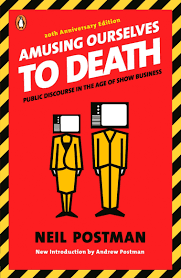
Amusing Ourselves to Death
by Neil Postman
8.34 / 10 42K ratings
- Language
- English
- Published
- 1987
- Publisher
- Methuen
- Pages
- 212
- ISBN
- 9780413404404
In "Amusing Ourselves to Death," Neil Postman presents a critique of how media shapes public discourse and understanding. Published in 1985, the book argues that the rise of television as a dominant medium has fundamentally altered the nature of public communication, transforming serious matters of politics, news, religion, and education into forms of entertainment.
Postman contends that the medium itself dictates the content, suggesting that a culture saturated with visual imagery and instant gratification risks losing its capacity for rational thought and coherent public debate. He posits that society is moving toward a future akin to Aldous Huxley's "Brave New World," where people are controlled by distraction and amusement rather than by external oppression. This work challenges readers to consider the profound implications of how information is presented and consumed, urging a critical examination of technology's influence on our collective intelligence and civic life.
Postman contends that the medium itself dictates the content, suggesting that a culture saturated with visual imagery and instant gratification risks losing its capacity for rational thought and coherent public debate. He posits that society is moving toward a future akin to Aldous Huxley's "Brave New World," where people are controlled by distraction and amusement rather than by external oppression. This work challenges readers to consider the profound implications of how information is presented and consumed, urging a critical examination of technology's influence on our collective intelligence and civic life.
Original edition
Wir amüsieren uns zu Tode. Urteilsbildung im Zeitalter der UnterhaltungsindustrieOriginally published in 1985 German Fischer-Taschenbuch-Verlag
Other editions (52)



No summary for this edition yet.
What other readers say
Liked
Reviewers widely commend the book for its remarkable prescience, noting how its insights, penned in 1985, feel incredibly relevant to today's digital landscape, encompassing social media and contemporary political discourse. Many praise the author's compelling central thesis, which contrasts George Orwell's vision of external oppression with Aldous Huxley's fear of a society subdued by self-imposed distraction and entertainment. This framework is consistently highlighted as illuminating how various media shape public understanding. The book is lauded for its insightful analysis of how the shift from print to visual media has fundamentally altered public discourse in areas like politics, news, education, and religion, transforming serious subjects into forms of entertainment. Readers frequently describe it as thought-provoking, eye-opening, and essential for understanding modern cultural trends, often leading to a re-evaluation of their own media consumption habits.
Disliked
Despite its lauded impact, some reviewers identify several drawbacks. A common criticism is that certain sections feel dated, particularly the extensive focus on television as the primary visual medium, though many acknowledge its theories extend well to the internet. Some found the book to be repetitive, with arguments feeling flat or concluding similarly across chapters, leading to a perception of it being a "tiresome rant" at times. Critics also suggest the author occasionally oversimplifies the relationship between media and truth, sometimes implying direct causation where only correlation might exist, and idealizing past print-based cultures without fully acknowledging historical literacy limitations or the potential manipulative aspects of written text. A few reviewers wished for more nuanced exploration of visual media's potential benefits or for the author to offer clearer solutions to the problems identified.
In short
Ultimately, the book is considered a powerful and foundational work that continues to resonate deeply with readers, many of whom describe it as having a profound and lasting impact on their perspective. Its enduring relevance, particularly in an age dominated by diverse digital media, makes it a vital call for increased media literacy and critical engagement with how information is presented and consumed. This book is highly recommended for anyone interested in media studies, cultural criticism, the philosophy of communication, or understanding the evolution of public discourse. It will particularly appeal to those who question the impact of technology on thought and society, and to parents considering the influence of screen time on intellectual development.
No reviews yet. Be the first.