Ma bibliothèque
Tu n'as pas encore de listes. Crée-en une dans Ma biblio.
Aller à Ma biblioMa bibliothèque
Tu n'as pas encore de listes. Crée-en une dans Ma biblio.
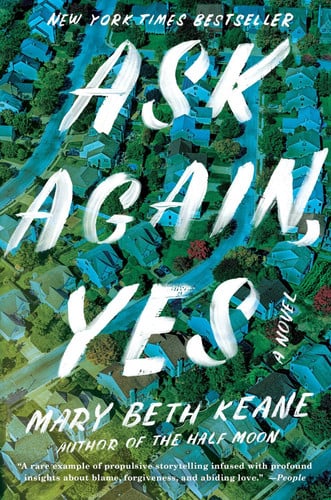
Aller à Ma biblioAsk Again, Yes A Novel
- Langue
- Anglais
- Publié en
- Maison d'édition
- Simon and Schuster
- Pages
- 400
- ISBN
- 9781982106980
The story centers on the deep bond between the Gleesons' daughter, Kate, and the Stanhopes' son, Peter. Their childhood friendship blossoms into love, but a single, violent night tears their families apart, forcing them into separate worlds haunted by the past. Years later, they find their way back to each other, but their relationship is tested by the echoes of that long-ago tragedy. This novel is a powerful exploration of love, mental illness, and the complex nature of forgiveness, questioning whether the ties that bind us can ever truly be broken.
Thèmes
A year later, that dream became a shingled house on Jefferson Street. Francis brought his new wife, Lena, to Gillam, a town so quiet it felt unreal to her. She missed the city's clamor, the comfort of her family packed into their Brooklyn apartment. Loneliness was a constant companion until the day a moving truck pulled up to the house next door. Out stepped Anne Stanhope, Brian's beautiful, brogue-tongued wife. Lena, pregnant and starved for friendship, rushed out to welcome her. But Anne was a woman encased in glass, polite but distant, deflecting Lena's every attempt at warmth. A shadow hung over her - a baby lost, a stillbirth - and she moved through her days with a sorrow she would not share. When her son, Peter, was born, she returned the baby swing Lena offered. “I can take care of my own baby,” she said, her words a wall built between their two houses, a silence that would stretch for years.
Across the narrow strip of grass that separated their homes, a friendship bloomed in defiance of the frost between their mothers. Kate Gleeson and Peter Stanhope were born six months apart, and their lives became intertwined from their first steps. They shared a seat on the school bus, whispered secrets by the great boulders in their backyards, and navigated the world as a unit of two. But while Kate's home was loud with laughter and the easy chaos of her two older sisters, Peter's was steeped in a tense, watchful quiet. He learned to read the weather of his mother's moods, the days she would retreat to her bedroom and vanish, the manic energy that could erupt into sudden, inexplicable rage. He learned to be careful, to keep the fragile peace, and to share the darkness of his life with no one, not even Kate.
The fragile world the children had built for themselves shattered in their eighth-grade year. It began with an innocent moment of burgeoning romance by the rocks, a first kiss that felt as inevitable as it was terrifying. But Anne Stanhope saw them. “You think you're so smart,” she hissed at Kate, her voice venomous, her eyes filled with a fury that had no clear source. The confrontation spiraled, drawing in Lena, who slapped her own daughter in a fit of panic. Later that night, in the Stanhope house, the argument between Anne and Brian reached a fever pitch. As his mother's rage escalated, her threats turning physical, Peter saw his father retreat, walking up the stairs and leaving him alone with the storm.
Fearing for his father's life, Peter ran through the darkness to the Gleesons' house and used their kitchen phone to call 911. “My mother has my father's gun,” he told the dispatcher, his voice small in the sudden, vast silence of the Gleesons' home. Francis, hearing the boy's terror, did what he was trained to do. He crossed the lawn to intervene, pounding on the Stanhopes' door, calling their names into the night. Anne opened the door, her face ashen and exhausted. She looked broken. “I'm very sorry about all this,” she said, her voice soft with regret. Then, moving with a speed that defied her sorrow, she reached under a couch cushion, removed the gun, pointed, and fired.
The shot echoed through the quiet suburban street, irrevocably altering the lives of two families. Francis Gleeson survived, but the bullet tore through his face, leaving him a stranger to himself. Anne Stanhope was sent to a state psychiatric hospital, her illness finally given a name and a sentence. Brian Stanhope, unable to face the wreckage, packed a bag and disappeared south, leaving Peter in the care of his uncle George in Queens. The friendship between Kate and Peter, the central pillar of their young lives, was obliterated. For years, they lived in separate worlds, haunted by a shared night they could never speak of, each nursing a wound the other could not see.
Years passed. Then, a letter arrived at Kate's college dorm. Peter had found her. Tentatively, they began to write, and then to meet, their old bond reigniting in the anonymous streets of New York City. The love they felt was a continuation of a story that had been violently interrupted, a secret they kept from Kate's family. They married at city hall on a Tuesday morning, two young people building a life against the pull of a devastating past. They bought a small house, had two children of their own - Frankie and Molly. Peter, seeking a path of honor and order, became a cop, climbing the ranks of the NYPD, a captain with a steady gaze and a quiet authority his men respected. They were happy, or so it seemed.
But the past is never truly past. The trauma Peter inherited, the legacy of his mother's illness and his father's abandonment, festered within him. He began to drink, quietly at first, then heavily, hiding the extent of it from Kate, from himself. The drinking was a secret kept in the basement, in the quiet hours after the family was asleep. The pressure built until it exploded one day on the job, when he accidentally discharged his weapon. No one was hurt, but the incident cost him his career and forced him into a reckoning. Stripped of his shield and his identity, he finally admitted he needed help.
As Peter entered rehab, Kate, alone and desperate, drove to the edge of their property one night and approached a dark sedan that had been parked there for hours. Inside was Anne. For years, Peter's mother had been watching them from a distance, a ghost haunting the periphery of their lives. In that car, in the middle of the night, two women bound by their love for the same man began to talk. It was the start of a fragile, uncertain healing. The path forward was a landscape of forgiveness - for Peter to forgive his parents, for Francis to forgive Anne, for Kate to forgive them all.
Months later, with Peter home and sober, teaching history at a local high school, they sat at dinner with her parents. They had made it through the storm. He had regrets, he told her, not about marrying her, but about how he'd asked, how he'd just assumed her answer. He wished he'd done it properly. “If you regret it so much,” she said, her eyes shining across the table, “ask me now. Ask again.” Across the years of pain and silence, of love lost and found again, she leaned toward him. “Then and now,” she whispered, her voice full of a certainty that had weathered everything, “I say yes.”
Pas encore de discussion pour ce livre.
Supprimer la discussion
Es-tu sûr de vouloir supprimer cette discussion ? Cette action est irréversible.
Rating Sources
Reviewers widely praise Ask Again, Yes for its deeply intimate and insightful character portraits, which explore human nature and relationships with remarkable empathy. Many found the scenes perfectly crafted, making the characters' actions feel incredibly real and relatable. The novel is described as engrossing and compelling, drawing readers in from the beginning and keeping them invested in the lives of two families over several decades. The author is commended for seamlessly weaving complex themes such as mental illness, addiction, love, loss, and forgiveness into the narrative, tackling difficult subjects with sensitivity rather than sentimentality. This approach creates a profoundly humanizing story that evokes a wide range of emotions, from sadness to hope, leaving a lasting impression on many.
Despite the widespread acclaim, some readers noted a few areas for improvement. A common observation was the pacing, with several reviewers finding the initial sections slow-burning and the middle sometimes drawn out, which occasionally hindered their immediate engagement. While the book is generally lauded for its emotional depth, a few readers struggled to form a strong connection with all the main characters, wishing for more anticipation or stronger personalities. One reviewer also mentioned a decade-long time jump that felt like a missed opportunity for further character and plot development. Additionally, a few found the story somewhat predictable or similar to other family dramas in the genre, though still enjoyable.
Overall, Ask Again, Yes is highly recommended as a powerful and thought-provoking work of literary fiction, earning many top ratings from reviewers who found it unforgettable. It is celebrated for its exploration of life, love, family, and the journey towards healing and forgiveness. This book is particularly suited for readers who appreciate character-driven family sagas that delve into the nuances of human behavior and relationships across generations. Those who enjoy contemplative stories that tackle difficult, realistic issues with empathy, and are looking for a meaty read that sparks discussion, will likely find this novel a rewarding experience.
Pas encore d'avis. Sois le premier à en donner un !
Supprimer l'avis
Es-tu sûr de vouloir supprimer cet avis ? C'est irréversible.