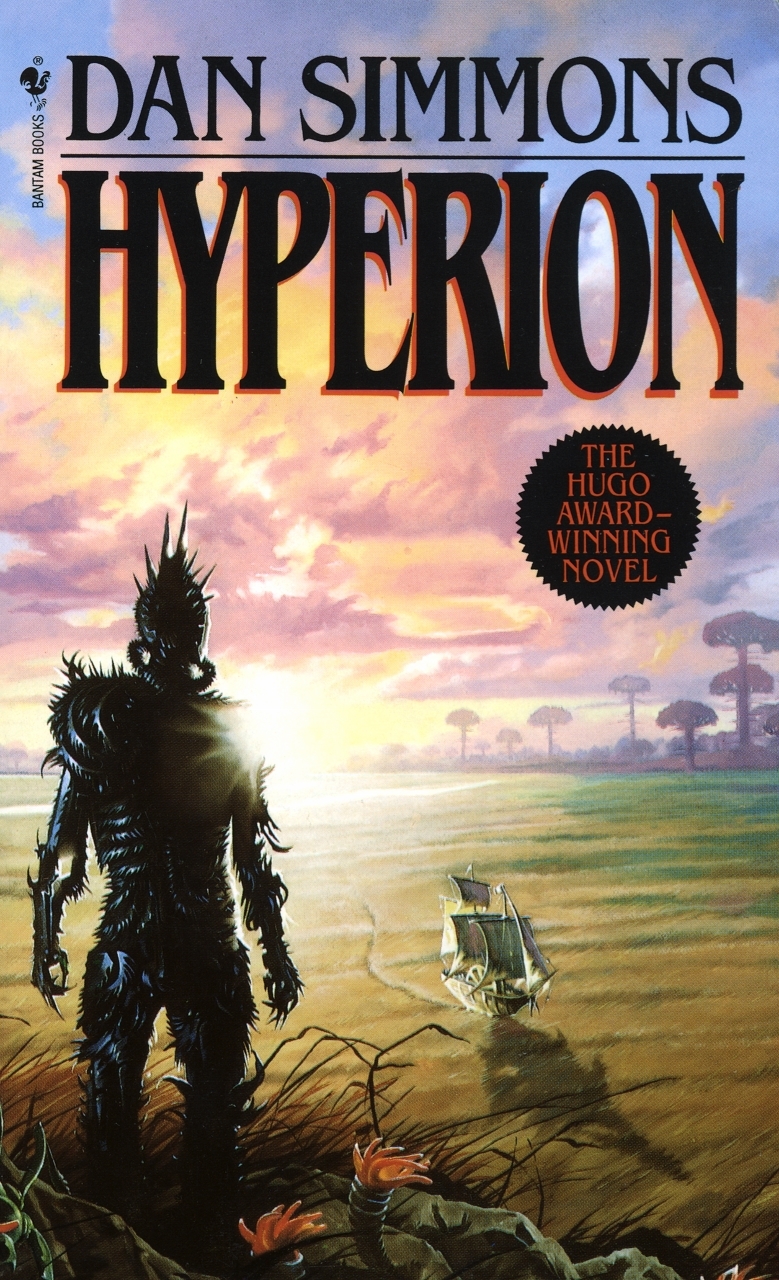
On the world called Hyperion, beyond the reach of galactic law, a creature known as the Shrike awaits. Some worship it, some fear it, and others have vowed to destroy it. In the Valley of the Time Tombs, colossal structures that move backward through time, the Shrike waits for them all. With the galaxy on the verge of Armageddon, seven pilgrims embark on a final voyage to Hyperion, each seeking answers to the unsolved riddles of their lives. Each carries a desperate hope and a terrible secret, and one may hold the fate of humanity in their hands.
Structured as a series of interconnected tales, the novel follows the pilgrims as they share their stories, revealing their reasons for undertaking the dangerous journey. Their individual narratives - spanning genres from horror and mystery to romance and war - weave together to form a complex tapestry that explores themes of love, sacrifice, faith, and the ethical dilemmas of advanced technology. The pilgrims' pasts are all mysteriously linked to the Shrike, and their collective journey to the Time Tombs will unravel a cosmic struggle for power and the future of consciousness.
The starship *Yggdrasill*, a living vessel of interwoven trees and star-silk, glides through the void, carrying seven souls toward the enigmatic world of Hyperion. Across the vast expanse of the Hegemony of Man, a sprawling dominion of two hundred worlds linked by the instantaneous magic of farcaster portals, a final pilgrimage has been called. The Ouster swarms, humanity's genetically altered, space-dwelling cousins, threaten to engulf Hyperion, and with it, the mysterious Time Tombs and the dread Shrike. These seven pilgrims, chosen by the Church of the Final Atonement and the Hegemony itself, bear secrets and desperate hopes, bound for an encounter with a creature both worshipped and reviled, a being of metal thorns said to impale its victims on a Tree of Pain.
As their journey unfolds, the pilgrims, a diverse assembly of humanity, agree to share their stories, each one a thread in the intricate tapestry of Hyperion's fate. Father Lenar Hoyt, a young Catholic priest, first recounts the harrowing journals of Father Paul Duré, an archaeologist exiled to Hyperion. Duré's tale speaks of the Bikura, a strange indigenous people living in the planet's Cleft, and their unsettling connection to parasitic cruciforms that grant a grotesque form of resurrection, raising profound questions about faith, suffering, and the true cost of immortality.
Next, Colonel Fedmahn Kassad, a soldier forged in countless battles against the Ousters, unveils a past steeped in violence and a recurring, dreamlike affair with a mysterious woman named Moneta, or perhaps Mnemosyne. Their encounters, often amidst the chaos of war, entwined him with the very fabric of Hyperion, with the Shrike appearing as both a tormentor and a twisted ally, manipulating time and space in their brutal dances. His narrative is a bloody meditation on love, war, and the blurred lines between reality and prophecy.
The ancient, foul-mouthed poet, Martin Silenus, delivers his tale with a mixture of artistic fervor and bitter cynicism. He speaks of Old Earth, its destruction, and his long, tortured life, driven by an obsessive need to complete his epic poem, "The Hyperion Cantos." For Silenus, Hyperion is both muse and tormentor, a world where he once lived with Sad King Billy, and where he believes the Shrike holds the key to his artistic salvation, or perhaps his final damnation.
Then comes the heart-wrenching account of Sol Weintraub, a Jewish scholar. His story revolves around his daughter, Rachel, who, after an encounter with the Time Tombs on Hyperion, began to age backward, suffering from the horrific "Merlin Sickness." With each passing day, Rachel grows younger, her memories fading, reverting to infancy. Sol bears an unbearable burden: recurring dreams in which a voice commands him to sacrifice his daughter to the Shrike at the Time Tombs, echoing ancient biblical trials of faith and love.
Brawne Lamia, the hard-nosed private investigator, shares her noir-tinged romance with a cybrid, a human body animated by an artificial intelligence, modeled after the Romantic poet John Keats. Their love story, born amidst a dangerous investigation into the TechnoCore's hidden agendas, leads them into a web of deceit, interstellar conspiracies, and a direct, terrifying confrontation with the Shrike, revealing glimpses of the AI's vast, unfathomable power and their own plans for humanity.
Finally, the Consul, the former planetary governor of Hyperion and the last to speak, hints at his own complex history with the world and its secrets, his motivations for joining the pilgrimage remaining veiled even as the *Yggdrasill* draws closer to its perilous destination. His tale, left unfinished, hangs heavy with the weight of political intrigue and personal betrayal, setting the stage for the true purpose of their desperate journey.
As the pilgrims' stories conclude, a sense of foreboding deepens. The *Yggdrasill* nears the Valley of the Time Tombs, colossal structures that move inexplicably backward through time, guarded by the very entity they have come to confront. The air crackles with the impending Ouster invasion, the Hegemony's desperate gambit, and the unknown intentions of the Shrike. Each pilgrim now stands on the precipice of their individual fates, their interwoven lives converging at a single, terrifying point, where the mysteries of Hyperion, the Shrike, and humanity's future await their unveiling.
What other readers say
Liked
Hyperion is widely celebrated as an exceptionally imaginative and magnificent classic within the science fiction genre. Reviewers frequently laud its unique narrative structure, often likened to The Canterbury Tales in space, which presents a series of interconnected stories told by diverse pilgrims. This approach is praised for its ability to reveal important insights into the universe and its central mysteries, while showcasing the author's remarkable versatility in writing style and tone across different tales. Many highlight the profound philosophical and emotional depth found in individual narratives, particularly noting a heartbreaking exploration of family and parenthood, and a terrifying and impactful story of faith. The novel is acclaimed for packing an astonishing number of original sci-fi ideas into its pages, with lush, poetic prose that offers strong characterization and subtle, yet expansive, world-building that feels both futuristic and familiar. Its prescience in envisioning future technologies and societal structures is also a common point of admiration.
Disliked
Despite its many strengths, some readers found the novel's fragmented narrative structure to be a mixed experience, leading to varying levels of engagement with certain pilgrim tales and occasionally hindering deeper emotional connections with characters. A recurring criticism centers on the book's abrupt ending, which functions as a significant cliffhanger, leaving many overarching plotlines unresolved and frustrating those who expected a more conclusive narrative arc. Initial pacing was also cited as a challenge by some, who struggled to immerse themselves in the complex world and its concepts from the outset. For a segment of readers, the dense prose, extensive literary allusions, and emphasis on conceptual world-building over straightforward plot progression made the book feel overwhelming or overly academic. Additionally, some reviewers expressed dissatisfaction with aspects of character portrayal, including one female character's perceived limited role, and a few found elements of the dialogue flat or certain narrative choices indulgent.
In short
Overall, Hyperion stands as a highly regarded classic and a significant achievement in science fiction, frequently appearing on "best of" lists for its ambition and originality. While its open-ended conclusion, intricate conceptual frameworks, and multifaceted narrative style may not appeal to every reader, its exceptional prose, imaginative scope, and profound thematic explorations are widely lauded. This book is strongly recommended for dedicated science fiction enthusiasts, readers who appreciate literary depth and philosophical inquiry, and those willing to engage with a challenging yet ultimately rewarding story that serves as a grand setup for a larger epic. It is particularly suited for those who enjoy a thought-provoking, gritty, and meticulously crafted universe, even if it sometimes leaves a sense of unsettling gloom rather than definitive resolution.