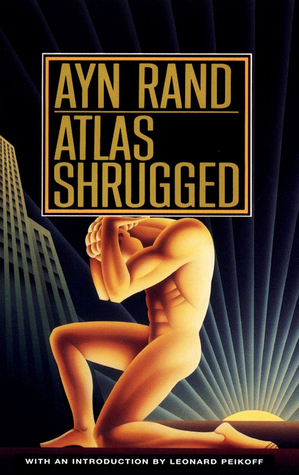
In a dystopian United States teetering on the brink of economic collapse, innovative minds and industrial giants begin to mysteriously disappear. As the nation's most brilliant producers vanish, the once-thriving society spirals into stagnation under the weight of increasing government control and collectivist policies. Dagny Taggart, a relentless railroad executive, fights to keep her transcontinental railway operational amidst crumbling infrastructure and a pervasive question that echoes through the despair: "Who is John Galt?"
This narrative explores the struggle of those who create against a system that seeks to exploit their productivity, blending elements of mystery, romance, and science fiction. It presents a world where individual ambition and rational achievement are under siege, compelling readers to consider the profound impact of the mind on existence and the consequences when the most capable individuals withdraw their contributions.
This narrative explores the struggle of those who create against a system that seeks to exploit their productivity, blending elements of mystery, romance, and science fiction. It presents a world where individual ambition and rational achievement are under siege, compelling readers to consider the profound impact of the mind on existence and the consequences when the most capable individuals withdraw their contributions.
- Genres
- Fiction › Speculative fiction › Science fictionFiction › Speculative fiction › Dystopian fiction
- Mood
- Adventurous
- Where and when
- United States
- Style
- Form: Novel
What readers say
3.69
413K ratings across the web 6 in 10 readers loved it, 2 didn't like it
The reviews highlight that the book is a profoundly influential and thought-provoking work, often described as a "kick in the ass" that challenges readers to examine their own beliefs and behavior. Many appreciate its strong advocacy for individualism, personal responsibility, and the pursuit of one's own happiness through rational thought and achievement. Readers who identify as "creators" or "innovators" often resonate with the book's celebration of human ingenuity, ambition, and the potential for greatness, finding it an empowering read that champions those who build and take risks. Even some who ultimately disagree with its philosophy acknowledge its utility in understanding a different perspective, particularly the frustrations felt by competent individuals. The novel is also noted for its passionate expression of ideas and, for some, its engaging plot and the compelling portrayal of its strong female protagonist.
Despite its impact, the book draws significant criticism for its literary shortcomings. Reviewers frequently describe the writing style as wordy, monotonous, repetitive, and stiff, with dialogue that often feels unnatural. A major point of contention is the character development, with many finding the characters to be one-dimensional "robots" or "caricatures" designed merely to serve the author's philosophical agenda, rather than believable human beings. The philosophical message itself is often perceived as overly simplistic, extreme, and lacking nuance, advocating for a form of selfishness that dismisses cooperation, compassion, and the needs of society's most vulnerable. Critics also point to an unrealistic plot, heavy-handed messaging, and a didactic approach that "tells" rather than "shows," often employing "straw man" arguments. Furthermore, some reviews find the depiction of romantic relationships and sexuality to be problematic or "odd."
Ultimately, the book is highly polarizing, eliciting strong reactions ranging from deep admiration to profound detestation, often influencing readers significantly, especially in their younger years. While its literary merit is widely debated and often criticized, its enduring relevance as a work of ideas, particularly in philosophical, economic, and political discourse, is undeniable. This book would appeal to readers who are open to exploring challenging and extreme philosophical viewpoints, particularly those interested in objectivism, libertarianism, or a strong emphasis on individualism and self-reliance. It is also recommended for those who appreciate an epic, idea-driven narrative and are willing to overlook stylistic flaws for the sake of a powerful, albeit controversial, message.
Reviews
No reviews yet. Be the first.
Details & editions
- This edition
- Penguin Books, Limited, 2007
- ISBN
- 9780141188935
- Language
- English
Original edition Atlas Shrugged Originally published in 1970 · English · Signet