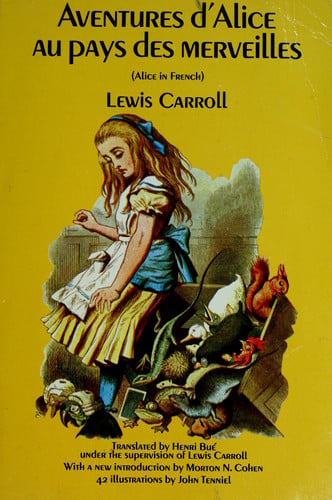
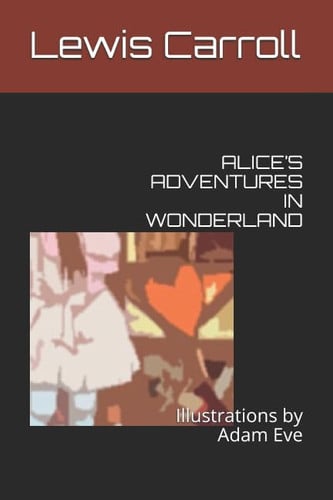
When a curious young Alice follows a peculiar White Rabbit down a rabbit hole, she tumbles into a world where logic is turned on its head and the ordinary is anything but. This subterranean realm, known as Wonderland, introduces her to a parade of eccentric characters, from a perpetually grinning Cheshire Cat to a tea party hosted by the Mad Hatter and March Hare, and a formidable Queen of Hearts who rules with a whimsical, yet terrifying, authority. As Alice navigates this bewildering landscape, where her size constantly changes and conversations defy sense, she grapples with her own identity and the arbitrary rules of a world that challenges everything she knows.
Lewis Carroll's enduring tale invites readers into a vibrant, nonsensical adventure that explores themes of growing up, the nature of reality, and the power of imagination. It is a journey that continues to captivate generations, offering a unique blend of humor, satire, and profound questions that linger long after the final page.
A drowsy afternoon by a riverbank yields an unexpected turn when a young girl named Alice spots a White Rabbit, impeccably dressed in a waistcoat and clutching a pocket watch, muttering about being late. Her curiosity piqued, she follows him without a second thought, tumbling headlong down a deep rabbit hole. The fall is long and peculiar, shelves and odd objects whizzing by, until she lands softly in a long hall lined with doors of all sizes. She finds a tiny key that unlocks a diminutive door, revealing a breathtaking garden, but alas, she is far too large to enter.
A bottle labeled "DRINK ME" appears, and upon imbibing its contents, Alice shrinks to a size small enough to pass through the door. However, she has left the key on the table, now towering above her. A cake marked "EAT ME" then causes her to grow to an enormous size, her head nearly touching the ceiling. Overwhelmed, she weeps a pool of giant tears, which she then shrinks into, finding herself swimming alongside a Mouse and other creatures. They reach a bank, and after a nonsensical "Caucus Race" to dry off, Alice inadvertently scares them away with tales of her cat, Dinah.
Her size fluctuates wildly again after encountering the White Rabbit once more, who mistakes her for his housemaid and sends her on an errand. Inside his house, a mysterious drink causes her to grow so large that she fills the room, her arm bursting through a window. Eventually, after eating a magical cake, she shrinks again, small enough to wander into a forest where she encounters a languid Caterpillar perched on a mushroom, smoking a hookah. Their conversation is a perplexing exchange about identity and size, with the Caterpillar eventually advising her that different sides of his mushroom will alter her height.
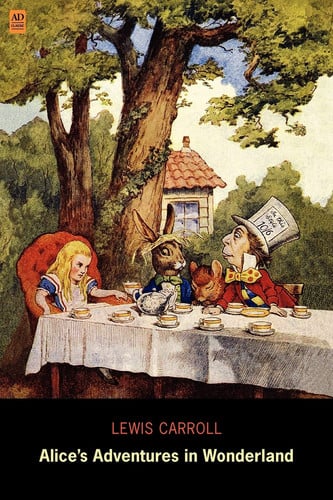
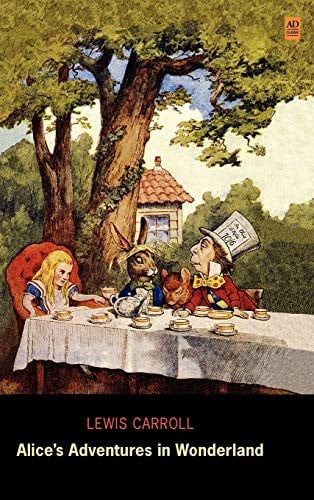
Navigating further into this strange land, Alice finds herself at the Duchess's house, where a chaotic scene unfolds involving a perpetually grinning Cheshire Cat, a Duchess who nurses a baby that soon transforms into a pig, and a Cook who flings dishes with abandon. The Cheshire Cat, with its unsettling ability to appear and disappear, offers cryptic advice and directs her towards the Mad Hatter. She soon stumbles upon a perpetual tea party, hosted by the Mad Hatter, the March Hare, and a sleepy Dormouse. This gathering is a whirlwind of riddles without answers, nonsensical pronouncements, and a complete disregard for time or etiquette, leaving Alice utterly bewildered and frustrated.
Leaving the tea party in exasperation, Alice discovers a tree with a door, leading her back to the long hall. This time, armed with the knowledge of the mushroom, she manages to shrink herself to the perfect size, finally entering the beautiful garden she glimpsed earlier. Here, she finds a bizarre croquet game in progress, presided over by the tyrannical Queen of Hearts, whose every other word is an order for decapitation. Hedgehogs serve as balls, flamingos as mallets, and playing cards as arches, all in a state of constant, unruly motion.
Alice witnesses the Queen's arbitrary justice, including the attempted beheading of the Cheshire Cat (which proves impossible as only its head is present), and is then introduced to the melancholic Mock Turtle and the Gryphon, who share tales of their peculiar schooling and the delights of the Lobster Quadrille. The grand finale is a nonsensical trial for the Knave of Hearts, accused of stealing the Queen's tarts. Alice, now grown to her full height and having found her voice amidst the absurdity, challenges the proceedings, declaring them to be nothing more than a pack of cards. At her defiant words, the playing cards rise into the air and swarm around her.
Suddenly, Alice finds herself back on the riverbank, her head in her sister's lap, the "falling leaves" that had swirled around her in her dream turning out to be real leaves. She recounts her extraordinary adventures to her sister, who, in turn, imagines the fantastical world and the curious child who journeyed through it.
What other readers say
Liked
Alice's Adventures in Wonderland is widely celebrated for its unparalleled imagination, whimsy, and dreamlike atmosphere, drawing readers into a truly unique and immersive world. Reviewers consistently praise the book for its creative setting, memorable characters such as the Cheshire Cat and the Mad Hatter, and clever wordplay, including puns and philosophical dialogues that can be enjoyed on multiple levels. Many find it a source of joy, fulfillment, and bittersweet nostalgia, offering something new with each reread. The enduring quality of its quotes and its ability to spark curiosity and wonder are frequently highlighted, with some readers even finding it a comforting escape during difficult times. The story is often described as a timeless classic that has deeply influenced literature and popular culture, retaining its charm and brilliance over the years.
Disliked
Despite its many admirers, the book is not without its detractors. A significant point of criticism is its highly illogical and nonsensical nature, which some readers find tedious, confusing, and difficult to follow. Those who prefer structured narratives and logical progression often struggle with the constant contradictions and unpredictable events. Some reviewers describe the experience as bewildering or even frustrating, leading them to abandon the book or finish it purely out of a sense of obligation. Additionally, Alice herself is occasionally perceived as a sassy, cheeky, or even rude character, which can detract from the reading experience for some. The original illustrations are generally appreciated, but the text alone can be challenging, with some preferring adaptations that streamline the story.
In short
Overall, Alice's Adventures in Wonderland is a quintessential classic that continues to fascinate and divide readers. It is highly recommended for those who appreciate imaginative, fantastical literature, enjoy wordplay and philosophical undertones, and are open to a narrative that defies conventional logic. Readers who cherish books that evoke a sense of childhood wonder and provide a unique escape will likely find it a beloved favorite. However, those who prefer straightforward plots, logical consistency, or find literary nonsense unappealing may struggle with its distinctive style.