
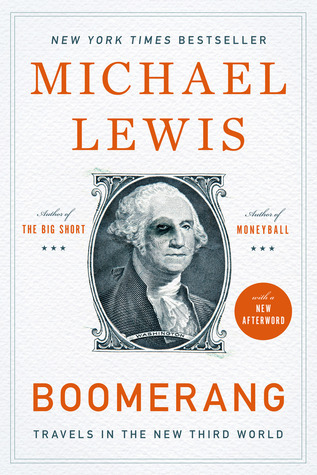
Boomerang
by Michael Lewis, Michael Collier
7.8 / 10 48K ratings
- Language
- English
- Published
- 2012
- Publisher
- Penguin Books, Limited
- Pages
- 240
- ISBN
- 9780141975016
Michael Lewis embarks on a journey to understand the global financial meltdown, moving beyond the American housing market to explore the sovereign debt crises that swept across Europe and even impacted California. He investigates how nations like Iceland, Greece, and Ireland, once thriving, found themselves on the brink of economic collapse, each with distinct cultural traits contributing to their financial undoing. Lewis also examines Germany's paradoxical role as a financially disciplined nation that still incurred significant losses abroad, and the surprising fiscal troubles within the United States' own municipalities.
Through vivid storytelling and insightful observations, Lewis reveals the human element behind complex economic disasters, illustrating how cheap financing and a collective willingness to believe in endless prosperity led to a reckoning across diverse societies. This book offers a compelling, often humorous, look at the interconnectedness of global economies and the behaviors that can lead to widespread financial turmoil, making sense of a crisis that reshaped the modern world.
Through vivid storytelling and insightful observations, Lewis reveals the human element behind complex economic disasters, illustrating how cheap financing and a collective willingness to believe in endless prosperity led to a reckoning across diverse societies. This book offers a compelling, often humorous, look at the interconnectedness of global economies and the behaviors that can lead to widespread financial turmoil, making sense of a crisis that reshaped the modern world.
- Genres
- Fiction › Action & adventure
- Themes
- Journalism
- Where and when
- United States Russia Asia 2000s
Original edition
Bumerangue (Em Portugues do Brasil)Originally published in 2011 Portuguese Sextante
Other editions (47)


Listen to the summary Narrated summary
The global financial landscape, still reeling from the tremors of the American subprime mortgage crisis, began to reveal deeper fissures, not in the bustling canyons of Wall Street, but in the seemingly stable economies of the Western world. A prescient hedge fund manager, Kyle Bass, had seen beyond the initial collapse, predicting that governments themselves were poised to absorb trillions in toxic private-sector debt, leading to an unprecedented wave of sovereign defaults. As his grim forecasts began to materialize across Europe, a journey commenced to understand the peculiar national psychologies that had led entire countries to the precipice of ruin.
The first stop on this unraveling tour was Iceland, a remote island nation that, in a dizzying span of five years, had transformed itself from a fishing economy into a global financial player. Its three largest banks had swollen their assets from a mere few billion dollars to over $140 billion, driven by an almost childlike embrace of leveraged foreign borrowing and an eagerness to play the high-stakes game of international finance. Everyone, from fishmongers to hot dog vendors, seemed to have become an investor, borrowing heavily in foreign currencies at low interest rates, convinced that the good times would never end. But when the worldwide financial markets seized, Iceland's banks evaporated, leaving its 300,000 citizens with losses equivalent to roughly $330,000 per person, a staggering sum that turned a nation into a cautionary tale of collective financial delusion.
Next, the path led to Greece, a land where the very concept of fiscal responsibility seemed to have been a charming, if inconvenient, foreign custom. Here, the crisis was not born of reckless international speculation by private banks, but from a deeply ingrained culture of tax evasion and systemic corruption that had permeated every layer of society. The state itself was a participant, lending its own government billions while its citizens expertly dodged their obligations, creating a vast, unacknowledged deficit that eventually became too immense to hide. The tale of the Vatopaidi monastery, where monks swapped a worthless lake for valuable government properties, illustrated the casual audacity with which the public trust had been plundered, contributing to the downfall of a government. The question lingered: could a society so atomized by self-interest ever summon the collective will to reform?
Ireland presented a different sort of tragedy, a nation that had used cheap foreign money not to conquer global finance or loot the state, but to fuel an insatiable, almost childlike obsession with domestic real estate. The Irish, long accustomed to being the poor cousin of Europe, found themselves awash in credit and embarked on an epic building spree. Ghost estates, unfinished and abandoned housing developments, dotted the countryside, stark monuments to a collective delusion that property values would only ever go up. Their banks, deeply entangled in these inflated domestic loans, collapsed under the weight of their own making, leaving a once-proud nation to grapple with the devastating consequences of its misplaced dreams.
Even Germany, the supposed paragon of financial discipline, held its own peculiar contradictions within the global meltdown. While outwardly conservative and fiscally prudent at home, German banks had astonishingly managed to lose colossal sums abroad, pouring billions into Icelandic banks, Irish property, and even American subprime bonds. The irony was palpable: the Germans, who often expressed a national obsession with order and cleanliness, had, in their pursuit of yield, unwittingly become deeply involved in the creation and distribution of financial "toxic waste." Their leaders, caught between their voters' aversion to bailouts and the looming threat of a complete collapse of the European banking system, faced an agonizing choice, highlighting the deep cultural chasm that separated the continent's debtors from its reluctant creditors.
Finally, the journey circled back to the United States, not to Wall Street, but to the municipal bond market and the forgotten corners of local government, like Vallejo, California. Here, the financial crisis manifested not in abstract derivatives but in the tangible erosion of public services. Police forces were decimated, fire departments gutted, and the very fabric of community life began to fray as local governments, once thought immune to the excesses of high finance, found themselves staring into the abyss of bankruptcy. The global financial crisis, it became clear, was not merely a story of intricate financial instruments and distant national economies; it was a deeply human story, revealing the peculiar flaws and follies embedded within each culture, ultimately showcasing how the world's interconnectedness meant that one nation's financial missteps could boomerang back to haunt them all.
The first stop on this unraveling tour was Iceland, a remote island nation that, in a dizzying span of five years, had transformed itself from a fishing economy into a global financial player. Its three largest banks had swollen their assets from a mere few billion dollars to over $140 billion, driven by an almost childlike embrace of leveraged foreign borrowing and an eagerness to play the high-stakes game of international finance. Everyone, from fishmongers to hot dog vendors, seemed to have become an investor, borrowing heavily in foreign currencies at low interest rates, convinced that the good times would never end. But when the worldwide financial markets seized, Iceland's banks evaporated, leaving its 300,000 citizens with losses equivalent to roughly $330,000 per person, a staggering sum that turned a nation into a cautionary tale of collective financial delusion.
Next, the path led to Greece, a land where the very concept of fiscal responsibility seemed to have been a charming, if inconvenient, foreign custom. Here, the crisis was not born of reckless international speculation by private banks, but from a deeply ingrained culture of tax evasion and systemic corruption that had permeated every layer of society. The state itself was a participant, lending its own government billions while its citizens expertly dodged their obligations, creating a vast, unacknowledged deficit that eventually became too immense to hide. The tale of the Vatopaidi monastery, where monks swapped a worthless lake for valuable government properties, illustrated the casual audacity with which the public trust had been plundered, contributing to the downfall of a government. The question lingered: could a society so atomized by self-interest ever summon the collective will to reform?
Ireland presented a different sort of tragedy, a nation that had used cheap foreign money not to conquer global finance or loot the state, but to fuel an insatiable, almost childlike obsession with domestic real estate. The Irish, long accustomed to being the poor cousin of Europe, found themselves awash in credit and embarked on an epic building spree. Ghost estates, unfinished and abandoned housing developments, dotted the countryside, stark monuments to a collective delusion that property values would only ever go up. Their banks, deeply entangled in these inflated domestic loans, collapsed under the weight of their own making, leaving a once-proud nation to grapple with the devastating consequences of its misplaced dreams.
Even Germany, the supposed paragon of financial discipline, held its own peculiar contradictions within the global meltdown. While outwardly conservative and fiscally prudent at home, German banks had astonishingly managed to lose colossal sums abroad, pouring billions into Icelandic banks, Irish property, and even American subprime bonds. The irony was palpable: the Germans, who often expressed a national obsession with order and cleanliness, had, in their pursuit of yield, unwittingly become deeply involved in the creation and distribution of financial "toxic waste." Their leaders, caught between their voters' aversion to bailouts and the looming threat of a complete collapse of the European banking system, faced an agonizing choice, highlighting the deep cultural chasm that separated the continent's debtors from its reluctant creditors.
Finally, the journey circled back to the United States, not to Wall Street, but to the municipal bond market and the forgotten corners of local government, like Vallejo, California. Here, the financial crisis manifested not in abstract derivatives but in the tangible erosion of public services. Police forces were decimated, fire departments gutted, and the very fabric of community life began to fray as local governments, once thought immune to the excesses of high finance, found themselves staring into the abyss of bankruptcy. The global financial crisis, it became clear, was not merely a story of intricate financial instruments and distant national economies; it was a deeply human story, revealing the peculiar flaws and follies embedded within each culture, ultimately showcasing how the world's interconnectedness meant that one nation's financial missteps could boomerang back to haunt them all.
What other readers say
Liked
Reviewers largely praise Michael Lewis's exceptional talent for making complex financial subjects understandable and engaging. Many highlight his uncanny ability to simplify intricate economic issues with clear, accessible language, often enhanced by his distinctive mordant wit and snappy prose. The book is frequently described as a fascinating, entertaining, and even hilarious read, offering both delight and enlightenment despite its serious subject matter. Readers appreciated the rich information and insight provided, which helps make sense of the wider global economic story and offers a broad understanding of impending financial challenges. The book's unique travelogue style, exploring different nations, also contributed to its compelling and memorable narrative.
Disliked
However, the book draws significant criticism for its perceived oversimplification and reliance on national stereotypes. Several reviewers found Lewis's portrayals of entire nations to be mean-spirited caricatures, sometimes bordering on politically incorrect. Some felt the book lacked sufficient depth and analytical rigor, appearing rushed or more like a collection of previously published magazine articles rather than a cohesive, in-depth investigation. Concerns were also raised about a potential bias in Lewis's viewpoint, with some readers feeling he placed too much blame on average citizens compared to financial institutions. A few specific factual points were also questioned regarding the accuracy of certain predictions or cultural interpretations.
In short
Despite these criticisms, many reviewers still recommend the book, often describing it as a thought-provoking and informative read that skillfully blends humor with sobering economic realities. While some consider it less profound than Lewis's other acclaimed works, it remains an accessible entry point into understanding the global financial crisis. This book is particularly suited for readers who enjoy Michael Lewis's signature style and wit, those seeking an entertaining overview of complex economic events without delving into overly technical details, and individuals curious about the human and cultural dimensions of financial meltdowns across various countries. It offers an eye-opening journey that encourages reflection on global economic trends.
No reviews yet. Be the first.