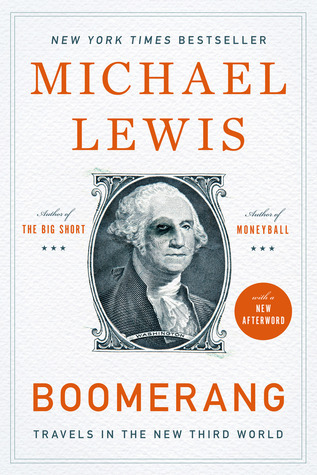
Boomerang
by Michael Lewis, Michael Collier
- First published 2011
- 213 pages
- English
Michael Lewis embarks on a journey to understand the global financial meltdown, moving beyond the American housing market to explore the sovereign debt crises that swept across Europe and even impacted California. He investigates how nations like Iceland, Greece, and Ireland, once thriving, found themselves on the brink of economic collapse, each with distinct cultural traits contributing to their financial undoing. Lewis also examines Germany's paradoxical role as a financially disciplined nation that still incurred significant losses abroad, and the surprising fiscal troubles within the United States' own municipalities.
Through vivid storytelling and insightful observations, Lewis reveals the human element behind complex economic disasters, illustrating how cheap financing and a collective willingness to believe in endless prosperity led to a reckoning across diverse societies. This book offers a compelling, often humorous, look at the interconnectedness of global economies and the behaviors that can lead to widespread financial turmoil, making sense of a crisis that reshaped the modern world.
Through vivid storytelling and insightful observations, Lewis reveals the human element behind complex economic disasters, illustrating how cheap financing and a collective willingness to believe in endless prosperity led to a reckoning across diverse societies. This book offers a compelling, often humorous, look at the interconnectedness of global economies and the behaviors that can lead to widespread financial turmoil, making sense of a crisis that reshaped the modern world.
What readers say
3.90
48K ratings across the web 7 in 10 readers loved it, 1 didn't like it
Reviewers largely praise Michael Lewis's exceptional talent for making complex financial subjects understandable and engaging. Many highlight his uncanny ability to simplify intricate economic issues with clear, accessible language, often enhanced by his distinctive mordant wit and snappy prose. The book is frequently described as a fascinating, entertaining, and even hilarious read, offering both delight and enlightenment despite its serious subject matter. Readers appreciated the rich information and insight provided, which helps make sense of the wider global economic story and offers a broad understanding of impending financial challenges. The book's unique travelogue style, exploring different nations, also contributed to its compelling and memorable narrative.
However, the book draws significant criticism for its perceived oversimplification and reliance on national stereotypes. Several reviewers found Lewis's portrayals of entire nations to be mean-spirited caricatures, sometimes bordering on politically incorrect. Some felt the book lacked sufficient depth and analytical rigor, appearing rushed or more like a collection of previously published magazine articles rather than a cohesive, in-depth investigation. Concerns were also raised about a potential bias in Lewis's viewpoint, with some readers feeling he placed too much blame on average citizens compared to financial institutions. A few specific factual points were also questioned regarding the accuracy of certain predictions or cultural interpretations.
Despite these criticisms, many reviewers still recommend the book, often describing it as a thought-provoking and informative read that skillfully blends humor with sobering economic realities. While some consider it less profound than Lewis's other acclaimed works, it remains an accessible entry point into understanding the global financial crisis. This book is particularly suited for readers who enjoy Michael Lewis's signature style and wit, those seeking an entertaining overview of complex economic events without delving into overly technical details, and individuals curious about the human and cultural dimensions of financial meltdowns across various countries. It offers an eye-opening journey that encourages reflection on global economic trends.
Reviews
No reviews yet. Be the first.
Details & editions
- This edition
- W. W. Norton & Company, 2012
- ISBN
- 9780393344486
- Language
- English
Original edition Bumerangue (Em Portugues do Brasil) Originally published in 2011 · Portuguese · Sextante