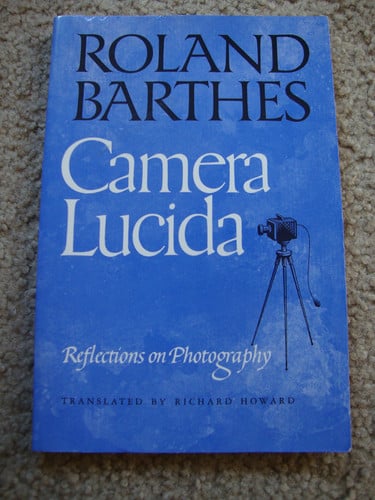
Positives The book is widely praised as a unique, profound, and highly influential meditation on photography that transcends purely technical discussions. Reviewers highlight its deeply personal and contemplative approach, where Roland Barthes delves into the essence and meaning of images within himself, rather than offering a purely theoretical or historical account. The work is lauded for introducing key concepts such as "studium" and "punctum," which offer new ways to understand how photographs affect viewers both intellectually and emotionally. Many found it to be an intricate and affecting read, exploring the profound connections between photography, love, grief, death, and immortality. Its poetic language and philosophical insights are seen as stimulating, encouraging readers to think about photographs in unfamiliar and more meaningful ways, often enhancing their appreciation for the art form.
Negatives Despite its acclaim, some reviewers find the book to be polarizing. Critics point out that it deviates significantly from Barthes' usual structuralist and semiotic analyses, which can disappoint readers expecting a more academic or comprehensive discourse on photography as an art form or its role in contemporary culture and media. The book is described by some as overly personal, sentimental, or even solipsistic, with a narrow focus that neglects the technical aspects of photography, its history, or its sociological implications. Reviewers also noted that Barthes' arguments can sometimes be dense, difficult to follow, or even reductive, particularly in his interpretations of certain images or his dismissal of contextual information. Some find his observations dated or his philosophical claims problematic, suggesting that the book occasionally prioritizes subjective experience over broader analysis, leading to a less balanced or comprehensive understanding of the medium.
Conclusion Ultimately, "Camera Lucida" is regarded as an extraordinary and thought-provoking work, even if it doesn't offer a definitive or universally accepted theory of photography. Its strength lies in its ability to provoke strong reactions and encourage deep reflection, making it a pivotal text in photography studies. This book would particularly appeal to readers interested in philosophical and personal meditations on art, time, memory, and loss, especially those who appreciate a subjective, emotionally resonant exploration rather than a technical manual or a broad academic survey. It is recommended for anyone who photographs, appreciates photography, or seeks to understand the profound human experience embedded within images.