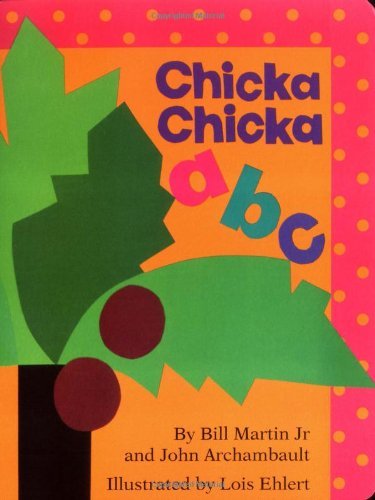
In a rhythmic, rollicking race, the letters of the alphabet dare each other to the top of the coconut tree. As A, B, and C climb their way up, the whole alphabet follows in a colorful and chaotic scramble. But as more and more letters join the adventure, the tree begins to bend under the weight, leading to a tumbling, jumbled heap. This chant-like story turns the simple act of learning letters into a memorable, musical escapade.
With its catchy repetition and bold, cheerful art, this book transforms the alphabet from abstract symbols into lively characters on a mission. The playful narrative not only introduces lowercase and uppercase letters but also fosters a love for language and reading through its irresistible rhythm. It's an engaging journey through the ABCs that makes learning feel like pure fun, leaving children eager to see what happens when the letters decide to climb again.
A told B, and B told C, "I'll meet you at the top of the coconut tree!" And so began a grand, alphabetical adventure under a sky of brilliant blue. Little lowercase letters, brimming with youthful energy, began their ascent, one after another, eager to reach the leafy crown. First came A, then B, then C, scrambling up the sturdy brown trunk, their tiny forms a colorful parade against the green.
As D and E and F followed close behind, a joyful chatter filled the air. G, then H, then I, and J and "tag-along K" made their way up, each little letter finding a precarious perch. But the coconut tree, though tall and strong, began to sway under the ever-increasing weight. L, M, N, O, P, and Q, R, S, and T, U, V, still more, joined the growing throng.
With W, X, Y, and Z, the very last to climb, the tree groaned and bent. There was simply no more room! A sudden, dramatic tilt, and then - Oh, no! Chicka Chicka Boom Boom! Down they all tumbled, a colorful cascade of letters, landing in a heap at the base of the tree.
A great commotion arose as the uppercase letters, the grown-up relatives, came rushing to the scene. Mama and Papa, and Uncles and Aunts, quickly gathered their little dears. Each lowercase letter was accounted for, though some bore the marks of their adventurous fall: "skinned-knee D and stubbed-toe E, and patched-up F. Then comes G all out of breath". H and I were tangled, J and K were crying, and poor P had a black eye, while T had a loose tooth.
As the sun began to set, casting long shadows across the jungle floor, all the letters were finally safe and sound, nestled in the embrace of their larger kin. But as the night deepened and the moon cast a silvery glow, a tiny, mischievous "a" peered out from his bed. He couldn't resist the call of the coconut tree. He quietly slipped away, climbed back up, and from the very top, dared the rest of the alphabet to catch him.
What other readers say
Liked
Many reviewers hail this book as a beloved classic, often recalling fond childhood memories of it being read aloud and sharing it with new generations. It is frequently described as a fun, cute, and engaging story, particularly effective for teaching the alphabet due to its strong rhythmic and rhyming structure. Readers highlight its suitability for singing, making it an interactive experience for children. The book is praised for its vibrant, bright, and colorful illustrations, which are consistently noted as a significant draw for young audiences. Its repetitive nature and playful language are celebrated as excellent tools for early literacy development, appealing to generations of youngsters and making learning enjoyable.
Disliked
While overwhelmingly positive, some reviews offer minor criticisms or mixed feelings. A few readers found the art simplistic, describing the book as an "average kid's book" or merely "okay" for their children, suggesting it didn't always hold their attention as much as other titles. One older child found it "kinda boring," indicating it might be less captivating for those beyond the target age range. A couple of adult readers expressed that the story or the sheer number of letters could be "a little confusing." Additionally, a small number of highly analytical reviews interpreted the narrative as an "exercise in futility" or an "existential purgatory," though these are unique perspectives largely outside the general consensus for a children's book.
In short
Overall, Chicka Chicka Boom Boom is widely considered an enduring and highly recommended children's book, especially for early learners. Its primary strength lies in making the alphabet fun and accessible, with its catchy rhythm, lively rhymes, and captivating visuals. This book is particularly well-suited for toddlers, preschoolers, and kindergartners who are beginning to learn their ABCs and enjoy interactive read-alouds. It is also cherished by parents and caregivers seeking a joyful and effective tool for early literacy, making it a beloved staple for any child's bookshelf.