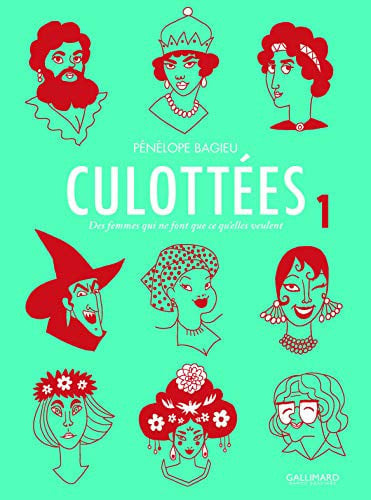
There are women who were told to be quiet, to be compliant, to disappear into the roles assigned to them by birth, by society, by men. They were expected to be wives, mothers, or muses, their own desires a footnote to the grand narratives of history. But some refused. They were empresses and explorers, dancers and lighthouse keepers, rebels and scientists. They were women who, in ways loud and quiet, brazen and stubborn, did only what they wanted to do.
In the Vosges mountains of France, a young woman named Clémentine Delait discovered she had something extra: a beard. At first, she shaved, hiding what made her different. But one day, visiting a fair, she saw a bearded lady with a disappointingly sparse chin. “I could do better than that!” she wagered. And so she did. Clémentine let her beard grow, a magnificent, flowing cascade of hair that transformed her life. With her supportive husband, Joseph, she turned their café into a sensation, “The Bar of the Bearded Lady.” She became a celebrity, a mascot for soldiers during the war, a woman who took an anomaly and spun it into a life of fame, independence, and unapologetic self-possession.
Centuries earlier, in the kingdom of Ndongo, a princess named Nzinga was born with the umbilical cord wrapped around her neck - a sign, it was foretold, that she would be proud and difficult. The prophecy proved true. Sent to negotiate with the Portuguese governor, who sought to dominate her people, she entered a room where he sat on a throne, offering her only cushions on the floor to signify her subservience. Without missing a beat, Nzinga commanded one of her servants to kneel on all fours, creating a human throne. She then negotiated, eye to eye, as an equal. For forty years, she would lead her armies, outsmarting European powers and resisting colonization with brilliant military strategy and ruthless diplomacy, a queen who refused to kneel before anyone.
Some battles are fought not for land, but for a role. Margaret Hamilton dreamed of being an actress, but her face was not the kind Hollywood made into a star. So she took the parts she could get: spinsters, gossips, and villains. When the role of the Wicked Witch of the West came up, she was determined to get it. Her demonic cackle during the audition terrified the casting directors. On set, her skin was coated in a copper-based green paint so toxic she could only consume liquids through a straw. During one scene, a pyrotechnic effect misfired, and the paint caught fire, leaving her with severe burns. Yet she returned to finish the film, her performance so terrifying that many of her scenes were cut. She would forever be the witch who haunted the dreams of children, a gentle, kind woman who found her power in being terrifying.
Not all rebellions are grand spectacles. In 19th-century Holland, Josephina van Gorkum, a Catholic aristocrat, fell in love with a Protestant soldier, Jacob van Gorkum. In a society strictly segregated by religion - a system known as “pillarization” - their marriage was a scandal. But their greatest challenge came from the certainty of death. The law dictated they be buried in separate parts of the cemetery, divided by a high brick wall. Josephina would not accept an eternity apart from the man she loved. When Jacob died, he was buried in the Protestant section. Eight years later, as she lay dying, Josephina gave her final instructions. She was not to be interred in her family crypt, but against the wall on the Catholic side, as close to Jacob as possible. Their tombs stand there today, two stone hands reaching over the wall, their fingers forever clasped in a final, quiet act of defiance.
From an Apache warrior and shaman named Lozen, who could feel the direction of her enemies in the palms of her hands, to Annette Kellerman, the swimmer who scandalized the world by designing a form-fitting one-piece swimsuit and became an aquatic film star; from a Chinese empress who seized power for herself to a social worker who ended a civil war with an army of women, these lives blaze across time. Each one is a testament to the refusal to accept the world as it is. They are the inventors, the troublemakers, the visionaries - the women who looked at the path laid out for them, shrugged, and walked in the other direction.