
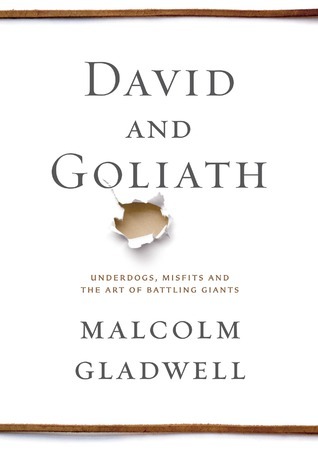
DAVID Y GOLIAT
7.94 / 10 195K ratings
- Language
- English
- Published
- 2012
- Publisher
- Taurus
- Pages
- 284
- ISBN
- 9789587586121
Malcolm Gladwell challenges our most basic assumptions about power and weakness, starting with the classic tale of the shepherd boy and the giant. We think we know the story of David and Goliath, but a closer look reveals that what we perceive as strength can be a significant vulnerability, and apparent disadvantages can conceal powerful assets. This re-examination sets the stage for a journey through history, psychology, and the lives of remarkable individuals who turned the tables on overwhelming odds.
Through a series of compelling real-world stories, the book explores the surprising dynamics of conflict and challenge. It examines how a basketball team of novices could dominate seasoned opponents, how civil rights leaders defeated a powerful establishment, and how individuals overcame personal hardships like dyslexia to achieve greatness. These are not simple tales of underdog luck; they are illustrations of how adversity can forge unique skills, how the powerful become complacent, and why the conventional rules of engagement are not always the ones that lead to victory. It reveals that giants are not always what they seem, and that the act of facing impossible odds can produce unexpected greatness.
Through a series of compelling real-world stories, the book explores the surprising dynamics of conflict and challenge. It examines how a basketball team of novices could dominate seasoned opponents, how civil rights leaders defeated a powerful establishment, and how individuals overcame personal hardships like dyslexia to achieve greatness. These are not simple tales of underdog luck; they are illustrations of how adversity can forge unique skills, how the powerful become complacent, and why the conventional rules of engagement are not always the ones that lead to victory. It reveals that giants are not always what they seem, and that the act of facing impossible odds can produce unexpected greatness.
Other editions (88)



Listen to the summary Narrated summary
The age-old tale of David and Goliath, often told as a triumph of the weak over the strong, is profoundly misunderstood. We tend to view Goliath as overwhelmingly powerful and David as a hopeless underdog, yet this perspective misses the true dynamics at play. Goliath, a heavily armored infantryman, was built for close combat, but his immense size and potential condition like acromegaly likely left him with impaired vision and slow movement. David, on the other hand, was a highly skilled slinger, a projectile warrior whose weapon could launch a stone with the stopping power of a modern handgun, making him a devastating force at a distance. When David faced Goliath not with a sword but with his sling, he wasn't acting as an underdog; he was employing superior, unconventional tactics against a lumbering target, turning Goliath's perceived strengths - his size and armor - into profound weaknesses.
This re-evaluation of the David and Goliath story serves as a foundational insight: what we consider advantages or disadvantages are often misjudged. Conventional wisdom frequently blinds us to the hidden strengths of the underdog and the concealed vulnerabilities of the giant. Many instances throughout history and contemporary life reveal that overwhelming resources or power can, beyond a certain point, become detrimental, creating an "inverted U-curve" where more is not always better.
Consider the seemingly insurmountable challenge of a small, unathletic girls' basketball team. Instead of trying to compete on the giant's terms of raw talent and conventional play, their coach, Vivek Ranadivé, implemented a full-court press, a strategy typically deemed too aggressive and exhausting for young players. This unconventional approach, born out of their perceived weakness, disrupted the expectations of their more physically gifted opponents and led them to unexpected victories.
Similarly, individuals who face significant hardships, what can be termed "desirable difficulties," often develop compensatory strengths that lead to extraordinary success. For example, the acclaimed lawyer David Boies, who struggled with dyslexia, was forced to develop an exceptional memory and rely on listening and oral argumentation rather than reading dense legal texts. This "disadvantage" ultimately honed his courtroom skills, making him one of the most formidable trial attorneys.
The principle extends to institutions and societal challenges. The implementation of California's "Three Strikes Law," intended to deter crime with harsh penalties, paradoxically led to unintended consequences, such as more serious crimes being committed to avoid a third strike, and overburdened courts. This illustrates how an overwhelming application of power, meant as an advantage, can backfire, creating new problems or exacerbating existing ones.
The French village of Le Chambon-sur-Lignon during World War II offers another powerful example. Surrounded by a tradition of dissent and a remote location, the villagers, led by their pastor André Trocmé, chose to defy the Nazi regime and shelter thousands of Jewish refugees. Their relative isolation and strong moral conviction, rather than military might, became their strength, allowing them to resist a far more powerful adversary.
These narratives reveal a consistent pattern: true strength often lies not in size or obvious power, but in adaptability, unconventional thinking, and the willingness to challenge established norms. The underdogs who succeed are those who recognize that the giant's apparent invincibility is often a facade, built upon assumptions that can be exploited. Their struggles, rather than being impediments, frequently forge resilience and ingenuity, making possible what might otherwise seem unthinkable.
What other readers say
Liked
The reviews consistently praise the author's exceptional storytelling ability, noting that he is a gifted writer who can craft compelling narratives and present complex information in an engaging way. Many readers found the book to be a delightful, stimulating, and thought-provoking read, sparking conversations and encouraging new perspectives on common beliefs. The book is lauded for its capacity to inspire and empower, particularly in illustrating how perceived disadvantages can be transformed into strengths and how underdogs can achieve remarkable success against the odds. Reviewers appreciate the accessible and enjoyable nature of the writing, which makes challenging ideas easy to absorb and reflect upon.
Disliked
Despite its strengths, the book draws criticism for its perceived lack of academic rigor and reliance on anecdotal evidence. Reviewers frequently mention that the author tends to select examples that support his points, potentially overlooking contradictory evidence or alternative interpretations. Some find his arguments to be tenuous, oversimplified, or overly generalized, leading to conclusions that are not always conclusive or convincing under scrutiny. The connections between the various stories and the central theme are sometimes described as disjointed, confusing, or too similar to his previous works, leaving some readers questioning the overall point. A common sentiment is that while the book is entertaining, it functions more as "pop psychology" than rigorous social science.
In short
Overall, David and Goliath is seen as an entertaining and thought-provoking read that challenges conventional wisdom, even if its methodology is not always scientifically robust. It is recommended for readers who appreciate compelling storytelling and enjoy having their assumptions questioned, rather than those seeking definitive academic proof. The book particularly appeals to individuals looking for inspiration and new ways to view obstacles, as well as those interested in psychology and human behavior presented in an accessible and engaging style. It is a worthwhile read for anyone who enjoys the author's distinctive approach and is open to a journey that makes them think and feel, without requiring deep analytical effort.
No reviews yet. Be the first.