
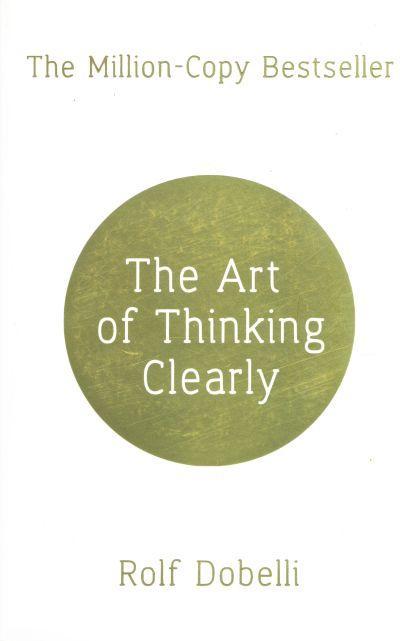
De kunst van het heldere denken
by Rolf Dobelli
7.68 / 10 43K ratings
- Language
- English
- Published
- 2012
- Publisher
- Bezige Bij B.v., Uitgeverij De
- Pages
- 198
- ISBN
- 9789023473046
Everyone makes systematic errors in judgment, often without realizing it. "The Art of Thinking Clearly" by Rolf Dobelli identifies these common cognitive biases and logical fallacies that routinely impede rational thought and decision-making. Across 99 concise chapters, the book explains various mental shortcuts and distortions, from survivorship bias to the sunk cost fallacy, using clear examples to illustrate how these ingrained patterns influence everyday choices.
This book offers a guide to recognizing these predictable errors, enabling readers to think more objectively and make better decisions in all aspects of life. By understanding the ways the mind can mislead, individuals can cultivate clearer judgment and avoid common pitfalls, leading to improved outcomes in personal and professional spheres.
This book offers a guide to recognizing these predictable errors, enabling readers to think more objectively and make better decisions in all aspects of life. By understanding the ways the mind can mislead, individuals can cultivate clearer judgment and avoid common pitfalls, leading to improved outcomes in personal and professional spheres.
Original edition
Die Kunst des klaren DenkensOriginally published in 2011 German Carl Hanser
Other editions (88)



Listen to the summary Narrated summary
We are all prone to systematic deviations from logic, routine mistakes in judgment that cloud our perceptions and lead us astray. These "cognitive errors" are not mere occasional slips but deeply ingrained patterns, barriers to rational thought that have persisted through generations. To navigate the complexities of life, whether in personal decisions, business, or even government, a fundamental shift is required: less irrationality. This isn't a guide to perfect thinking, for complete eradication of these errors would demand superhuman willpower, and some, surprisingly, are even necessary for a well-lived life. Instead, it serves as an insurance policy against self-induced unhappiness, a means to recognize and evade the most significant pitfalls.
Consider the pervasive Survivorship Bias, where we systematically overestimate our chances of success by focusing solely on the visible winners, entirely neglecting the countless failures that paved the way. We admire the thriving companies, the celebrated authors, the successful entrepreneurs, often forgetting the multitude of ventures, manuscripts, and endeavors that crumbled silently into obscurity. To guard against this, one must frequently visit the metaphorical graves of once-promising projects, a somber but clarifying exercise.
Then there is the Sunk Cost Fallacy, a stubborn refusal to abandon a failing endeavor simply because of the resources already invested. You find yourself pouring more money into a losing stock, continuing to read a dreadful book, or persisting with a doomed relationship, all because of the time, effort, or emotion already committed. The past, however, is irrecoverable; what truly matters is the present assessment of future potential, unburdened by what has already been spent.
Our minds are also susceptible to Confirmation Bias, a tendency to seek out and interpret information in a way that confirms our existing beliefs, while conveniently ignoring anything that contradicts them. This creates an echo chamber of our own thoughts, reinforcing prejudices and hindering genuine understanding. To combat this, actively seek out disconfirming evidence, even if it challenges cherished notions. Axing beliefs that feel like old friends is difficult but imperative for clear thinking.
The Halo Effect, for instance, causes us to be unduly influenced by a single, striking characteristic of a person or thing. If someone is charming or attractive, we are more likely to assume they are also intelligent, honest, and competent, even without evidence. Conversely, a negative first impression can unfairly tarnish our perception of all their other qualities. This shortcut in judgment prevents us from seeing the full, nuanced picture.
We also fall prey to the Illusion of Control, believing we have more sway over events than we actually do. This manifests in superstitious rituals, in the belief that our actions can influence random outcomes, or in an overestimation of our ability to predict the future. Accepting the limits of our influence allows for a more realistic and less anxious approach to life's uncertainties.
Finally, consider the Outcome Bias, where we judge a decision solely by its result, rather than by the quality of the decision-making process itself. A good outcome does not automatically validate a poor decision made on faulty reasoning, just as a bad outcome doesn't necessarily mean the initial decision was flawed, especially when randomness plays a significant role. The wise course is to scrutinize the reasons behind our choices, ensuring they are rational and understandable, regardless of how the dice ultimately fall. By recognizing these and many other systematic errors, we can chisel away at the irrationality that obscures our judgment, striving for a clearer, more discerning mind.
What other readers say
Liked
The book is widely praised for its accessible and engaging approach to dissecting common thinking errors and cognitive biases. Many readers found it a valuable introduction to metacognition, appreciating how it illuminates the shortcuts our brains take, often leading to irrational decisions. Its structure, featuring many short, concise chapters, is frequently highlighted as a strength, making complex concepts easy to digest and offering a refreshing alternative to traditional self-help or overly academic texts. Reviewers found many of the examples and stories insightful, prompting them to reflect on their own decision-making processes and fostering a greater awareness of the psychological pitfalls that can influence daily life. For those new to the subject, the book serves as an excellent starting point, providing a broad overview of important concepts.
Disliked
However, the book also draws significant criticism, particularly regarding its originality and depth. A recurring complaint is the accusation of plagiarism and an over-reliance on the work of other prominent authors in the field, often without proper attribution or adding novel insights. Critics argue that the content is frequently superficial, lacking rigorous scientific grounding, footnotes, or critical analysis of its anecdotes. Some examples are cited as being oversimplified, diluted, or even factually incorrect, suggesting a misunderstanding of the underlying principles. The book's format as a disconnected list of biases is also seen as a weakness by some, leading to a lack of coherent narrative and making the information forgettable in the long run. Furthermore, some readers found the author's tone to be overly cynical or even hypocritical, with the book failing to consistently offer concrete solutions to the errors it identifies.
In short
Ultimately, "The Art of Thinking Clearly" evokes a highly polarized response, with readers either finding it a highly beneficial introduction or a deeply flawed and derivative work. Its primary value lies in its ability to introduce a wide array of cognitive biases in an easy-to-read format. It is best suited for individuals who are new to the study of psychological biases and critical thinking, those who prefer short, digestible explanations over extensive academic treatises, and readers looking for a quick overview to stimulate self-reflection on their own thought processes. However, those seeking deep scientific analysis, original research, or comprehensive actionable strategies for overcoming biases may find the book falls short and would be better served by exploring the original works from which many of its ideas are drawn.
No reviews yet. Be the first.