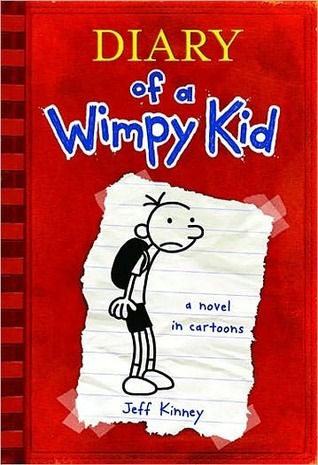
It's a new school year, and Greg Heffley finds himself in middle school, where undersized kids share the hallways with those who are taller, meaner, and already shaving. The hazards of growing up are uniquely revealed through Greg's own words and drawings as he records them in his diary. But don't expect "Dear Diary" this and "Dear Diary" that. This is a journal, and Greg is only writing in it because he knows one day he will be rich and famous, and then he'll have better things to do than answer people's stupid questions.
Greg is happy to have his best friend, Rowley, along for the ride, but when Rowley's star starts to rise, he tries to use his friend's new popularity to his own advantage. This kicks off a chain of events that will test their friendship in hilarious fashion. Through a series of schemes to achieve the recognition he feels he deserves - from creating a haunted house to navigating the dreaded "Cheese Touch" - Greg's attempts at popularity often end in comical disaster. This novel in cartoons documents the unforgettable experience of one boy's attempt to survive the awkward, treacherous, and often ridiculous world of middle school.
First of all, let me get something straight: This is a JOURNAL, not a diary. It was Mom's idea, and if she thinks I'm going to write down my “feelings” in here, she's crazy. The only reason I agreed is because when I'm rich and famous, I won't have time to answer people's stupid questions. For now, though, I'm stuck in middle school with a bunch of morons. It's the dumbest idea ever invented, mixing kids like me who haven't hit their growth spurt with gorillas who need to shave twice a day. The best I can figure is that I'm somewhere around the 52nd or 53rd most popular this year. My best friend, Rowley, is probably hovering around the 150 mark, but I don't think he even cares.
Life at Westmore Middle School is a minefield. On the basketball court, there's a moldy, ancient piece of cheese that's been there since last spring. If you touch it, you get the Cheese Touch, which is basically like the Cooties, and you're a social outcast until you can pass it on to someone else. At home, things aren't much better. My older brother, Rodrick, is in a heavy metal band called Löded Diper and spends most of his time thinking up ways to make my life miserable. My little brother, Manny, is treated like a prince and never gets in trouble for anything, even when he draws on my bedroom door in permanent marker. And Dad is always on my case about going outside to do something “active,” which usually means I have to sneak over to Rowley's to play video games.
I've been trying to teach Rowley the rules of middle school, but it's a losing battle. He still says things like, “Wanna come over and play?” I've told him a billion times that we're supposed to say “hang out,” but it just goes in one ear and out the other. Having him around isn't exactly helping my image, but I decided to take him under my wing anyway. Mostly because it's fun to use all the tricks Rodrick pulls on me, on him. “Did you know,” I'll ask him, “that if your hand is bigger than your face, it's a sign of low intelligence?” He falls for it every time.
My schemes to climb the popularity ladder never seem to work out. When I tried to create the ultimate haunted house in Rowley's basement to make some cash, we only managed to scare one little kid so badly he hid under the bed, and then Rowley's dad shut the whole thing down. For Halloween, my plan to hit 152 houses was ruined when Mom made us take Manny along, and then Dad came with us to make sure we stayed in the neighborhood. We ended up getting chased by a truck full of teenagers, and just when we thought we were safe, Dad, hiding in the bushes with a trash can full of water, drenched us and all our candy.
Things really went downhill when Mom made me audition for the school play, *The Wizard of Oz*. I figured I could get the part of a Tree, since they get to throw apples at Dorothy, who was being played by my arch-nemesis, Patty Farrell. But the costumes didn't have armholes, and to make matters worse, the director decided us Trees had to sing a song called “We Three Trees.” During the performance, I saw Rodrick in the audience with a video camera, ready to record my humiliation for all time. I refused to sing, which confused the other Trees, and soon we were all just standing there in silence. In a moment of inspiration, I remembered why I'd wanted the part in the first place. I started pegging Dorothy with apples, and soon, the whole stage erupted into chaos. The play was shut down, but at least I didn't have to sing.
My friendship with Rowley started to crack after I got us both signed up for Safety Patrol. I was chasing some kindergartners with a worm on a stick and a neighbor lady saw me, but she thought I was Rowley because I was wearing his coat. Rowley got suspended from Patrols, and I let him take the fall so I wouldn't lose my free hot chocolate privileges. He eventually ratted me out, and not only did he get his spot back, he got a promotion. To make things worse, he started submitting the “Zoo-Wee Mama” comic we created together to the school paper, and he got all the credit.
The whole thing blew up on the blacktop after school. A crowd gathered, thinking we were going to fight, but before anyone could throw a punch, that same truckload of teenagers from Halloween pulled up. They grabbed Rowley and dragged him over to the dreaded Cheese. I won't say exactly what they made him do, but let's just say he ate it. When they came for me, I did some fast talking. “I would,” I said, “but I'm allergic to dairy!” And they actually bought it.
The next day at school, everyone was gathered around the empty spot on the blacktop, wondering where the Cheese had gone. People were panicking, and I could see Rowley was about to break. He'd have to move to another country if people found out. That's when I stepped up. I told everyone I was sick of looking at that disgusting cheese, so I got rid of it myself. For a second, there was silence. I thought they might cheer, but then I realized what I'd just done. If I got rid of the Cheese, that meant I had the Cheese Touch.
Having the Cheese Touch hasn't been so bad, though. Nobody will sit near me at lunch, and I didn't have to do the square-dancing unit in Phys Ed. Rowley and I are hanging out again, so I guess things are back to normal. In the yearbook, he was voted “Class Clown,” which stings a little. But that's fine. He can have the fame. Because if he ever gets too big for his britches, I'll be there to remind him of a certain moldy piece of cheese.
What other readers say
Liked
Many readers praise the book for its humor, finding it genuinely funny and capable of eliciting laughter from both children and adults. The unique format, featuring a diary-style narrative with handwritten-mimicking text and abundant cartoon illustrations, is frequently highlighted as innovative and engaging, making it a quick and enjoyable read. Reviewers note that the main character's authentic voice resonates with readers, particularly pre-teens and middle schoolers, who find his experiences and personality relatable, even if he embodies the awkward, selfish, or sometimes ruthless aspects of that age. The book is especially recommended for reluctant readers, as its accessible language, simple sentences, and visual elements make it an enticing entry point into reading. Some even consider it a modern classic for its portrayal of contemporary middle school life.
Disliked
Despite its popularity, several reviewers express strong negative opinions, primarily centered on the main character. Many describe him as a mean, unlikeable, self-absorbed, or even sociopathic individual who consistently blames others, lacks empathy, and shows no personal growth or learning throughout the story. This portrayal raises concerns among some adults who feel the book promotes negative behaviors and offers a poor role model for its target audience, suggesting it sends the wrong messages to young readers. Additionally, a few parents initially mistook the book for being suitable for younger children (e.g., 6-year-olds) due to its visual style and easy vocabulary, only to find the content and character's actions inappropriate for that age group. These critics often express disappointment that the character's actions are rarely met with consequences or opportunities for redemption.
In short
In conclusion, the book appears to be a polarizing read that sparks strong reactions. While some adults find its humor and unique presentation delightful and cathartic, allowing them to reconnect with their own inner child, others are deeply troubled by the protagonist's lack of redeeming qualities and the absence of moral lessons. The consensus indicates that the book is primarily intended for middle school-aged readers, roughly ages nine and up, particularly those who enjoy lighthearted, observational humor and a highly visual narrative style. It is likely to appeal to readers who appreciate entertainment for its own sake and do not necessarily seek profound wisdom, complex character development, or morally exemplary protagonists in their recreational reading.