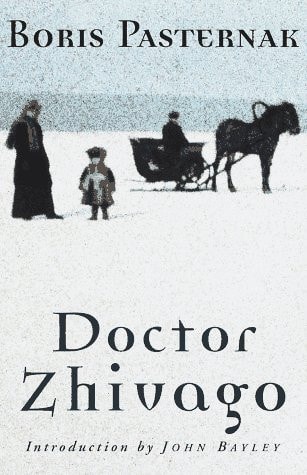
Set against the tumultuous backdrop of early 20th-century Russia, from the 1905 Revolution through World War I and the subsequent Civil War, Doctor Zhivago chronicles the life of Yuri Zhivago, a physician and poet whose personal journey intertwines with the epic sweep of historical upheaval. As his country undergoes profound change, Zhivago navigates a world of shifting loyalties and immense suffering, seeking to maintain his humanity and artistic spirit.
His story explores the tension between individual desires and the demands of society, highlighting the profound impact of revolution on personal lives and the search for meaning amidst chaos. Through Zhivago's loves and losses, the novel offers a lyrical and deeply human testament to the enduring power of the human spirit and the unpredictable nature of fate.
The world shifts and churns, a kaleidoscope of snow and fire, as young Yuri Zhivago, an orphan first losing his mother and then his estranged, dissolute father, finds his footing in the care of the kind Gromeko family. He grows into a physician with a poet's soul, observing the world with a keen, sensitive eye, his verse an intimate reflection of the tumultuous times. His path intertwines early with that of Larissa Fyodorovna, or Lara, a girl whose fiery spirit and tragic circumstances leave an indelible mark. Their initial encounters are fleeting, shadowed by the manipulative lawyer Komarovsky, whose dark influence touches Lara's youth and her mother's despair. Meanwhile, Yuri marries Tonya, the Gromekos' daughter, a loyal and steadfast woman who offers him a comforting sense of home and tradition.
The quietude of their lives, however, is a fragile thing, soon shattered by the thunder of the First World War. Yuri is conscripted as a military doctor, plunged into the brutal realities of the front lines. It is amidst the chaos and suffering that his destiny again converges with Lara's, now a nurse searching for her husband, Pasha Antipov, who has vanished into the maelstrom of war. Their shared experiences in the field, tending to the wounded and witnessing the profound human cost of conflict, forge a deep, undeniable connection between them, a bond of understanding and unspoken passion that transcends their existing commitments.
As the war bleeds into the Russian Revolution, the very fabric of society unravels. Moscow, once familiar, becomes a city of scarcity and fear, its intellectual life stifled by the burgeoning fervor of political change. Yuri, with Tonya and their children, flees to the rural quiet of Varykino, an abandoned estate in the Ural Mountains, hoping to escape the escalating civil war. Yet, even in this isolated haven, the revolution's tendrils reach them. It is here that Yuri unexpectedly reunites with Lara in the nearby town of Yuriatin, and their rekindled connection blossoms into a profound, if illicit, love.
Their fragile idyll is brutally interrupted when Yuri is abducted by Red partisans, forced to serve as their doctor for nearly two years. He witnesses atrocities, endures hardship, and grapples with the ideological zeal that consumes the land. Throughout his captivity, his thoughts are a constant pendulum, swinging between his longing for Lara and his duty to Tonya and their family. Upon his eventual escape, he makes his way back to Yuriatin, drawn by an irresistible force to Lara, rather than returning to his waiting wife.
Their reunion in Yuriatin is brief and poignant, a fleeting moment of solace amidst the unrelenting turmoil. Pasha Antipov, Lara's husband, has by this time transformed into the fearsome Red Army commander, Strelnikov, a ruthless figure embodying the revolution's unforgiving spirit. When Komarovsky reappears, offering Lara an escape to the Far East, a desperate choice is presented. Lara, for the sake of her daughter and her own safety, departs with him, a heartbreaking separation from Yuri.
Abandoned and adrift, Yuri returns to Moscow, a city irrevocably changed, where he struggles to find his place in the new Soviet order. His health declines, his spirit weighted by loss and disillusionment. He takes up with Marina, a simple woman, and they have children, but the shadows of his past, and particularly the memory of Lara, never truly leave him. He eventually leaves this family too, a ghost wandering the streets of Moscow, until, one day, he collapses on a tram and dies of a heart attack, his life extinguished by the relentless march of history and personal grief.
Years later, in the aftermath of another great war, Yuri's old friends, Dudorov and Gordon, encounter a young laundress named Tanya. Her story, a tale of abandonment and hardship, slowly reveals a striking resemblance to Yuri and Lara. It is through her that the lingering threads of their intertwined lives are finally, tragically, brought together, as she is revealed to be the daughter of Yuri and Lara, raised as an orphan after her mother's disappearance. The two friends, reflecting on Yuri's life and the enduring power of his poetry, find a quiet hope for Russia's future, a testament to the resilience of the human spirit even after profound devastation.
What other readers say
Liked
Many reviewers hail "Doctor Zhivago" as a literary masterpiece, praising its lyrical and dreamlike prose, which is often described as poetic and eloquent. Readers are captivated by Pasternak's stunning descriptions of the Russian landscape, particularly the winter scenes, which are vivid, atmospheric, and memorable. The novel is noted for its abundance of ideas, philosophical discussions, and insightful reflections on life, art, and human existence during a tumultuous period. It is considered an epic and deeply personal story that beautifully intertwines individual fates with the sweeping historical changes of Russia. The character of Lara is frequently highlighted as a strong and multi-faceted figure, and the book's ability to evoke profound emotions and offer a unique examination of universal themes is a recurring positive.
Disliked
Despite its strengths, several reviewers point out significant drawbacks. A common critique is the novel's sprawling structure and pacing, with some finding it too long, disjointed, or slow, particularly for readers accustomed to plot-driven narratives. The large cast of characters, coupled with the use of multiple names and patronymics for each, often leads to confusion. While some praise the philosophical depth, others feel the dialogue frequently devolves into lengthy, passionate speeches rather than natural conversation, which can hinder the narrative flow and make characters feel like mouthpieces for the author's ideas. The central love story, often highlighted in adaptations, is described by some as unconvincing, with the main character, Yuri, seen as flawed, ineffectual, or even having commitment issues. Additionally, the frequent and improbable coincidences in the plot are noted as straining credulity, and Pasternak's portrayal of women is sometimes criticized as idealized or patronizing.
In short
Ultimately, "Doctor Zhivago" is widely regarded as a monumental and significant work, with many considering it a timeless Russian masterpiece that demands attention. While some readers found it challenging and even occasionally frustrating, its profound philosophical insights, poetic writing, and ambitious scope resonated deeply with many. It is recommended for those who appreciate epic historical fiction, especially tales set against the backdrop of significant social and political upheaval, and for readers who value lyrical prose and deep introspection over fast-paced plot. While not every reader will find it an unmitigated favorite, its unique blend of personal drama and historical commentary, along with its exploration of themes like art, freedom, and the human spirit, makes it a powerful and memorable reading experience for those willing to engage with its complexities.