
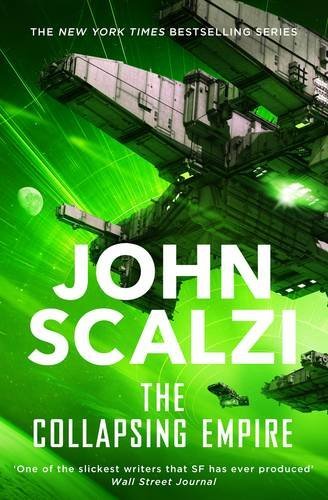
El fin del imperio
by John Scalzi
- Language
- Spanish
- Published
- 2018
- Publisher
- Minotauro
- Pages
- 323
- ISBN
- 9788445005620
Humanity's sprawling interstellar empire, the Interdependency, faces an unprecedented crisis: the very pathways that connect its star systems are collapsing. For a thousand years, the Flow, an extra-dimensional network, has allowed faster-than-light travel, creating a civilization where every world is interdependent, none capable of surviving alone.
Now, this vital network is shifting, threatening to sever worlds from each other and plunge humanity into isolation and certain doom. Thrust into leadership, the inexperienced Emperox Grayland II must contend with this impending catastrophe while navigating ruthless political machinations from powerful mercantile houses vying for control. A brilliant scientist races to confirm the dire predictions, and a pragmatic starship captain finds herself entangled in the desperate struggle for survival. As the foundations of their civilization crumble, these disparate figures must confront betrayal, power struggles, and the grim reality that the future of all humankind rests on their ability to act before the last connection is severed forever.
Now, this vital network is shifting, threatening to sever worlds from each other and plunge humanity into isolation and certain doom. Thrust into leadership, the inexperienced Emperox Grayland II must contend with this impending catastrophe while navigating ruthless political machinations from powerful mercantile houses vying for control. A brilliant scientist races to confirm the dire predictions, and a pragmatic starship captain finds herself entangled in the desperate struggle for survival. As the foundations of their civilization crumble, these disparate figures must confront betrayal, power struggles, and the grim reality that the future of all humankind rests on their ability to act before the last connection is severed forever.
Original edition
The Collapsing EmpireOriginally published in 2017 English Tor Books
Other editions (30)



Listen to the summary Narrated summary
The vast, glittering expanse of the Interdependency, a human empire spanning forty-eight star systems, owed its very existence to the Flow. This intricate, extra-dimensional network of streams allowed for faster-than-light travel, knitting together worlds that would otherwise be isolated, each utterly dependent on the others for survival and resources. It was a divinely sanctioned system, a thousand years in the making, ruled by the Emperox and upheld by powerful, monopolistic trading houses who grew immensely wealthy by controlling the shoals, the entry and exit points of the Flow.
But the Flow, a natural phenomenon poorly understood even by the most brilliant minds, was beginning to shift. On the distant rim world of End, a physicist named Count Claremont had spent decades studying its unpredictable currents. His calculations painted a dire picture: the Flow was not merely changing course, but collapsing, threatening to sever the links between star systems and plunge the entire Interdependency into an unimaginable dark age. Knowing the empire's survival hinged on this perilous truth, he dispatched his son, Marce, also a physicist, to the galactic capital, the Hub, to warn the Emperox.
However, fate had intervened. Emperox Attavio VI, Marce's old friend, was on his deathbed, his final moments spent with his daughter, Cardenia Wu-Patrick. Cardenia, a woman who never sought the throne, found herself unexpectedly thrust into the mantle of Emperox Grayland II, burdened with a crown she never desired and a future she hadn't prepared for. Her father, in a dream-like state, imparted the chilling reality of the Flow's imminent collapse, a secret that would shake the very foundations of her inherited empire.
As Cardenia grappled with her new, unwanted responsibilities, the political machinations of the great trading houses began to churn. Among them, the ruthless Nohamapetans, led by the ambitious Nadashe, saw not disaster but opportunity. They believed the Flow would merely reshape, placing End at the center of a new network, and they conspired to seize power, even if it meant destabilizing the entire empire. They covertly supported rebels on End, orchestrated terrorist bombings on the Hub, and framed Count Claremont for murder, all to further their agenda.
Meanwhile, Marce Claremont arrived at the Hub, carrying his father's grim tidings, only to find a new Emperox on the throne and a court rife with skepticism and denial. Few were willing to believe that their divinely structured, comfortable existence was on the brink of absolute ruin. Amidst this, the sharp-tongued, shrewd merchant Kiva Lagos, a scion of the House of Lagos, found herself entangled in the burgeoning chaos. She was a woman who could turn any difficult situation into a profitable one, even amidst the looming collapse, and her cynical pragmatism often cut through the bureaucratic inertia.
The Emperox Cardenia, Marce, and Kiva, an unlikely alliance forged by circumstance, began to unravel the threads of the Nohamapetan conspiracy and the horrifying truth of the Flow's terminal instability. Cardenia, despite her initial reluctance, found a burgeoning strength and resolve, understanding the immense weight of her duty to humanity. She faced down political opponents and the deeply ingrained disbelief of her own court, struggling to convince them of the impending doom.
As Marce's ship became the last to leave End before its Flow entrance shoal closed, the full horror of the situation began to dawn. The Interdependency, an empire built on interconnectedness, was slowly, irrevocably fragmenting, each system facing isolation and potential extinction. The Nohamapetans, exposed but still powerful, launched a brutal attack on End, attempting to silence Marce and destroy the evidence of their treachery. The story concludes with the empire teetering on the precipice, its future uncertain, with Cardenia and Marce desperately trying to warn every system of the need to evacuate to End, while the powerful trading houses, accustomed to luxury, clung to denial and their own desperate bids for power.
What readers say
4.13
62K ratings across the web 8 in 10 readers loved it
Readers widely praise The Collapsing Empire as a delightful, accessible, and fast-paced space opera that marks a strong return to the genre for the author. The novel is celebrated for its engaging and witty writing style, full of snarky banter and sharp dialogue that keeps the story moving at a breakneck speed. Many reviewers highlight the imaginative world-building, particularly the unique concept of "the Flow" which facilitates interstellar travel and underpins the intricate political and mercantile system known as the Interdependency. The book features a memorable cast of characters, with a particular emphasis on strong, well-developed, and often foul-mouthed women who drive much of the political intrigue and action. It offers a compelling blend of old-fashioned sci-fi fun with modern sensibilities, tackling themes of political machinations, resource scarcity, and societal interdependence through allegory without being preachy. The narrative is often described as addictive, keeping readers glued to the page with its twists and turns.
Despite the widespread enjoyment, some readers found aspects of The Collapsing Empire to be less satisfying. A frequent criticism is that the book functions heavily as a setup for a larger series, resulting in a prolonged introduction and significant "info-dumping" to establish the world. This sometimes led to a slower pace in the middle sections, with extended dialogue that, while often witty, could feel excessive to some. Several reviewers expressed frustration with the abrupt ending, which serves as a cliffhanger rather than offering a satisfying resolution for the individual novel, leaving some feeling "cheated" or that the book was incomplete. While many praised the characters, a few found them to lack emotional depth or felt that certain characterizations, particularly the heavy use of profanity by some, were overdone or unappealing. One reviewer also noted a "lazy" exposition scene where world mechanics are explained to children. Some also felt the plot strands were thin or characters formulaic, struggling to recall details after finishing.
Overall, The Collapsing Empire is largely considered a strong and entertaining entry into space opera, effectively setting the stage for a promising series. While some readers desired a more conclusive ending for this installment, many were thoroughly engaged and eager to continue with the sequels, finding the book succeeded in hooking them into the new universe and its characters. It is highly recommended for existing fans of the author's previous works, especially those who enjoy his signature wit, fast-paced storytelling, and political intrigue. Newcomers to science fiction or space opera will also find it an accessible and enjoyable starting point, particularly if they appreciate character-driven narratives with a modern, snarky tone and a focus on grand dilemmas and complex societal structures.
No reviews yet. Be the first.