Add to library
You don't have any lists yet. Create one in My Library.
Go to My LibraryAdd to library
You don't have any lists yet. Create one in My Library.
Go to My LibraryEnder's Shadow
- Language
- English
- Published in
- Publisher
- Perfection Learning Corporation
- Pages
- 469
- ISBN
- 9780756901530
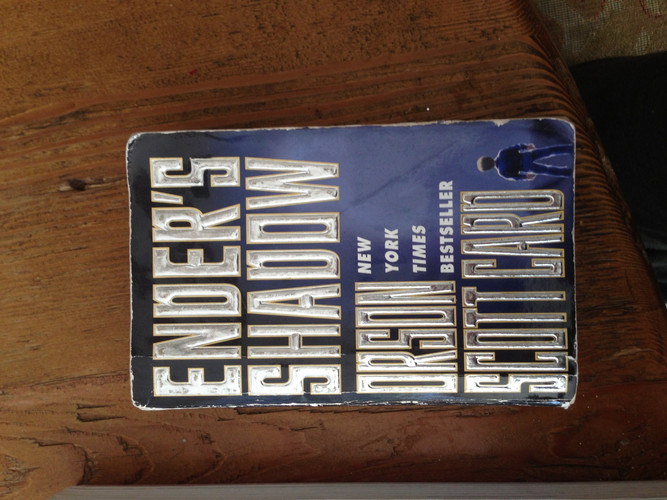
This is the story of the war with the alien Buggers told from the shadows. It is a narrative of a boy who was never meant to be a hero, who sees the grand strategy from a unique and critical perspective. While one legend is being forged in the spotlight, another is being tempered in the darkness, analyzing, calculating, and becoming the secret weapon humanity never knew it needed. The book explores the same events as the original classic but through a new pair of eyes, revealing that behind the celebrated hero was another, working to ensure victory at any cost.
Subjects
Original edition details
Other editions (23)
Other editions

Ender's Shadow
2000 • Tor Publishing Group
English
Ender's Shadow
2002 • Macmillan
English

Ender's Shadow
2013 • Tom Doherty Associates
English

Ender's Shadow
2002 • Macmillan
English

Ender's Shadow
2000 • Tom Doherty Associates
English

Ender's Shadow (The Shadow Series)
2005 • Macmillan Audio
English
Ender's Shadow
2013 • TOR
English

Shadow of the Giant
1999 • Tom Doherty Associates, LLC
English

Ender's Shadow
2000 • Orbit
English

Ender's Shadow
2001 • Dove Booksellers
English

Ender's Shadow
2012 • Macmillan Audio
English

Shadow of the Giant
2002 • Turtleback
English

Ender's Shadow
1999 • Orbit
English

Ender's Shadow
2005 • Audio Renaissance
English

Ender's Shadow Book 1 of The Shadow Saga
2011 • Little, Brown Book Group
English

Ender's Shadow
2002 • Audio Literature
English

SOMBRA DE ENDER, LA: Nº 4 (ENDER)
2000 • EDB FICCION
Spanish

La sombra de ender / Ender's Shadow (Spanish Edition)
2014 • B de Bolsillo
Spanish

La Sombra de Ender
2012 • B de Bolsillo (Ediciones B)
Spanish

La stratégie de l'ombre
2001 • ATALANTE
French

La Sombra de Ender
2005 • EdicionesB, S.A.
Spanish

La sombra de Ender (Saga de la Sombra de Ender 1)
2020 • B de Bolsillo (Ediciones B)
Spanish

Ender's Shadow
2013 • Tor
English
He chose his instrument: a girl named Poke, the reluctant leader of a small, failing crew. She was kind, which made her vulnerable, but also willing to listen to a four-year-old who spoke with the chilling logic of a general. The plan was simple and audacious: stop paying tribute to every bully who demanded it. Instead, they would buy one. They would find a strong, fearsome boy, defeat him in a show of overwhelming force, and then offer him leadership in exchange for his protection. “You give the food to one bully,” the small boy explained, “and he keeps the other bullies away from you.”
They chose Achilles, a boy whose cunning was as sharp as his malice, his physical power compromised only by a malformed leg. The ambush was a success, a flurry of small bodies and bricks in a dark alley. But when Poke stood over him, ready to deliver the final blow, the small boy saw the unquenchable fire of vengeance in Achilles's eyes. “Kill him,” he whispered to Poke. But she couldn't. Instead, Achilles, with a voice of silken poison, transformed them. He did not become their enforcer; he became their “papa,” and they his “family.” He gave them raisins and pride, and they gave him their absolute loyalty. The boy who was now called Bean watched, knowing he had created a monster, and that one day, that monster would come for him.
Under Achilles's leadership, the family thrived. They seized control of the best soup kitchen line in the city, and Bean, ever the strategist, whispered a new idea that spread through the streets like a virus: every bully could become a “papa” with his own family, turning the chaotic violence into a fragile, ordered society. This sudden flowering of civilization in the gutter attracted the attention of a quiet observer, a nun named Sister Carlotta. She was a recruiter, searching for the brilliant minds the International Fleet needed to command its armies against a terrible alien foe. She saw Achilles, the charismatic leader, but it was the tiny, silent boy in his shadow, the one who accidentally revealed he could read, who truly held the spark she sought. Her interest became Bean's only hope when Achilles, tying up loose ends, murdered Poke and left her body floating in the canal. Bean knew he was next. The only escape was up, into the cold, clean emptiness of space.
He arrived at Battle School a pariah before he even stepped off the shuttle. An officer singled him out, announcing to all the other new recruits that this tiny, impossibly young boy had scored higher than any of them on every test. He was marked, isolated, a target. So he did what he had always done: he became a ghost. He learned the secret ways of the station, the hidden paths through ventilation shafts, a network of tunnels only he was small enough to navigate. He created a second, secret identity on the school's computer network. And he began his true work: the study of another boy, the one all the teachers whispered about, the one who was winning all the games - Ender Wiggin. Bean devoted himself to understanding Ender's genius, shadowing his every move, deconstructing his every victory, determined to learn what made this boy the one destined to save the world.
When the teachers decided to forge Ender into their ultimate weapon, they gave him a new command, Dragon Army, an army of rejects and untried recruits. But the roster was not theirs; it was Bean's. Tasked with creating a hypothetical army, Bean had secretly built the perfect tool for Ender, stacking it with overlooked, underestimated, and brilliant soldiers - including himself. Ender, not knowing this, treated Bean with the same harsh discipline as everyone else. But Bean pushed back, demanding a command of his own, proving his tactical genius in practice sessions. He became Ender's secret weapon, his strategist, inventing new tactics like the thin, nearly invisible wire that could change a soldier's trajectory in zero gravity, turning the physics of the battle room into a weapon.
The games became relentless, the rules constantly changing, the pressure designed to break a commander. Bean saw the teachers' design clearly: they were isolating Ender, pushing him past his limits. The danger escalated beyond the game when a rival commander, Bonzo Madrid, cornered Ender in the showers. Bean, anticipating the attack, tried to orchestrate a defense, but it was too late. Ender fought for his life and won, leaving Bonzo's broken body on the wet floor. The game was over. Ender was graduated, sent away. For a brief time, Bean was given his own army, a chance to lead. But he knew his destiny was not to replace Ender, but to follow him.
Reunited at Command School on a hollowed-out asteroid, Bean and the small cadre of Ender's most trusted soldiers became his command staff. As they trained in advanced simulations, Bean's analytical mind detected an impossibility: there was no time lag in communications, no matter the simulated distance. He pieced together the terrifying truth. These were not simulations. They were real battles, fought by a real fleet light-years away. The children were commanding living men and women, sending them to their deaths without ever knowing the weight of their commands. The teachers were protecting them from the horror of the truth, so they could fight without the burden of compassion. But Bean knew.
In the final battle, they faced an impossible enemy: an entire planet, swarming with a fleet so vast it seemed infinite. Ender, exhausted and broken by the relentless pressure and the secret grief he couldn't name, froze. He saw no path to victory. But Bean, his shadow, his secret sharer in the terrible truth, saw the one, desperate, suicidal move that remained. He whispered a phrase from their first days in Dragon Army, a simple rule of the game that had become a key to the universe: “The enemy's gate is down.” Spurred by the words, Ender sacrificed his entire fleet in a final, cataclysmic strike against the enemy planet, obliterating it and ending the war forever.
In the aftermath, as political wars erupted back on Earth and the children of Battle School were hailed as saviors, Sister Carlotta's quiet search finally bore fruit. Bean was not a nameless child of the streets. He was Julian Delphiki, the genetically altered twin of another boy in the school, Nikolai. His genes, tweaked for genius, also carried a terrible price: his body's accelerated growth meant he would not live to be an old man. But he would not face that future alone. After a lifetime of isolation, of being the shadow, the observer, the secret, he was taken to a home on a sun-drenched hill in Crete. There, waiting for him, were the parents he never knew, and the brother who stepped forward with a smile, his own face reflected in the boy's. “Welcome home, little brother,” said Nikolai. And for the first time, Bean was not a shadow, but a son.
No discussions yet for this book.
Delete Discussion
Are you sure you want to delete this discussion? This action cannot be undone.
Rating Sources
Ender's Shadow is widely praised for offering a compelling and fresh parallel narrative to the acclaimed original, presenting events from the perspective of a different central character. Many reviewers found this character's detailed backstory, exceptional intelligence, and analytical mind to be deeply fascinating and often more relatable than the original protagonist. The book is lauded for its master storytelling and strong characterization, which expands the universe with greater socio-political and economic depth. Readers frequently highlight how it complements the original story, enriching the overall experience and providing new layers of understanding without simply rehashing familiar events. The audiobook version also receives specific commendation for its high-quality, full-cast production.
However, the book also garners criticism, particularly regarding its pacing, with some readers finding the protagonist's extensive internal monologues and over-analysis to be repetitive and slow. A notable point of contention is the portrayal of the main character as an almost impossibly brilliant figure, which some felt leaned into "wish-fulfillment" territory and strained believability. Critics also suggest that the narrative can, for some, negatively impact the perception of the original story by recontextualizing events in a way that diminishes the role or characterization of the original protagonist. Additionally, some reviewers noted inconsistencies in character interactions and found certain thematic discussions or adult-focused subplots to be didactic or less engaging.
Despite these divided opinions, Ender's Shadow is generally considered a significant and worthwhile addition to its literary universe. It is highly recommended for fans of the original who are eager to explore its world from a fresh angle and delve into the intricate psychology of its supporting characters. Readers who appreciate deep character studies, expanded world-building, and a more mature narrative style will likely find this book a rewarding experience, especially when approached with an open mind to re-examining familiar events.
No reviews yet. Be the first to review this book!
Delete Review
Are you sure you want to delete this review? This action cannot be undone.