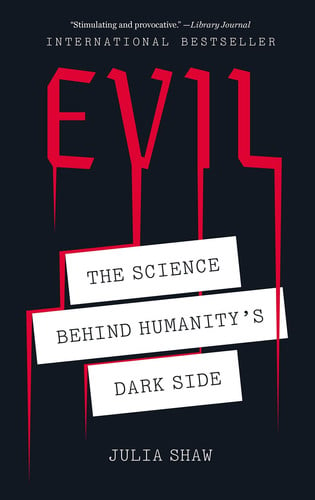
Evil
by Julia Shaw
7.16 / 10 3.9K ratings
- Language
- English
- Published
- 2020
- Publisher
- Harry N. Abrams
- Pages
- 320
- ISBN
- 9781419735196
What makes a person commit acts deemed evil? Dr. Julia Shaw, a criminal psychologist, delves into the scientific underpinnings of humanity's dark side, moving beyond simplistic labels of good and bad. This exploration investigates the psychological, sociological, and neuroscientific factors that contribute to behaviors often categorized as evil.
Shaw examines how our brains, societal structures, and individual circumstances can lead to actions ranging from everyday transgressions to more severe deeds. Through a blend of academic research, popular culture references, and real-world examples, the book challenges readers to consider the subjective nature of evil and rethink their understanding of human morality. It offers a perspective on why people do bad things, prompting a deeper look into the complexities of human behavior.
Shaw examines how our brains, societal structures, and individual circumstances can lead to actions ranging from everyday transgressions to more severe deeds. Through a blend of academic research, popular culture references, and real-world examples, the book challenges readers to consider the subjective nature of evil and rethink their understanding of human morality. It offers a perspective on why people do bad things, prompting a deeper look into the complexities of human behavior.
Subjects
- Health, Fitness & Dieting
- Biographies & Memoirs
- Medical Books
- Psychology
- Mental Health
- Politics & Social Sciences
- Social Sciences
- Psychology & Counseling
- Sociology
- Science
- True Crime
- Social Science
- Murder & Mayhem
- Life Sciences
- Criminology
- Social Psychology
- Personality
- Social Psychology & Interactions
- Neuroscience
- Personality Disorders
- Human Sexuality
Original edition
EvilOriginally published in 2019 English Brilliance Audio
Other editions (3)
Listen to the summary Narrated summary
The very notion of "evil" often conjures images of monstrous acts and aberrant individuals, yet the truth, when examined through the lens of science, reveals a far more complex and unsettling reality. We are drawn to these dark narratives, from serial killers to pop culture violence, compelled to understand what drives such acts. But what if "evil" is not an inherent, immutable force, but rather a relative construct, deeply rooted in our unique cultures and perceptions? What one society deems abhorrent, another might consider normal, suggesting that the concept itself is fluid and subjective.
Delving beyond philosophical or religious interpretations, an exploration of human behavior uncovers the scientific underpinnings of our capacity for darkness. It's not about morality or punishment, but about the "why" - what within our makeup allows for violent or malevolent choices. The broad concept of "evil" can be dissected into smaller, observable pieces, using neuroscience and psychology to illuminate the behaviors that seem to be present in those capable of committing acts we label as evil.
Consider the psychology of bloodlust or the neuroscience of malevolent intent; these are not features exclusive to a select few. We all possess, to varying degrees, the potential for dark behaviors, and it often boils down to a matter of moral luck and impulse control that prevents most from acting on these impulses. The idea that we are all somewhere on the spectrum of dark behaviors challenges the comfortable distinction between "us" and "them," suggesting that given the right circumstances, many might find themselves capable of acts they once considered unthinkable.
This perspective urges us to reconsider the labels we so readily apply. To brand someone a "murderer" or "rapist" with a villainous noun, or to use terms like "psychopath" or "pedophile" as disapprobation, can strip away empathy. Such linguistic habits convince us that certain individuals are beyond understanding or compassion. Yet, an absence of empathy, for instance, might be neurologically determined at birth, prompting questions about culpability and the inherent freedom to choose differently.
Through a myriad of case studies, academic research, and examples from popular culture, the intricate tapestry of human misconduct is unraveled. From the insidious dynamics of workplace misbehavior to the complex motivations behind murder, the threads of our darkest impulses are traced. Even the seemingly innocuous desire to harm tiny, fluffy animals, a peculiar aggression many have felt but never understood, is explored as a potential self-defense mechanism of the brain against an overload of cuteness.
Ultimately, the journey into humanity's dark side is an invitation to confront uncomfortable truths about ourselves and society. It challenges the simplistic categorization of good and bad, pushing us to examine the nuances of moral responsibility. By understanding the psychological and neurobiological frameworks that underpin our actions, rather than solely attributing malevolence to individual "evil," a deeper, more empathetic, and ultimately more effective approach to preventing harm and fostering a more ethical world can emerge.
Delving beyond philosophical or religious interpretations, an exploration of human behavior uncovers the scientific underpinnings of our capacity for darkness. It's not about morality or punishment, but about the "why" - what within our makeup allows for violent or malevolent choices. The broad concept of "evil" can be dissected into smaller, observable pieces, using neuroscience and psychology to illuminate the behaviors that seem to be present in those capable of committing acts we label as evil.
Consider the psychology of bloodlust or the neuroscience of malevolent intent; these are not features exclusive to a select few. We all possess, to varying degrees, the potential for dark behaviors, and it often boils down to a matter of moral luck and impulse control that prevents most from acting on these impulses. The idea that we are all somewhere on the spectrum of dark behaviors challenges the comfortable distinction between "us" and "them," suggesting that given the right circumstances, many might find themselves capable of acts they once considered unthinkable.
This perspective urges us to reconsider the labels we so readily apply. To brand someone a "murderer" or "rapist" with a villainous noun, or to use terms like "psychopath" or "pedophile" as disapprobation, can strip away empathy. Such linguistic habits convince us that certain individuals are beyond understanding or compassion. Yet, an absence of empathy, for instance, might be neurologically determined at birth, prompting questions about culpability and the inherent freedom to choose differently.
Through a myriad of case studies, academic research, and examples from popular culture, the intricate tapestry of human misconduct is unraveled. From the insidious dynamics of workplace misbehavior to the complex motivations behind murder, the threads of our darkest impulses are traced. Even the seemingly innocuous desire to harm tiny, fluffy animals, a peculiar aggression many have felt but never understood, is explored as a potential self-defense mechanism of the brain against an overload of cuteness.
Ultimately, the journey into humanity's dark side is an invitation to confront uncomfortable truths about ourselves and society. It challenges the simplistic categorization of good and bad, pushing us to examine the nuances of moral responsibility. By understanding the psychological and neurobiological frameworks that underpin our actions, rather than solely attributing malevolence to individual "evil," a deeper, more empathetic, and ultimately more effective approach to preventing harm and fostering a more ethical world can emerge.
What other readers say
Liked
Julia Shaw's book offers a highly thought-provoking exploration of the concept of evil, challenging readers to re-evaluate their understanding of harmful human behavior. Many reviewers appreciated the book's ambition to delve into a complex and often uncomfortable subject, leading to valuable discussions and self-reflection. It is praised for encouraging a nuanced, bio-psycho-social perspective on actions typically labeled as evil, advocating for empathy and understanding rather than simply condemning perpetrators as monsters. The book's premise, which questions the utility of the "evil" label and highlights the subjective nature of morality, resonated with some readers who found it to be a courageous and progressive undertaking.
Disliked
However, the book also drew significant criticism for several perceived shortcomings. A recurring complaint is that it often falls short of its "science behind humanity's dark side" subtitle, relying more on the author's personal opinions, anecdotes, and a preachy, at times condescending, tone. Reviewers frequently felt the arguments lacked depth and rigorous scientific backing, with some studies mentioned (like the Stanford Prison Experiment) being outdated or disputed without sufficient critical analysis. The broad scope of topics covered, from technology to various forms of deviance, was seen by many as leading to superficiality rather than in-depth exploration. Furthermore, the author's stance on certain sensitive subjects, such as pedophilia and bestiality, proved highly controversial and off-putting to a substantial portion of the readership.
In short
In conclusion, this book is best suited for readers who are open to challenging their established notions of good and evil and are prepared to engage with a provocative and often uncomfortable perspective on human behavior. Those seeking a deep, science-heavy academic text or clear-cut answers on the origins of malevolence may find it disappointing. It is likely to appeal more to individuals interested in sparking ethical debates and exploring the subjective dimensions of morality, rather than those expecting a purely scientific analysis of humanity's darker impulses.
No reviews yet. Be the first.