
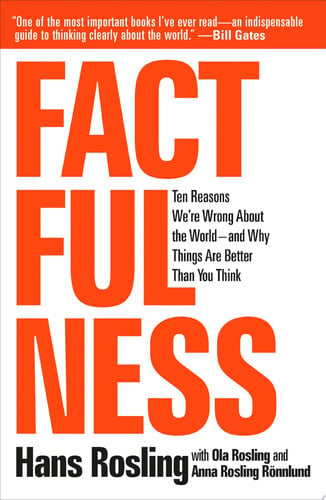
Factfulness - Dünya Hakkinda Yanilmamizin On Nedeni Ve Neden Her Sey Aslinda Sandiginizdan Daha Iyi Ciltli
by Hans Rosling, Anna Rosling Rönnlund, Ola Rosling
8.7 / 10 207K ratings
- Language
- Turkish
- Published
- 2019
- Publisher
- Pegasus Yayincilik
- Pages
- 352
- ISBN
- 9786052997451
When asked simple questions about global trends - from poverty rates to population growth - most people, from everyday citizens to Nobel laureates, answer incorrectly. So incorrectly, in fact, that a chimpanzee choosing answers at random would consistently outperform them. This is the startling revelation at the heart of "Factfulness," a book that dismantles the overdramatic worldview that has become so pervasive. It argues that our brains are wired with ten dramatic instincts that distort how we see the world, leading us to believe it is more frightening, more violent, and more hopeless than it actually is.
This book offers a radical new framework for understanding the world based not on biases, but on facts. Through lively anecdotes, surprising data, and moving stories, Hans Rosling and his co-authors reveal that for all its imperfections, the world is in a much better state than we might think. By learning to recognize our innate biases, we can replace fear with factfulness, develop a worldview based on evidence, and become better equipped to focus on the concerns that truly threaten us the most. This is an essential guide to thinking clearly about the world and understanding the silent miracle of human progress.
This book offers a radical new framework for understanding the world based not on biases, but on facts. Through lively anecdotes, surprising data, and moving stories, Hans Rosling and his co-authors reveal that for all its imperfections, the world is in a much better state than we might think. By learning to recognize our innate biases, we can replace fear with factfulness, develop a worldview based on evidence, and become better equipped to focus on the concerns that truly threaten us the most. This is an essential guide to thinking clearly about the world and understanding the silent miracle of human progress.
Subjects
- Literature & Fiction
- Subjects
- Self-Help
- Health, Fitness & Dieting
- Biographies & Memoirs
- Business & Money
- Management & Leadership
- Science & Math
- Education & Reference
- Religion & Spirituality
- Economics
- Medical Books
- Mathematics
- Essays & Correspondence
- Politics & Social Sciences
- Philosophy
- Specialty Boutique
- New, Used & Rental Textbooks
- Biological Sciences
- Social Sciences
- Business & Economics
- Religious
- Personal Growth
- Project Management
- Politics & Government
- Psychology & Counseling
- Education
- Religious Studies
- Sociology
- Psychology
- Science
- Social Science
- Research
- Decision-Making & Problem Solving
- Skills
- Educational Psychology
- Applied
- Cognitive Psychology & Cognition
- Specific Topics
- Cognitive Psychology
- Behavioral Sciences
- Anthropology
- Popular Culture
- Statistics
- Cognitive
- Cultural & Social
- Probability & Statistics
- Cognitive Science
- New York Times bestseller
- Ethics & Morality
- Decision Making
- Future Studies
- Social Classes & Economic Disparity
- Forecasting
- Development & Growth
- Econometrics & Statistics
- Economic Policy & Development
- Quality of life
Original edition
Factfulness Ten Reasons We're Wrong About the World--and Why Things Are Better Than You ThinkOriginally published in 2018 English Flatiron Books
Other editions (20)
- Factfulness Ten Reasons We're Wrong About the World--and Why Things Are Better Than You Think

- Factfulness Ten Reasons We're Wrong About the World--and Why Things Are Better Than You Think

- Factfulness Ten Reasons We're Wrong About the World--and Why Things Are Better Than You Think
- Factfulness el món va millor del que et penses : deu raons que fan que no el vegis tal com és

- Factfulness (Illustrated)

Listen to the summary Narrated summary
You carry within you a worldview, shaped by news headlines and ingrained assumptions, that tells a dramatic story of a world divided, dangerous, and in constant decline. Yet, when presented with simple, factual questions about global trends - on poverty, health, and education - most people, even highly educated ones, consistently score worse than random chance. This isn't due to ignorance alone, but to deeply ingrained instincts that distort your perception, painting a picture far more frightening and hopeless than reality.
One of the most powerful of these is the Gap Instinct, the irresistible urge to divide the world into two opposing groups: rich and poor, developed and developing. This stark dichotomy, however, is a relic of a bygone era. The truth is far more nuanced, with the vast majority of humanity residing in a spectrum of four income levels, most of them in the middle. The idea of a chasm separating "us" from "them" is an illusion; most people are neither desperately impoverished nor extravagantly wealthy, but steadily improving their lives, moving through these levels with increasing access to resources and opportunities.
Then there is the Negativity Instinct, a primal pull that makes you constantly notice the bad more than the good. News, by its very nature, thrives on dramatic events - disasters, conflicts, and crises - while the slow, steady progress that lifts millions out of poverty or cures diseases rarely makes headlines. This constant barrage of bad news leads to a pervasive sense that things are always getting worse, when in fact, many global indicators show remarkable, albeit gradual, improvement.
The Fear Instinct further clouds your judgment, making critical thinking almost impossible when alarm bells are ringing. You are wired to pay attention to frightening things, systematically overestimating risks like violence, captivity, and contamination, while often ignoring more common dangers. This instinct can be exploited, leading to rash decisions and misplaced priorities. To see the world clearly, you must learn to distinguish between actual risks and perceived threats, basing your reactions on data rather than primal terror.
Beyond these, other instincts subtly warp your understanding. The Straight Line Instinct assumes that trends will continue indefinitely in a linear fashion, ignoring the reality of S-bends, humps, and plateaus in real-world data. The Size Instinct can lead you to misjudge the importance of a single number without comparing it to others or understanding its context. The Generalization Instinct creates misleading stereotypes by grouping diverse individuals or cultures, while the Destiny Instinct suggests that innate characteristics determine the unchangeable fate of people or nations, blind to the constant, incremental change that shapes societies.
The Single Perspective Instinct makes you favor one simple explanation or solution, blinding you to other possibilities, while the Blame Instinct seeks a single culprit or hero, preventing a deeper understanding of complex systemic issues. Finally, the Urgency Instinct pushes for immediate action in perceived crises, often overriding careful thought and leading to poor decisions. These instincts, though once useful for survival, now create an "overdramatic worldview" that is both stressful and fundamentally incorrect.
To counter these ingrained biases and cultivate "factfulness" means actively seeking a fact-based worldview. It involves recognizing when these instincts are at play and deliberately employing strategies to see beyond the drama. This means scrutinizing data, looking for proportions, comparing numbers, and understanding the different rates of change. It means being humble about your own knowledge and being open to new information that challenges your preconceived notions.
The world, in truth, is both bad and better. Tremendous challenges persist - poverty, disease, environmental degradation - but alongside them, immense progress has been made. Extreme poverty has halved in recent decades, child mortality rates have plummeted, and access to education is more widespread than ever. Embracing a fact-based worldview allows you to appreciate this progress without complacency, to understand real dangers without succumbing to fear, and to focus your energy on solving the actual problems that remain, free from the distortions of an overdramatic imagination.
One of the most powerful of these is the Gap Instinct, the irresistible urge to divide the world into two opposing groups: rich and poor, developed and developing. This stark dichotomy, however, is a relic of a bygone era. The truth is far more nuanced, with the vast majority of humanity residing in a spectrum of four income levels, most of them in the middle. The idea of a chasm separating "us" from "them" is an illusion; most people are neither desperately impoverished nor extravagantly wealthy, but steadily improving their lives, moving through these levels with increasing access to resources and opportunities.
Then there is the Negativity Instinct, a primal pull that makes you constantly notice the bad more than the good. News, by its very nature, thrives on dramatic events - disasters, conflicts, and crises - while the slow, steady progress that lifts millions out of poverty or cures diseases rarely makes headlines. This constant barrage of bad news leads to a pervasive sense that things are always getting worse, when in fact, many global indicators show remarkable, albeit gradual, improvement.
The Fear Instinct further clouds your judgment, making critical thinking almost impossible when alarm bells are ringing. You are wired to pay attention to frightening things, systematically overestimating risks like violence, captivity, and contamination, while often ignoring more common dangers. This instinct can be exploited, leading to rash decisions and misplaced priorities. To see the world clearly, you must learn to distinguish between actual risks and perceived threats, basing your reactions on data rather than primal terror.
Beyond these, other instincts subtly warp your understanding. The Straight Line Instinct assumes that trends will continue indefinitely in a linear fashion, ignoring the reality of S-bends, humps, and plateaus in real-world data. The Size Instinct can lead you to misjudge the importance of a single number without comparing it to others or understanding its context. The Generalization Instinct creates misleading stereotypes by grouping diverse individuals or cultures, while the Destiny Instinct suggests that innate characteristics determine the unchangeable fate of people or nations, blind to the constant, incremental change that shapes societies.
The Single Perspective Instinct makes you favor one simple explanation or solution, blinding you to other possibilities, while the Blame Instinct seeks a single culprit or hero, preventing a deeper understanding of complex systemic issues. Finally, the Urgency Instinct pushes for immediate action in perceived crises, often overriding careful thought and leading to poor decisions. These instincts, though once useful for survival, now create an "overdramatic worldview" that is both stressful and fundamentally incorrect.
To counter these ingrained biases and cultivate "factfulness" means actively seeking a fact-based worldview. It involves recognizing when these instincts are at play and deliberately employing strategies to see beyond the drama. This means scrutinizing data, looking for proportions, comparing numbers, and understanding the different rates of change. It means being humble about your own knowledge and being open to new information that challenges your preconceived notions.
The world, in truth, is both bad and better. Tremendous challenges persist - poverty, disease, environmental degradation - but alongside them, immense progress has been made. Extreme poverty has halved in recent decades, child mortality rates have plummeted, and access to education is more widespread than ever. Embracing a fact-based worldview allows you to appreciate this progress without complacency, to understand real dangers without succumbing to fear, and to focus your energy on solving the actual problems that remain, free from the distortions of an overdramatic imagination.
What other readers say
Liked
The book Factfulness is widely praised for its accessible and engaging presentation of global data, offering a fresh and often surprising perspective on the state of the world. Many reviewers highlight its core message that, contrary to popular belief, humanity has made significant progress across various indicators such as health, education, and poverty reduction. The author, along with his co-authors, introduces a new, more nuanced framework for understanding global development, moving beyond outdated "developed" versus "developing" classifications. Readers appreciate how the book helps to identify and overcome common cognitive biases and dramatic instincts that often distort our perception of reality. It encourages critical thinking by focusing on facts and data, promoting a non-judgmental approach to understanding complex issues, and ultimately fostering a more hopeful yet realistic worldview.
Disliked
Despite its positive reception, some readers found the book to be repetitive in its arguments and examples, occasionally adopting a condescending tone when highlighting widespread ignorance of global facts. Critics also point out that while the book champions data, its presentation sometimes selectively emphasizes certain statistics or uses averages in a way that can be misleading, potentially oversimplifying complex issues or obscuring underlying distributions. Concerns were raised that the book's optimistic outlook might lead to a glib analysis, overlooking critical global challenges such as environmental degradation, social inequality, and the root causes of poverty, thereby potentially letting wealthier nations "off the hook." Some reviewers also felt the book diminished the role of mass media in shaping public misconceptions and questioned the practicality or depth of its proposed new classification system for global income levels.
In short
Overall, Factfulness is considered an important and eye-opening book that challenges ingrained pessimistic worldviews with evidence-based insights. While some find its methodology or underlying message problematic, most agree that it offers valuable tools for a more rational and fact-driven understanding of global trends. It encourages readers to embrace a "possibilist" mindset – acknowledging that while problems persist, progress is achievable and ongoing. This book is highly recommended for anyone interested in global affairs, statistics, and critical thinking, particularly those who feel overwhelmed by negative news or wish to update their understanding of the world with a more balanced and data-informed perspective.
No reviews yet. Be the first.