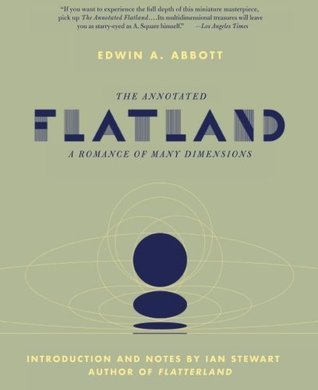
Flatland: Une Aventure à Plusieurs Dimensions
- First published 1974
- 187 pages
- French
- Classic
Enter a two-dimensional world where geometric shapes are sentient beings and social status is determined by the number of one's sides. In Flatland, a Square narrates his existence, detailing the rigid hierarchies and customs of his平面 society, where women are mere line segments and polygons with more angles hold greater prestige. His predictable life is upended by a visitor from a realm beyond his comprehension - a Sphere from Spaceland, a world of three dimensions. This encounter challenges everything the Square knows about reality and perception, as he struggles to grasp a concept that defies the very fabric of his flat universe.
This novella explores the limitations of understanding and the societal resistance to new ideas, using its unique premise to comment on class, gender, and the nature of knowledge itself. The Square's journey from Flatland to Spaceland and back forces him to confront the boundaries of his own perception and the incredulity of his peers when faced with truths beyond their experience. It offers a unique exploration of dimensions, social structures, and the struggle to communicate revolutionary concepts.
This novella explores the limitations of understanding and the societal resistance to new ideas, using its unique premise to comment on class, gender, and the nature of knowledge itself. The Square's journey from Flatland to Spaceland and back forces him to confront the boundaries of his own perception and the incredulity of his peers when faced with truths beyond their experience. It offers a unique exploration of dimensions, social structures, and the struggle to communicate revolutionary concepts.
What readers say
3.81
81K ratings across the web 7 in 10 readers loved it, 1 didn't like it
Reviews for this book consistently praise its ingenious central concept, presenting it as a brilliant work of speculative mathematics and a mind-expanding thought experiment. Readers highlight its avant-garde nature, especially considering its 19th-century origin, for exploring higher dimensions and challenging conventional perceptions of reality. Beyond its mathematical ingenuity, the book is widely appreciated as a sharp social satire of Victorian-era class structures, gender inequality, and dogmatic thinking. Many find its commentary on societal rigidity and the difficulty of accepting new ideas to be timeless and thought-provoking, often drawing parallels to works like Orwell's 1984 or Plato's Cave allegory. Its unique blend of genres, literary allusions, and philosophical depth make it a fascinating and memorable read for those open to its unconventional approach.
However, the reviews also point to several significant drawbacks. A common criticism is that the book's narrative and plot are often considered weak, simple, or contrived, with some reviewers finding the writing itself to be merely adequate rather than eloquent. The conceptual nature of the book means that some sections can be "brain-twisty" or require considerable mental effort, which might deter readers seeking a straightforward story. The most substantial negative feedback revolves around the book's portrayal of women, which is almost universally described as overtly misogynistic and outdated. While some argue this aspect is intended as satire, many reviewers find it genuinely offensive and difficult to overlook, detracting significantly from their enjoyment of the work. A few detailed critiques also raise questions about the geometric accuracy or internal consistency of the two-dimensional world as described.
Overall, this book is widely regarded as a unique classic, valued more for its intellectual concepts and satirical ideas than for its storytelling prowess. It is highly recommended for readers with an open mind, particularly those interested in mathematics, geometry, philosophy, or social commentary, who are willing to engage with a challenging thought experiment. Those who appreciate historical context and can overlook or contextualize its notably outdated social views, especially concerning gender, will likely find it a worthwhile and thought-provoking experience. However, readers primarily seeking an entertaining plot or those sensitive to pervasive misogyny may find it a frustrating read.
Reviews
No reviews yet. Be the first.
Details & editions
- This edition
- DENOEL, 1984
- ISBN
- 9782207301104
- Language
- French
Original edition Flatland A Romance of Many Dimensions Originally published in 1974 · English · Blackwell