
Four Hour Chef
7.8 / 10 345K ratings
- Language
- English
- Published
- 2012
- Publisher
- Amazon Publishing
- Pages
- 672
- ISBN
- 9781477800072
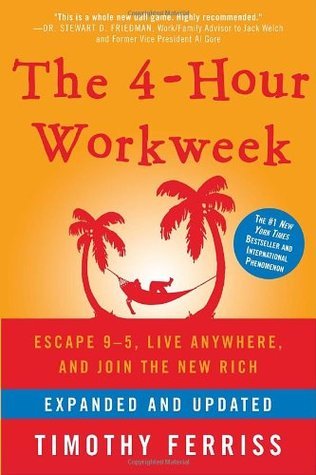
Tired of the traditional 9-to-5 grind and the promise of retirement decades away? The 4-Hour Work Week challenges the ingrained assumptions about work and life, proposing a different path to financial freedom and personal fulfillment. This book outlines a framework for "lifestyle design," where time and mobility become the ultimate currencies, allowing you to escape the confines of a conventional job and live anywhere.
Discover strategies to automate income, outsource tasks, and eliminate time-wasting activities, enabling you to achieve more meaningful results in fewer hours. Learn to prioritize what truly matters, creating a life rich with mini-retirements, adventure, and personal growth, rather than deferring your dreams. This guide provides a blueprint to redefine your relationship with work and design a life that offers both wealth and the freedom to enjoy it now.
Discover strategies to automate income, outsource tasks, and eliminate time-wasting activities, enabling you to achieve more meaningful results in fewer hours. Learn to prioritize what truly matters, creating a life rich with mini-retirements, adventure, and personal growth, rather than deferring your dreams. This guide provides a blueprint to redefine your relationship with work and design a life that offers both wealth and the freedom to enjoy it now.
Original edition
The 4-hour Work WeekOriginally published in 2007 English Blackstone Audio, Inc.
Other editions (48)



Listen to the summary Narrated summary
Imagine a life where the drudgery of the 9-to-5 workday, the endless commute, and the dream of a distant retirement fade into obsolescence. This is not a fantasy, but a blueprint for the "New Rich" - those who prioritize time and mobility over mere money, understanding that true wealth lies in the freedom to live as you choose, when you choose, and where you choose. Your goal is not to accumulate millions, but to design a life that offers the experiences of a millionaire right now, leveraging time and location as your ultimate currencies.
The journey begins with Definition, a radical questioning of the ingrained assumptions that keep you shackled to the traditional work paradigm. Cast aside the notion of deferred life, where enjoyment is postponed until a mythical retirement. Instead, discover what truly excites you, what dreams you harbor, and then "dreamline" them - assigning concrete timelines and steps to transform vague desires into achievable goals. Understand that relative income, the amount you earn per hour, is far more important than absolute income, and that distress is to be avoided, while eustress, the beneficial kind of stress that promotes growth, is to be embraced.
Next comes Elimination, a ruthless pruning of the unnecessary to reclaim your most precious resource: time. Forget conventional time management; the real secret lies in ignoring the unimportant. Embrace the Pareto Principle, the 80/20 rule, which reveals that 80% of your desired results often stem from just 20% of your efforts. Identify and double down on those high-impact tasks, while fiercely cutting out the rest. Similarly, Parkinson's Law dictates that work expands to fill the time allotted for its completion, so impose strict, short deadlines to increase focus and output. Adopt a low-information diet, filtering out the constant noise of news and email, and cultivate a "not-to-do" list to actively avoid distractions.
Once you've eliminated the superfluous, it's time for Automation. This is where you put cash flow on autopilot, transforming your income into a system that works for you, rather than you working for it. Learn the art of outsourcing, delegating mundane and time-consuming tasks to virtual assistants, freeing yourself to focus on high-value activities that align with your passions. Consider creating a muse - a scalable, product-based business, often selling information, that requires minimal management once established, ideally less than a day per week. The aim is to generate a location-independent income, multiplying its practical value by enabling you to live anywhere.
Finally, you reach Liberation. This is the stage where you create freedom of location, breaking free from the geographical constraints of the traditional office. For employees, this means strategically negotiating remote work, proving your productivity from afar, and gradually expanding your remote time until full mobility is achieved. Embrace the concept of "mini-retirements," taking extended breaks throughout your life to travel, learn, and pursue new passions, rather than waiting for a single, distant retirement. The ultimate goal is to design a lifestyle that is rich in experiences, self-discovery, and adventure, proving that you don't have to put in decades of hard work to earn the free time you desire.
The journey begins with Definition, a radical questioning of the ingrained assumptions that keep you shackled to the traditional work paradigm. Cast aside the notion of deferred life, where enjoyment is postponed until a mythical retirement. Instead, discover what truly excites you, what dreams you harbor, and then "dreamline" them - assigning concrete timelines and steps to transform vague desires into achievable goals. Understand that relative income, the amount you earn per hour, is far more important than absolute income, and that distress is to be avoided, while eustress, the beneficial kind of stress that promotes growth, is to be embraced.
Next comes Elimination, a ruthless pruning of the unnecessary to reclaim your most precious resource: time. Forget conventional time management; the real secret lies in ignoring the unimportant. Embrace the Pareto Principle, the 80/20 rule, which reveals that 80% of your desired results often stem from just 20% of your efforts. Identify and double down on those high-impact tasks, while fiercely cutting out the rest. Similarly, Parkinson's Law dictates that work expands to fill the time allotted for its completion, so impose strict, short deadlines to increase focus and output. Adopt a low-information diet, filtering out the constant noise of news and email, and cultivate a "not-to-do" list to actively avoid distractions.
Once you've eliminated the superfluous, it's time for Automation. This is where you put cash flow on autopilot, transforming your income into a system that works for you, rather than you working for it. Learn the art of outsourcing, delegating mundane and time-consuming tasks to virtual assistants, freeing yourself to focus on high-value activities that align with your passions. Consider creating a muse - a scalable, product-based business, often selling information, that requires minimal management once established, ideally less than a day per week. The aim is to generate a location-independent income, multiplying its practical value by enabling you to live anywhere.
Finally, you reach Liberation. This is the stage where you create freedom of location, breaking free from the geographical constraints of the traditional office. For employees, this means strategically negotiating remote work, proving your productivity from afar, and gradually expanding your remote time until full mobility is achieved. Embrace the concept of "mini-retirements," taking extended breaks throughout your life to travel, learn, and pursue new passions, rather than waiting for a single, distant retirement. The ultimate goal is to design a lifestyle that is rich in experiences, self-discovery, and adventure, proving that you don't have to put in decades of hard work to earn the free time you desire.
What other readers say
Liked
The book is widely praised for its ability to challenge conventional wisdom regarding work, career paths, and traditional retirement. Many readers found it thought-provoking and mind-expanding, offering a fresh perspective on designing a life focused on freedom and happiness rather than endless labor. It provides valuable and actionable tips on improving productivity, streamlining workflows, and managing time more effectively, such as checking emails less frequently, batching tasks, and avoiding unnecessary meetings. The concept of "mini-retirements" is highlighted as a compelling alternative to deferring enjoyment until old age, encouraging readers to integrate travel and personal pursuits throughout their lives. Furthermore, the book inspires an entrepreneurial mindset, emphasizing automation and delegation to create systems that generate income with minimal personal oversight, enabling a significant re-evaluation of one's professional and personal priorities.
Disliked
Despite its positive aspects, the book garners significant criticism, particularly concerning its tone and the ethical implications of its advice. Many reviewers describe the author's personality as boastful, self-promoting, and often off-putting, leading to a perception of "scumbaggery" or a lack of moral compass. Critics point to recommendations that encourage bending rules, lying to colleagues or superiors, shirking responsibility, and exploiting loopholes, such as winning competitions on technicalities or outsourcing tasks to underpaid assistants. A common complaint is that the book's core premise of a "4-hour work week" is unrealistic or only achievable for a select few with specific privileges and circumstances, failing to provide a universally applicable roadmap. Reviewers also note contradictions in the author's own practices and express concern that adopting the book's full philosophy could lead to social isolation, a decline in community values, and a detrimental impact on overall societal trust and productivity.
In short
Ultimately, this book presents a polarizing but undeniably influential perspective on modern work and life. While it offers valuable insights into efficiency, prioritization, and challenging the status quo, readers must approach it with a discerning eye, sifting through controversial advice and a contentious authorial voice. It is best suited for individuals who feel constrained by traditional employment structures and are eager to explore unconventional methods for achieving greater personal freedom and work-life balance. Those interested in entrepreneurship, automation, and location independence, who are willing to critically evaluate ethically questionable tactics, may find inspiring ideas and practical tools. However, readers seeking a purely ethical guide, or those in careers where such radical delegation and rule-bending are impractical or impossible, may find the book frustrating and unrealistic.
No reviews yet. Be the first.