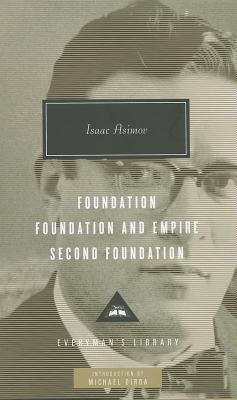
Fundación
by Isaac Asimov
- First published 1970
- 264 pages
- Spanish
- Classic
For twelve thousand years, the Galactic Empire has ruled supreme, a sprawling civilization of millions of worlds. But its long reign is coming to an end. The decay is invisible to all but one man: Hari Seldon, the creator of a revolutionary science called psychohistory. Through mathematics, he can look into the future and see the inevitable outcome - a 30,000-year dark age of ignorance, barbarism, and war that will engulf humanity. Though he cannot stop the collapse, Seldon devises a daring plan to shorten the coming darkness to a single millennium.
Seldon gathers the most brilliant minds in the Empire and exiles them to a bleak, remote planet at the edge of the galaxy. Their mission is to safeguard the totality of human knowledge, a sanctuary he calls the Foundation. This single beacon of hope is meant to preserve civilization and guide its rebirth. But as the Foundation faces a series of crises over the centuries, its inhabitants must trust in a plan whose architect is long dead, questioning whether the fate of humanity can truly be plotted by the mind of one man.
Seldon gathers the most brilliant minds in the Empire and exiles them to a bleak, remote planet at the edge of the galaxy. Their mission is to safeguard the totality of human knowledge, a sanctuary he calls the Foundation. This single beacon of hope is meant to preserve civilization and guide its rebirth. But as the Foundation faces a series of crises over the centuries, its inhabitants must trust in a plan whose architect is long dead, questioning whether the fate of humanity can truly be plotted by the mind of one man.
- Genres
- Fiction › Speculative fiction › Science fiction › Space operaFiction › Speculative fiction › FantasyFiction › Literary fiction › Psychological fictionFiction › Family saga
- Themes
- Science & technology › Robots & artificial intelligenceScience & technology › Space School & education
- Where and when
- 20th century
What readers say
4.17
618K ratings across the web 8 in 10 readers loved it, 1 didn't like it
Reviewers widely praise this book as a seminal and hugely influential work within the science fiction genre, often cited as a foundational text that shaped countless subsequent space operas and stories, including iconic franchises. Many highlight its ambitious and visionary concepts, particularly the idea of psychohistory – a mathematical discipline capable of predicting the future course of large human societies. Readers are captivated by its grand scope, imaginative world-building across vast stretches of time, and the focus on non-violent, diplomatic solutions to complex intergalactic challenges. The book is lauded for its intellectual depth, exploring socio-political and philosophical themes, such as the use of religion as a tool for control and the interplay between humanities and natural sciences, all presented with wit and cleverness that many find absorbing and thought-provoking.
However, the reviews also point out several significant drawbacks. A frequent criticism is the lack of character development; many find the characters to be flat, interchangeable, and lacking in personality or emotional depth, as the narrative prioritizes the evolution of civilizations over individual journeys. The writing style itself is often described as dry, dialogue-heavy, and lacking in descriptive prose, which can make the book feel more like a series of intellectual discussions than an immersive novel. Its structure as a "fix-up" of interconnected short stories, spanning decades, can lead to a disjointed reading experience and a perceived absence of continuous plot or climax. Furthermore, many reviewers note the book's dated elements, most notably the almost complete absence of significant female characters and their often stereotypical portrayal, alongside references to outdated technology.
Despite these criticisms, the overall verdict is that the book remains a classic and a must-read for science fiction enthusiasts. Its value lies primarily in its groundbreaking ideas, immense historical influence, and the sheer ambition of its conceptual framework, rather than in traditional literary strengths like characterization or elegant prose. It is highly recommended for readers who appreciate grand-scale speculative fiction, enjoy socio-political allegories, and prioritize innovative concepts and intellectual exploration over character-driven narratives, fast-paced action, or detailed world-building. Those new to the genre, or who prefer strong emotional arcs and descriptive writing, might find it a challenging read.
Reviews
No reviews yet. Be the first.
Details & editions
- This edition
- Debolsillo, 2022
- ISBN
- 9788497599245
- Language
- Spanish
Original edition Stiftelsen Originally published in 1970 · Swedish