
Gulliver's Travels
8.06 / 10 235K ratings
- Language
- English
- Published
- 2017
- Publisher
- CreateSpace Independent Publishing Platform
- Pages
- 144
- ISBN
- 9781976313516
Embark on a series of voyages that begin with a shipwreck and unfold into one of the most remarkable tales ever told. Lemuel Gulliver, a practical English surgeon with a desire to see the world, finds himself cast away in a series of strange and distant nations. His adventures place him in a land of tiny, six-inch-tall people consumed by petty politics, and then among giants who view his own society's customs with contempt. Each journey takes him further from the world he knows, forcing him to confront the absurdities of pride, power, and human behavior through the lens of these fantastical encounters.
Though often presented as a simple adventure story, Gulliver's Travels is a sharp and unflinching satire on human nature and the follies of civilization. Through Gulliver's deadpan observations of bizarre beings and their peculiar societies, the novel exposes the triviality of conflict, the arrogance of power, and the questionable foundations of our own world. What begins as a curious travelogue evolves into a profound and critical examination of humanity itself, leaving the reader to question whether the strange lands Gulliver visits are any more irrational than our own.
Though often presented as a simple adventure story, Gulliver's Travels is a sharp and unflinching satire on human nature and the follies of civilization. Through Gulliver's deadpan observations of bizarre beings and their peculiar societies, the novel exposes the triviality of conflict, the arrogance of power, and the questionable foundations of our own world. What begins as a curious travelogue evolves into a profound and critical examination of humanity itself, leaving the reader to question whether the strange lands Gulliver visits are any more irrational than our own.
Subjects
- Comics & Graphic Novels
- Kindle Store
- Categories
- Kindle eBooks
- Travel
- Asia
- China
- General
- Reference
- Literature & Fiction
- Genre Fiction
- Suspense
- Subjects
- Literary
- Action & Adventure
- Fantasy
- Mythology & Folk Tales
- Folklore
- Science Fiction & Fantasy
- FICTION_FANTASY_GENERAL
- Epic
- Historical
- Dragons & Mythical Creatures
- Self Service
- History
- Anthologies
- Arborist Merchandising Root
- Children's Books
- Science & Math
- Education & Reference
- Education & Teaching
- Schools & Teaching
- Non-Classifiable
- Novelty
- Political
- CHILDREN'S FICTION
- Poetry
- Horses
- Voyages and travels
- Law
- Legal History
- Contemporary
- United States
- Americas
- Ireland
- Parenting & Relationships
- Specialty Travel
- Holidays
- English & College Success
- English
- Humor
- Essays & Correspondence
- FICTION_GENERAL
- World
- Study & Teaching
- Education Theory
- Science Fiction
- Politics & Social Sciences
- Magical Realism
- Specialty Boutique
- New, Used & Rental Textbooks
- Teen & Young Adult
- Dramas & Plays
- Foreign Language Study & Reference
- Art
- Humor & Entertainment
- Fiction
- Biography & Autobiography
- Juvenile Fiction
- Travel Writing
- Examinations
- Fantasy & Magic
- Classics
- Short Stories
- Politics & Government
- Drawing
- Criticism
- Education
- Humor & Satire
- Humorous
- Fiction, action & adventure
- Literary Collections
- Women
- Fiction, general
- Fiction, humorous, general
- Children's fiction
- Adventure and adventurers, fiction
- Fiction, fantasy, general
- Juvenile fiction
- Adventure stories
- Social life and customs
- Science
- Adaptations
- AMERICAN FICTION (FICTIONAL WORKS BY ONE AUTHOR)
- Politics
- Nature
- History & Criticism
- Antiques & Collectibles
- Russia
- For National Curriculum Key Stage 2
- Satire
- Biography
- Biographical
- Linguistics
- For National Curriculum Key Stage 3
- Study and teaching
- Westerns
- Sports
- England
- English as a Second Language
- Juvenile literature
- Journeys
- Teaching
- Romans, nouvelles, etc. pour la jeunesse
- Language & Linguistics
- Media Tie-In
- Adventure
- Ancient & Medieval Literature
- Ancient & Classical
- Words, Language & Grammar
- Diaries & Journals
- Fiction - General
- LARGE TYPE BOOKS
- Short stories
- Political Science
- Audio Adult: Books On Tape
- Foreign Language Study
- Italian
- Regional & Cultural
- Thrillers
- European
- English, Irish, Scottish, Welsh
- Juvenile Nonfiction
- Science & Nature
- Language Arts & Disciplines
- Language
- German
- Fairy Tales, Folk Tales & Myths
- Genres & Styles
- English language
- Literary Criticism
- Essays & Travelogues
- Study Aids
- Literature
- Young Adult Fiction
- Fairy Tales & Folklore
- British & Irish
- Techniques
- Christian
- Sports & Recreation
- Chinese
- Chang pian xiao shuo
- Spanish
- Adventurers & Explorers
- French
- Spanish language
- Children's Books/Ages 9-12 Fiction
- Irish
- Adventure and adventurers
- British and irish fiction (fictional works by one author)
- English fiction
- Large type books
- English literature
- Dictionaries
- Arts & Humanities
- World Literature
- Technological
- FANTASY FICTION
- History and criticism
- Fairy Tales, Folk Tales, Legends & Mythology
- Portuguese
- Bilingual Education
- Readers
- Histoire
- Humorous Stories
- Literary Figures
- War
- Fantasy fiction
- Romans, nouvelles
- Intermediate
- Travelers
- Historical fiction
- Semiotics & Theory
- Dutch
- Survival Stories
- Sailing
- Foreign Language - Dictionaries
- Phrase Books
- FICTION
- Study guides
- SHORT STORIES
- Exploration & Discovery
- Russian
- Audiobooks
- Comics & graphic novels, general
- Alternate History
- Language Experience Approach
- Classic fiction
- Literature - Classics
- Sea Stories
- Legends, Myths, Fables
- Textbooks for foreign speakers
- FAIRY TALES
- Government
- Wit and humor
- Pirates
- Boys & Men
- 18th Century
- Legal Theory & Systems
- YOUNG ADULT FICTION
- Early works to 1800
- Humorous stories
- Translations
- Unabridged Audio - Fiction/General
- Politique et gouvernement
- Interactive Adventure
- Novela
- Non-US Legal Systems
- Books
- Renaissance
- Literature, collections
- BRITISH AND IRISH FICTION (FICTIONAL WORKS BY ONE AUTHOR)
- Children's Books/All Ages
- Comic books, strips
- Graphic novels
- Composition and exercises
- Correspondence
- Polish
- Korean
- Utopias
- Spanish language materials
- Action & Adventure - General
- Shipwrecks
- German literature
- Children's & Young Adult Literature
- Book
- Hungarian
- Fairy tales
- Science Fiction - General
- Czech
Original edition
Gulliver's Travels (Illustrated Junior Library)Originally published in 1947 English Grosset & Dunlap
Other editions (1324)



Listen to the summary Narrated summary
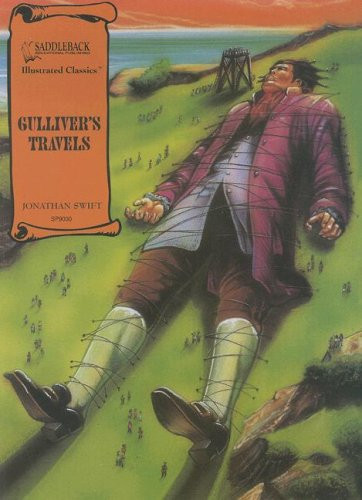
Lemuel Gulliver, a surgeon with a restless spirit, embarked on a series of voyages that would forever alter his perception of humanity. His first fateful journey, prompted by a shipwreck, cast him upon the shores of Lilliput, a land where everything, including its inhabitants, was astonishingly small. Waking to find himself pinned down by hundreds of tiny ropes, he soon discovered a world of people no taller than his thumb, their cities and customs miniature reflections of his own. He became their "Man-Mountain," a colossal figure aiding them in their petty wars against the equally diminutive Blefuscudians, a conflict sparked by nothing more than a disagreement over which end of an egg to crack. Gulliver's immense size gave him power, yet he witnessed the absurdity of their politics and the vanity of their court, even facing charges of treason for putting out a palace fire by urinating on it.
Escaping Lilliput, a twist of fate then found him marooned in Brobdingnag, a land of true giants. Here, the roles were reversed; Gulliver was the tiny curiosity, a plaything for a farmer's daughter, Glumdalclitch, who cared for him with gentle affection. His encounters with the colossal inhabitants were often perilous and humiliating, as he was forced to perform for money and later became a pet for the Queen. The King of Brobdingnag, a wise and thoughtful ruler, was appalled by Gulliver's descriptions of European society, viewing its systems and customs as barbarous and illogical when seen through the lens of their grand scale. Gulliver, in turn, began to see the flaws and follies of his own world with a newfound clarity, realizing how contemptible his own kind might appear to beings of greater stature and reason.
His third voyage led him to the floating island of Laputa, a land populated by absent-minded intellectuals so engrossed in abstract thought that they required servants to remind them to speak or look where they were going. Their scientific pursuits were utterly impractical, focused on extracting sunbeams from cucumbers or building houses from the roof down. Below Laputa lay other strange islands: Glubbdubdrib, where Gulliver conversed with the ghosts of historical figures, learning the true, often ignoble, stories behind their legendary reputations; and Luggnagg, where he encountered the Struldbrugs, immortals cursed not with eternal youth, but with eternal old age and all its miseries. These encounters deepened his understanding of human vanity, the deceit of history, and the true cost of an unending life.
The final and most profound of his journeys brought him to the land of the Houyhnhnms, a race of intelligent, rational horses who governed themselves with perfect reason and virtue. In stark contrast to these noble creatures were the Yahoos, grotesque, brutish human-like beings who embodied all the worst aspects of humanity: greed, filth, and irrationality. Living among the Houyhnhnms, Gulliver came to admire their honesty and communal simplicity, seeing them as the epitome of reason and virtue. He found himself increasingly repulsed by the Yahoos, and by extension, by humankind itself, recognizing in them the very vices he had observed throughout his travels.
Gulliver longed to stay forever in this land of pure reason, but the Houyhnhnms, though benevolent, eventually decided he was too much like the Yahoos and insisted he leave. His return to England was a profound shock; he could barely tolerate the sight of his own family, finding their human form and customs utterly detestable after his experiences. He retreated to his stables, finding more solace in the company of horses than in his fellow men, forever changed by the vast, strange worlds he had seen and the uncomfortable truths they had revealed about his own kind.
Escaping Lilliput, a twist of fate then found him marooned in Brobdingnag, a land of true giants. Here, the roles were reversed; Gulliver was the tiny curiosity, a plaything for a farmer's daughter, Glumdalclitch, who cared for him with gentle affection. His encounters with the colossal inhabitants were often perilous and humiliating, as he was forced to perform for money and later became a pet for the Queen. The King of Brobdingnag, a wise and thoughtful ruler, was appalled by Gulliver's descriptions of European society, viewing its systems and customs as barbarous and illogical when seen through the lens of their grand scale. Gulliver, in turn, began to see the flaws and follies of his own world with a newfound clarity, realizing how contemptible his own kind might appear to beings of greater stature and reason.
His third voyage led him to the floating island of Laputa, a land populated by absent-minded intellectuals so engrossed in abstract thought that they required servants to remind them to speak or look where they were going. Their scientific pursuits were utterly impractical, focused on extracting sunbeams from cucumbers or building houses from the roof down. Below Laputa lay other strange islands: Glubbdubdrib, where Gulliver conversed with the ghosts of historical figures, learning the true, often ignoble, stories behind their legendary reputations; and Luggnagg, where he encountered the Struldbrugs, immortals cursed not with eternal youth, but with eternal old age and all its miseries. These encounters deepened his understanding of human vanity, the deceit of history, and the true cost of an unending life.
The final and most profound of his journeys brought him to the land of the Houyhnhnms, a race of intelligent, rational horses who governed themselves with perfect reason and virtue. In stark contrast to these noble creatures were the Yahoos, grotesque, brutish human-like beings who embodied all the worst aspects of humanity: greed, filth, and irrationality. Living among the Houyhnhnms, Gulliver came to admire their honesty and communal simplicity, seeing them as the epitome of reason and virtue. He found himself increasingly repulsed by the Yahoos, and by extension, by humankind itself, recognizing in them the very vices he had observed throughout his travels.
Gulliver longed to stay forever in this land of pure reason, but the Houyhnhnms, though benevolent, eventually decided he was too much like the Yahoos and insisted he leave. His return to England was a profound shock; he could barely tolerate the sight of his own family, finding their human form and customs utterly detestable after his experiences. He retreated to his stables, finding more solace in the company of horses than in his fellow men, forever changed by the vast, strange worlds he had seen and the uncomfortable truths they had revealed about his own kind.
What other readers say
Liked
Readers have highlighted the author's distinctive and engaging voice as a significant positive aspect of the book. Reviewers particularly appreciate the author's snarky style, which suggests a witty, sharp, or humorous approach to the narrative. This characteristic appears to be a notable draw, contributing to an enjoyable and memorable reading experience for those who appreciate such a tone.
Disliked
Based on the available feedback, no specific negative aspects or criticisms of the book were brought to light. The provided reviews do not indicate any areas of concern regarding plot, character development, pacing, or other common literary elements, leaving these aspects unaddressed by the current feedback.
In short
Overall, the limited feedback suggests the book's main appeal lies in its unique authorial voice, particularly for those who enjoy a snarky and witty tone. Readers who appreciate sharp, humorous, or distinctive narrative styles are likely to find this book engaging. However, with very limited input, it is difficult to provide a comprehensive overall verdict beyond this specific stylistic strength.
No reviews yet. Be the first.