Hard Times
- First published 1858
- 384 pages
- English
- Classic
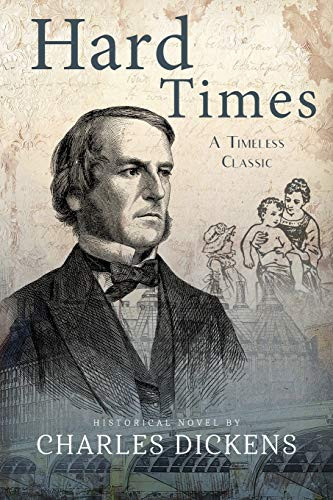
Step into Coketown, a grim industrial landscape where the smokestacks never cease and every building echoes a monotonous functionality. Here, Thomas Gradgrind, a man of rigid principles, champions a philosophy of cold, hard facts, raising his children, Louisa and Tom, to dismiss imagination and emotion as useless distractions.
As Louisa navigates a loveless marriage to the boastful factory owner Josiah Bounderby and her brother Tom succumbs to recklessness, the stark realities of their fact-driven upbringing begin to unravel. Amidst the dehumanizing machinery and the stark class divisions, the novel explores the profound human cost of a society that prioritizes utility over compassion, and reason over the vital spark of fancy. Discover how a world built solely on statistics ultimately fails its inhabitants, and the enduring power of empathy in the face of industrial rigidity.
As Louisa navigates a loveless marriage to the boastful factory owner Josiah Bounderby and her brother Tom succumbs to recklessness, the stark realities of their fact-driven upbringing begin to unravel. Amidst the dehumanizing machinery and the stark class divisions, the novel explores the profound human cost of a society that prioritizes utility over compassion, and reason over the vital spark of fancy. Discover how a world built solely on statistics ultimately fails its inhabitants, and the enduring power of empathy in the face of industrial rigidity.
What readers say
3.55
77K ratings across the web 5 in 10 readers loved it, 2 didn't like it
The reviews highlight Hard Times as a compelling and often brilliant work from Charles Dickens, particularly praised for its vivid characterizations and sharp social commentary. Readers frequently commend the memorable cast, including the fact-obsessed Mr. Gradgrind, the blustering Bounderby, the resilient Louisa, and the endearing Mrs. Sparsit, whose interactions provide both amusement and insight. The novel’s portrayal of Mr. Sleary and his traveling circus is consistently celebrated for its representation of imagination, spontaneity, and generosity of spirit, often seen as a counterpoint to the book’s more serious themes. Many reviewers found the story engaging, appreciating Dickens’s signature wit, sarcasm, and ability to blend scathing satire with poignant pathos. The book is lauded for its powerful critique of utilitarianism, industrialization’s impact on society, and the stifling effects of a purely fact-based education, presenting a clear picture of Victorian working-class life. Its relatively shorter length compared to other Dickens novels is also frequently noted as an accessible entry point to his work.
Despite its strengths, Hard Times draws criticism for several aspects, with some reviewers considering it among Dickens's lesser works. A common complaint is the novel’s lack of subtlety and heavy-handed moralizing, which can make the satire feel "sledgehammer-like" and the narrative overtly didactic. Some found the plot less intricate and rich than in other Dickens novels, describing it as a "menu card" rather than a "feast," with fewer expansive descriptions and a less complex tapestry of subplots. Critics also pointed to characters sometimes feeling like "mere constructs" or "programmed automatons" designed to convey specific ideologies, rather than fully developed individuals, and some found them shallow or their motivations unexplained. The depiction of workers, particularly the "noble poor," and the union organizers, also drew mixed reactions. Additionally, some readers found the story predictable, boring, or difficult to read due to dense prose and the extensive use of dialect, contributing to a sense of a "leaden rhetorical read."
Ultimately, Hard Times remains a significant and impactful novel, though opinions on its overall merit vary widely, from being considered Dickens's "best" to one of his "least favorite." It is widely acknowledged as a powerful social document that offers a snapshot of its era, raising important questions about education, societal values, and human compassion that many find still resonate today. While it may lack the epic scope and intricate plotting of some of his longer works, it is praised for its concise and focused narrative. This book is particularly recommended for readers interested in Victorian social commentary, the history of industrialization, and critiques of philosophical movements like utilitarianism. It appeals to those who appreciate Dickens’s unique blend of satire, character-driven storytelling, and his passionate advocacy for the human spirit and imagination, even if its directness might not appeal to all modern readers. For those new to Dickens, it can serve as an accessible introduction due to its brevity, but some reviewers caution against it being the sole experience of his brilliant oeuvre.
Reviews
No reviews yet. Be the first.
Details & editions
- This edition
- Collins, 2021
- ISBN
- 9780008465391
- Language
- English
Original edition Hard Times Originally published in 1858 · English
Other editions (2699)
- Oxford University Press · 1979

- Spartacus Books · 2020

- Sastrugi Press · 2021
- Independently published · 2021
- CreateSpace Independent Publishing Platform · 2015

- Independently published · 2021
- Amazon Digital Services LLC - KDP Print US · 2017

- Independently published · 2021
- Sastrugi Press · 2021
- Baker Street Press · 2021
