
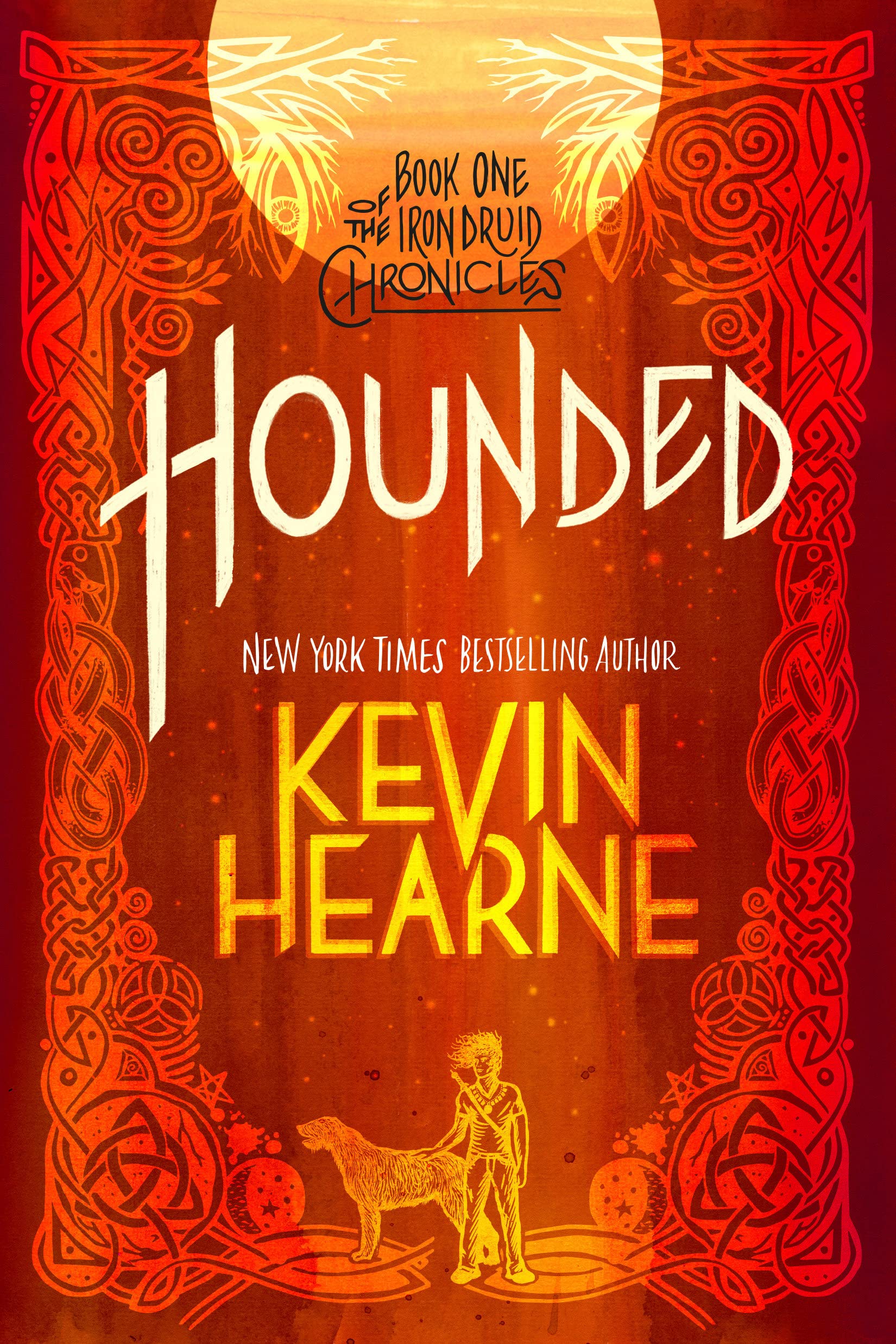
Hounded
by Kevin Hearne
8.2 / 10 94K ratings
- Language
- English
- Published
- 2011
- Publisher
- Del Rey
- Pages
- 336
- ISBN
- 9780345522535
Atticus O'Sullivan appears to be a handsome, tattooed twenty-one-year-old running an occult bookshop in modern-day Arizona, but he is actually the last of the Druids, a two-thousand-year-old immortal with a sharp wit and a magical sword. He has spent centuries staying ahead of those who wish him harm, particularly Aenghus Óg, a Celtic god who has relentlessly pursued Atticus for a stolen ancient blade. Now, tired of running, Atticus decides the time has come for a stand.
As ancient mythology collides with the contemporary world, Atticus must draw upon his earth-derived powers and enlist the help of a diverse cast of allies, including a seductive goddess of death, a team of vampire and werewolf attorneys, and his telepathic Irish wolfhound, Oberon, to confront the enraged deity. This urban fantasy blends action, humor, and Celtic lore as Atticus prepares for a confrontation that will determine his survival against formidable supernatural forces.
As ancient mythology collides with the contemporary world, Atticus must draw upon his earth-derived powers and enlist the help of a diverse cast of allies, including a seductive goddess of death, a team of vampire and werewolf attorneys, and his telepathic Irish wolfhound, Oberon, to confront the enraged deity. This urban fantasy blends action, humor, and Celtic lore as Atticus prepares for a confrontation that will determine his survival against formidable supernatural forces.
Original edition
HoundedOriginally published in 2011 English Harper Voyager
Other editions (40)




Listen to the summary Narrated summary
My name is Atticus O'Sullivan, and I'm the last of the Druids. Most folks in Tempe, Arizona, where I run my occult bookshop, "Third Eye Books and Herbs," figure me for a handsome, tattooed Irishman in his early twenties. They're only off by about twenty-one centuries. Hiding in plain sight has been my modus operandi for a long, long time, ever since I swiped a rather potent blade called Fragarach, the Answerer, from a certain Celtic god of love, Aenghus Óg. He's been a persistent sort, hounding my every step across continents and millennia, but I've grown tired of running. This desert town, with its low fae population and distinct lack of ash, oak, and thorn, felt like a safe haven, a place where I could finally lay low with my telepathic Irish Wolfhound, Oberon, and enjoy a decent fish and chips.
But the past, as it always does, has caught up. The peace shattered when five faeries, clearly expendable pawns, attacked my shop. I dispatched three, and my iron elemental took care of the rest, a rather visceral thank you for the delicious meal. This was merely a prelude. The Morrigan, the Celtic Chooser of the Slain, soon appeared, not to reap my soul just yet, but to deliver a chilling warning: Aenghus Óg and his formidable Tuatha Dé Danann were finally coming for me. She tossed her wands, and they confirmed a warrior would fight and die, though she conceded it might even be Aenghus Óg himself. Her presence, a stark reminder of my precarious existence, left a lingering chill, especially after she advised a few unwitting students to put their affairs in order.
My life, which usually involves selling fake weed to stoners and bantering with Oberon about the finer points of sausage, quickly escalated into a whirlwind of supernatural preparation. I secured my shop, checked on the amulet bonded to my aura, and braced for the inevitable. My circle of allies, though eclectic, is fiercely loyal. There's Leif, my night lawyer, who happens to be a vampire, and Hal, my day lawyer, a werewolf. Then there's the local coven of witches, led by Radomila, and the fiery Granuaile, a bartender possessed by a Hindu witch, all of whom I might need before this is over. Even Brighid, goddess of poetry and forge, and Aenghus Óg's own sister, offers a surprising, albeit cautious, hand.
The days leading up to the confrontation are a tense dance between mundane errands and dodging divine wrath. I find myself navigating the complexities of godly politics, trying to outwit a deity who, despite being the god of love, is remarkably unlovable when he's after something he believes is his. Fragarach, the sword he covets, is more than just a weapon; it's a symbol of my defiance and a source of immense power. It's the catalyst that has drawn every god, fae, and supernatural creature in the vicinity into this impending maelstrom.
The climax arrives, not with a whisper, but with the full, thunderous might of the Celtic pantheon descending upon Tempe. Aenghus Óg leads his forces, determined to reclaim his blade and exact centuries of revenge. It's a battle of ancient magic against modern wit, of divine power against the raw, earth-given strength of the last Druid. With Oberon by my side, his telepathic commentary a constant, comforting presence, and my motley crew of supernatural friends, I stand ready. My goal is simple: survive, keep Fragarach, and perhaps, just perhaps, finally be free of Aenghus Óg's relentless pursuit. This isn't just about a sword; it's about freedom, survival, and proving that even a twenty-one-century-old Druid can still kick some divine arse.
But the past, as it always does, has caught up. The peace shattered when five faeries, clearly expendable pawns, attacked my shop. I dispatched three, and my iron elemental took care of the rest, a rather visceral thank you for the delicious meal. This was merely a prelude. The Morrigan, the Celtic Chooser of the Slain, soon appeared, not to reap my soul just yet, but to deliver a chilling warning: Aenghus Óg and his formidable Tuatha Dé Danann were finally coming for me. She tossed her wands, and they confirmed a warrior would fight and die, though she conceded it might even be Aenghus Óg himself. Her presence, a stark reminder of my precarious existence, left a lingering chill, especially after she advised a few unwitting students to put their affairs in order.
My life, which usually involves selling fake weed to stoners and bantering with Oberon about the finer points of sausage, quickly escalated into a whirlwind of supernatural preparation. I secured my shop, checked on the amulet bonded to my aura, and braced for the inevitable. My circle of allies, though eclectic, is fiercely loyal. There's Leif, my night lawyer, who happens to be a vampire, and Hal, my day lawyer, a werewolf. Then there's the local coven of witches, led by Radomila, and the fiery Granuaile, a bartender possessed by a Hindu witch, all of whom I might need before this is over. Even Brighid, goddess of poetry and forge, and Aenghus Óg's own sister, offers a surprising, albeit cautious, hand.
The days leading up to the confrontation are a tense dance between mundane errands and dodging divine wrath. I find myself navigating the complexities of godly politics, trying to outwit a deity who, despite being the god of love, is remarkably unlovable when he's after something he believes is his. Fragarach, the sword he covets, is more than just a weapon; it's a symbol of my defiance and a source of immense power. It's the catalyst that has drawn every god, fae, and supernatural creature in the vicinity into this impending maelstrom.
The climax arrives, not with a whisper, but with the full, thunderous might of the Celtic pantheon descending upon Tempe. Aenghus Óg leads his forces, determined to reclaim his blade and exact centuries of revenge. It's a battle of ancient magic against modern wit, of divine power against the raw, earth-given strength of the last Druid. With Oberon by my side, his telepathic commentary a constant, comforting presence, and my motley crew of supernatural friends, I stand ready. My goal is simple: survive, keep Fragarach, and perhaps, just perhaps, finally be free of Aenghus Óg's relentless pursuit. This isn't just about a sword; it's about freedom, survival, and proving that even a twenty-one-century-old Druid can still kick some divine arse.
What other readers say
Liked
Reviews for this book highlight its engaging qualities, particularly its humor and fast-paced narrative. Many readers praised the protagonist, Atticus O’Sullivan, describing him as a charismatic, snarky, and powerful ancient druid who maintains a youthful appearance. His telepathic Irish wolfhound, Oberon, emerged as a universal favorite, providing significant comic relief through his unique personality and amusing obsessions. The book is lauded for its creative integration of Celtic mythology with a diverse array of other supernatural beings, gods, and magical elements, all set in a refreshing Arizona backdrop. Reviewers frequently cited the blend of modern and mythic worlds, along with the action-packed plot, as key factors in making it a fun and entertaining read.
Disliked
However, the book also drew considerable criticism. A recurring point of contention was Atticus’s character, with some reviewers finding him immature and unbelievable for his ancient age, often acting more like a teenager than a wise, 2,100-year-old figure. This perceived "too awesome" nature, where he consistently overcomes challenges with ease, diminished suspense for some, leading to accusations of him being a "Marty Stu." The humor, while appreciated by many, was sometimes described as forced, cheesy, or juvenile, with specific incidents drawing strong criticism for immaturity. Additionally, some felt the world-building, despite its ambition to encompass multiple mythologies, was occasionally muddled or shallow, and that character development relied too heavily on exposition rather than demonstration. One notable critique also focused on what was perceived as misogynistic undertones in the portrayal of female characters and certain plot points.
In short
Overall, the book offers a mixed but generally positive experience for its target audience. It is frequently compared to other popular urban fantasy series, often noted for being more lighthearted. This book is likely to appeal to readers seeking a fast-paced, humorous urban fantasy with a powerful, snarky male protagonist and a beloved talking animal companion. Those who enjoy diverse mythologies, action-packed plots, and can overlook a protagonist who might be considered "too awesome" or some juvenile humor will probably find it a fun and engaging read. Conversely, readers looking for deep character development, complex plots, a more serious tone, or those sensitive to perceived misogyny, might find it less satisfying.
No reviews yet. Be the first.