It began with a simple question, one I heard again and again as a young man running for the Illinois legislature. “You seem like a nice enough guy,” people would say. “Why do you want to go into something dirty and nasty like politics?” I understood their skepticism, born from a generation of broken promises. But I believed in another tradition, one that says we have a stake in one another, that what binds us together is greater than what drives us apart. Years later, after a crushing loss in a congressional race and a consultant's warning that a name like Barack Obama was a dead end after 9/11, that belief had been tested. I began to feel the familiar ache of an athlete who realizes he's gone as far as his talent will take him. And yet, it was this acceptance of my own limits that allowed me to launch a thoroughly cockeyed campaign for the United States Senate.
Traveling across Illinois, driving alone from town to town, I listened. I sat in farmhouses and union halls, listening to people talk about their jobs, their schools, their back pain, their war service. No blinding insights emerged, only the quiet recognition of how modest people's hopes were. They wanted a job that paid a living wage, health care that wouldn't bankrupt them, and a good education for their children. They didn't expect government to solve all their problems, but they figured it should help. Their fundamental decency and their quiet faith - their audacity to hope for something better in the face of all evidence to the contrary - reaffirmed my own. It reminded me that at the core of the American experience is a set of ideals that continues to stir our collective conscience, a common set of values that bind us together.
Upon arriving in Washington, however, that sense of common purpose felt like a distant memory. The Senate chamber, with its mahogany desks scratched with the names of giants like Webster and Kennedy, seemed a place of ghosts, a world's greatest deliberative body where no one was listening. I had followed the escalating ferocity of the capital's political battles from afar, but now I was in their midst. The air was thick with the static of a divided nation. The gap between the magnitude of our challenges - a broken health-care system, a failing energy policy, a war in Iraq - and the smallness of our politics felt vast and dispiriting. I saw how the arguments of the 1960s, the psychodrama of the Baby Boom generation, continued to drive our discourse, reducing every issue to a menu of either-or, for-or-against choices. I found my new Democratic colleagues weary and angry, while the Republican majority seemed governed by a rigid absolutism, a slash-and-burn style that treated compromise as a weakness to be purged.
To move forward, we must return to the values we share. I think of my mother, who taught me the simple principle of empathy - to stand in somebody else's shoes and see through their eyes. Our politics today suffers from an empathy deficit. We would not tolerate failing schools if we thought the children in them were our own. We would not allow millions to go without health insurance if we could imagine their terror. This moral code is grounded in our founding creed, the belief in individual liberty and the pursuit of happiness. But our individualism has always been bound by a set of communal values - family, community, faith, and fairness. It is this tension that our Constitution was designed to manage. The document is not a fixed blueprint but a framework for a great democratic conversation, forcing us to test our ideas, persuade others, and build a consent that is at once legitimate and fallible.
This conversation, however, is constantly threatened by the machinery of modern politics. I have felt its pressures myself: the ambition and, more powerfully, the fear of humiliation that drives the perpetual money chase. I remember cold-calling donors for my Senate campaign, feeling like my grandfather who sold life insurance and wasn't very good at it. This constant fundraising cycle isolates politicians, narrowing our interactions to the wealthy and powerful. We become beholden to the narrow agendas of interest groups and captive to a media that thrives on conflict, caricature, and spin, until every statement is scrutinized and every spontaneous gesture feels scripted. In such an environment, even the best-intentioned legislator can lose his moral bearings, his votes becoming a series of calculations designed to avoid controversy rather than to serve the common good.
Nowhere are the stakes of this political failure clearer than in our economy. On a private jet, soaring at forty thousand feet on my way to visit the gleaming headquarters of Google, I glimpsed one America: a world spun of light, where talent and innovation reap boundless rewards. On a drive to the town of Galesburg, where the Maytag plant was closing and a steelworker named Tim Wheeler choked up while telling me his son needed a liver transplant, I saw another. We are living in a winner-take-all economy, and we cannot drill or downsize our way to prosperity for all. Our history shows that government has always played a vital role in laying the foundations for growth - from Hamilton's financial system to Lincoln's land-grant colleges to FDR's social safety net. We must forge a new consensus for a new century, making the investments in education, clean energy, and science that will make us competitive, while renewing the social compact that ensures every American has access to health care, a secure retirement, and a fair shot at success.
This renewal requires more than just policy; it requires a change in spirit, a reconciliation of the divisions that define us. I was not raised in a religious household, but my work as a community organizer on the South Side of Chicago brought me into the church. There, I found a faith that did not require me to suspend critical thinking or retreat from the world, but rather called me to engage in the struggle for social justice. Progressives are wrong to abandon the field of religious discourse. We must insist that faith be translated into universal values, but we cannot ask people to leave their beliefs at the door. In the same way, we must confront the stubborn realities of race. I will never forget sitting at the funeral of Rosa Parks, a celebration of past victories, while the images of black poverty from Hurricane Katrina were still fresh in my mind. We have made profound progress, but better isn't good enough. The most effective path forward lies not in race-specific claims, but in universal programs - better schools, better jobs, better health care - that lift all boats and speak to our common aspirations.
My own life is a testament to those common aspirations. My childhood in Indonesia gave me an early glimpse of a world beyond our borders, a world of poverty and promise, of ancient cultures colliding with American power. It is a world that has grown smaller and more dangerous. In the wake of 9/11, we have seen how a foreign policy based on passion rather than reason, on ideology rather than fact, can lead us astray. To be secure, America must lead, not by imposition but by example, by building coalitions and strengthening the international rules that have served us so well. We must have the wisdom to know that our security depends not only on the might of our arms, but on the appeal of our ideals and our willingness to help those struggling in the huts and villages of half the globe.
In the end, this work begins at home. I am a United States senator, but I am also the man Michelle calls to buy ant traps on the way home from the airport. My public life is a constant negotiation with my private one, a source of both satisfaction and doubt. I think of my father's absence and my fierce resolve to be there for my own daughters, a resolve tested by the endless demands of a political career. I wonder if they will remember the small, ordinary acts through which a father's love is earned. It is the longing for a stable and decent life for them, and for all children, that propels me forward. At night, when I run along the Mall and stand before Lincoln's stark memorial, I look out at the monuments to our imperfect union and feel my heart fill with love for this country. I am reminded that for all our differences, we are one people, and that my own story is bound up in the larger American story, a story of hardship and progress, of a people with the audacity to hope.





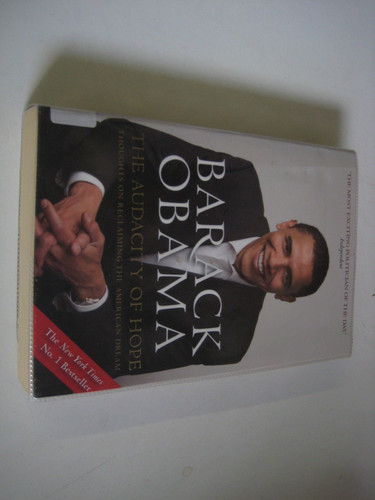


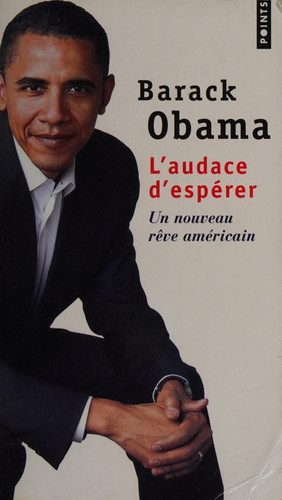


![Дерзость надежды мысли о возрождении амер. мечты : [пер. с англ.]](https://images.isbndb.com/covers/24395673484108.jpg)