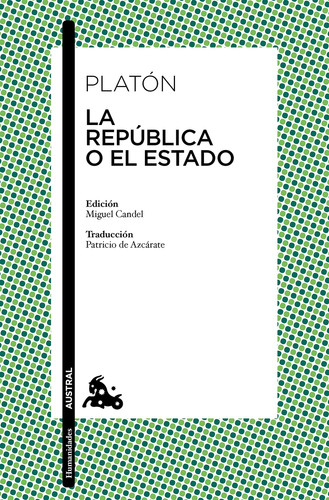
La República O El Estado
by Plato
7.94 / 10 233K ratings
- Language
- Spanish
- Published
- 2022
- Publisher
- Planeta Publishing Corporation
- Pages
- 399
- ISBN
- 9786070788864
Plato's The Republic is a foundational philosophical inquiry into the nature of justice, both in the individual and within society. Through a series of dialogues led by Socrates, the text constructs an elaborate vision of an ideal city-state, known as Kallipolis, to explore what constitutes a just political order and, by analogy, a just soul. The discussions delve into the roles of different social classes, the education of leaders, and the concept of philosopher-kings as ideal rulers, whose governance is based on wisdom and a pursuit of truth.
This work examines profound questions about ethics, governance, and the human condition, including the relationship between justice and happiness, the nature of reality, and the power of education to shape individuals and states. It presents arguments on the components of the human soul and how their harmony leads to a just and happy life. The Republic remains an influential text in political philosophy and ethics, continuing to challenge readers to consider the principles that should guide both personal conduct and the organization of society.
This work examines profound questions about ethics, governance, and the human condition, including the relationship between justice and happiness, the nature of reality, and the power of education to shape individuals and states. It presents arguments on the components of the human soul and how their harmony leads to a just and happy life. The Republic remains an influential text in political philosophy and ethics, continuing to challenge readers to consider the principles that should guide both personal conduct and the organization of society.
Subjects
- Kindle Store
- Categories
- Kindle eBooks
- General
- Reference
- Literature & Fiction
- Genre Fiction
- Europe
- Germany
- Arts & Photography
- Photography & Video
- Subjects
- Literary
- Self-Help
- Action & Adventure
- Fantasy
- Historical
- Self Service
- History
- Biographies & Memoirs
- Leaders & Notable People
- Military
- Arborist Merchandising Root
- Motivational
- Science & Math
- Education & Reference
- Education & Teaching
- Schools & Teaching
- Non-Classifiable
- Novelty
- Political
- Greece
- Poetry
- Law
- Religion & Spirituality
- Worship & Devotion
- Inspirational
- Study Guides
- Essays
- New Age & Spirituality
- Mathematics
- Cookbooks, Food & Wine
- English & College Success
- English
- Humor
- Essays & Correspondence
- World
- Study & Teaching
- Education Theory
- Science Fiction
- Politics & Social Sciences
- Philosophy
- Specialty Boutique
- New, Used & Rental Textbooks
- Teen & Young Adult
- Biological Sciences
- Foreign Language Study & Reference
- Art
- Humor & Entertainment
- Social Sciences
- Fiction
- Business & Economics
- Religious
- Regional & International
- Classics
- Politics & Government
- Public Affairs & Policy
- Criticism
- Education
- Love
- Literary Collections
- Religious Studies
- Sociology
- Science
- AMERICAN FICTION (FICTIONAL WORKS BY ONE AUTHOR)
- Instruction Methods
- Nonfiction
- Politics
- History & Criticism
- Antiques & Collectibles
- Instruction
- Religion
- True Crime
- Social Science
- Linguistics
- MAN-WOMAN RELATIONSHIPS_FICTION
- Metaphysics
- FICTION_FAMILY LIFE_GENERAL
- Ancient & Medieval Literature
- Ancient & Classical
- Words, Language & Grammar
- Fiction - General
- Political science
- Political Science
- Audio Adult: Books On Tape
- History & Theory
- Foreign Language Study
- Greek & Roman
- Social Philosophy
- People & Places
- European
- Juvenile Nonfiction
- Spirituality
- Political Ideologies
- Language Arts & Disciplines
- Language
- German
- History & Philosophy
- Specific Topics
- Movements & Periods
- Elections & Political Process
- Games & Activities
- Movements
- Genres & Styles
- Strategy
- Literary Criticism
- Ethics
- Study Aids
- Subjects & Themes
- International & World Politics
- Epistemology
- History & Schools of Thought
- Motivational & Inspirational
- Chinese
- Political Process
- NEW YORK (N.Y.)_FICTION
- Royalty
- World Literature
- Book Notes
- Human Rights
- Ancient Civilizations
- Rome
- Bilingual Education
- Baseball
- Social
- Medieval
- Greek
- Foreign Language Dictionaries & Thesauruses
- Philosophy & Social Aspects
- Ideologies & Doctrines
- Mind & Body
- Civilization
- Foreign Language - Dictionaries
- Phrase Books
- POLITICAL SCIENCE
- Card Games
- Ethics & Moral Philosophy
- Philosophy, Theory & Social Aspects
- Ancient
- Historiography
- Ethics & Morality
- Audiobooks
- Literary collections
- History & Surveys
- Literature - Classics
- MARRIED PEOPLE_FICTION
- Texts
- Portraits
- Political ethics
- Civics & Citizenship
- Rules & Procedures
- Artistic Photography
- Constitutions
- Public Affairs & Administration
- Early works to 1800
- Logic
- Ancient, Classical & Medieval
- Museum Studies
- Courts
- Portrait photography
- Individual Philosophers
- LITERARY CRITICISM
- Celebrities
- Textual Criticism
- Abridged Audio - Inspirational/Philosophy
- Politics and culture
- Utopias
- Con Artists, Hoaxes & Deceptions
- Ancient Languages
- State
- Magazines & Newspapers
Original edition
The RepublicOriginally published in 1888 English Binker North
Other editions (504)




Listen to the summary Narrated summary
In the bustling port of Piraeus, a conversation begins, seemingly innocently, at the home of the elderly Cephalus. The topic, at first, meanders through the tranquility of old age and the nature of wealth, but soon, a more profound question arises: what truly is justice? Cephalus offers that justice is simply speaking the truth and paying one's debts, a definition quickly challenged. His son, Polemarchus, then asserts that justice means doing good to friends and harm to enemies, a notion Socrates deftly dismantles, arguing that a truly just person would never intentionally inflict harm, even upon an adversary. The air thickens with a more aggressive challenge when the sophist Thrasymachus bursts into the discussion, declaring with fiery conviction that "justice is nothing other than the advantage of the stronger." He insists that rulers establish laws to benefit themselves, and what they call "justice" is merely a tool for their own gain, leaving the just man worse off than the unjust.
Socrates, however, is not swayed by this cynical view. He proposes that they embark on a grand thought experiment: to construct an ideal city in speech, believing that justice, writ large in a city, will be easier to discern and then apply to the individual soul. This city, a theoretical Kallipolis, is founded on the principle of specialization, where each person performs the task for which they are best suited by nature. Thus, three classes emerge: the producers, who provide goods and services; the auxiliaries, courageous warriors who defend the city; and the guardians, wise rulers who govern. A just society, then, is one where each of these parts performs its function in harmony, without interfering with the others.
The education of the guardians becomes paramount, for they are the very soul of this just city. They must be carefully trained in music and gymnastics, shielded from corrupting tales and influences, exposed only to stories that promote virtue and justice. This rigorous upbringing is designed to cultivate their rational faculties, preparing them for the ultimate responsibility of leadership. Indeed, it is argued that only philosophers, those who possess a deep love of wisdom and a grasp of eternal truths, are fit to rule. These "philosopher-kings" are not driven by personal gain but by a commitment to the common good, having seen the "Forms" and thus knowing what is truly good.
To illustrate the nature of this knowledge and the journey of the philosopher, three profound analogies are unveiled: the sun, the divided line, and the famous allegory of the cave. Imagine prisoners chained in a cave, seeing only shadows cast by a fire, believing these illusions to be reality. One prisoner escapes, ascends into the sunlight, and beholds the true world, eventually returning to share this profound truth, only to be met with disbelief and hostility. This journey symbolizes the ascent of the soul from the visible world of appearances to the intelligible realm of Forms, culminating in the apprehension of the Form of the Good, the ultimate source of all truth and being.
Just as the city has three classes, the individual soul is revealed to have three corresponding parts: the rational, the spirited, and the appetitive. The rational part seeks wisdom and truth, the spirited part yearns for honor and courage, and the appetitive part desires bodily pleasures and material possessions. An individual is just when these three parts are in harmony, with reason ruling over the spirited and appetitive elements, guiding the soul towards virtue. It is asserted that the just life is not only inherently good but also the most pleasant and fulfilling, contrasting sharply with the chaotic and unhappy existence of the unjust.
The discussion then turns to the various forms of unjust states and their corresponding individual characters, tracing the decline from the ideal aristocracy ruled by philosopher-kings, through timocracy, oligarchy, and democracy, ultimately descending into the wretchedness of tyranny. Each degeneration of the city mirrors a corruption within the soul, demonstrating how the pursuit of lesser goods - honor, wealth, unrestrained freedom - leads inevitably to imbalance and misery. The tyrant, consumed by his insatiable appetites, is shown to be the most unjust and unhappy of all.
Finally, the grand discourse concludes with the myth of Er, a soldier who dies and returns to life, recounting his experiences in the afterlife. He describes souls being judged, rewarded for their just lives, or punished for their injustices, for a thousand years. Afterward, each soul is given the chance to choose its next life, with the wisdom gained from past experiences guiding their choices. This myth serves as a powerful testament to the immortality of the soul and the enduring consequence of living a just or unjust life, emphasizing that justice is worthwhile not only for its own sake in this world but also for the eternal well-being of the soul.
Socrates, however, is not swayed by this cynical view. He proposes that they embark on a grand thought experiment: to construct an ideal city in speech, believing that justice, writ large in a city, will be easier to discern and then apply to the individual soul. This city, a theoretical Kallipolis, is founded on the principle of specialization, where each person performs the task for which they are best suited by nature. Thus, three classes emerge: the producers, who provide goods and services; the auxiliaries, courageous warriors who defend the city; and the guardians, wise rulers who govern. A just society, then, is one where each of these parts performs its function in harmony, without interfering with the others.
The education of the guardians becomes paramount, for they are the very soul of this just city. They must be carefully trained in music and gymnastics, shielded from corrupting tales and influences, exposed only to stories that promote virtue and justice. This rigorous upbringing is designed to cultivate their rational faculties, preparing them for the ultimate responsibility of leadership. Indeed, it is argued that only philosophers, those who possess a deep love of wisdom and a grasp of eternal truths, are fit to rule. These "philosopher-kings" are not driven by personal gain but by a commitment to the common good, having seen the "Forms" and thus knowing what is truly good.
To illustrate the nature of this knowledge and the journey of the philosopher, three profound analogies are unveiled: the sun, the divided line, and the famous allegory of the cave. Imagine prisoners chained in a cave, seeing only shadows cast by a fire, believing these illusions to be reality. One prisoner escapes, ascends into the sunlight, and beholds the true world, eventually returning to share this profound truth, only to be met with disbelief and hostility. This journey symbolizes the ascent of the soul from the visible world of appearances to the intelligible realm of Forms, culminating in the apprehension of the Form of the Good, the ultimate source of all truth and being.
Just as the city has three classes, the individual soul is revealed to have three corresponding parts: the rational, the spirited, and the appetitive. The rational part seeks wisdom and truth, the spirited part yearns for honor and courage, and the appetitive part desires bodily pleasures and material possessions. An individual is just when these three parts are in harmony, with reason ruling over the spirited and appetitive elements, guiding the soul towards virtue. It is asserted that the just life is not only inherently good but also the most pleasant and fulfilling, contrasting sharply with the chaotic and unhappy existence of the unjust.
The discussion then turns to the various forms of unjust states and their corresponding individual characters, tracing the decline from the ideal aristocracy ruled by philosopher-kings, through timocracy, oligarchy, and democracy, ultimately descending into the wretchedness of tyranny. Each degeneration of the city mirrors a corruption within the soul, demonstrating how the pursuit of lesser goods - honor, wealth, unrestrained freedom - leads inevitably to imbalance and misery. The tyrant, consumed by his insatiable appetites, is shown to be the most unjust and unhappy of all.
Finally, the grand discourse concludes with the myth of Er, a soldier who dies and returns to life, recounting his experiences in the afterlife. He describes souls being judged, rewarded for their just lives, or punished for their injustices, for a thousand years. Afterward, each soul is given the chance to choose its next life, with the wisdom gained from past experiences guiding their choices. This myth serves as a powerful testament to the immortality of the soul and the enduring consequence of living a just or unjust life, emphasizing that justice is worthwhile not only for its own sake in this world but also for the eternal well-being of the soul.
What other readers say
Liked
Readers overwhelmingly agree that this book is a monumental and foundational text in Western philosophy, recognized for its profound influence on subsequent thought. Many reviewers highlight its ability to stimulate deep intellectual engagement, encouraging readers to actively analyze arguments, identify fallacies, and think critically rather than passively accept ideas. Praised for its exquisite craftsmanship and poetic qualities, the work is seen as meticulously constructed, with every detail serving a purpose, making re-readings a richer experience. It is celebrated for posing fundamental questions across a vast array of disciplines, from ethics and metaphysics to political science, effectively illuminating the intellectual landscape for many. Furthermore, the book is noted for introducing brilliant and revolutionary ideas, including early suggestions for gender equality in education and political roles, laying groundwork for thousands of years of Western philosophical and political discourse. It champions the joy of thinking for its own sake, making it a valuable exercise in rigorous thought.
Disliked
Despite its lauded status, the book draws significant criticism for its argumentative methodology and certain conclusions. Reviewers frequently point to the use of strawman arguments, logical fallacies, and presumptive statements that often go unchallenged within the dialogues themselves, leading some to perceive the discussions as more of a monologue than a genuine debate. Many ideas are considered outdated by modern standards, featuring generalizations and conclusions that lack contemporary rational grounding. The text is also described as an arduous and demanding read, with a style from 2500 years ago that requires careful re-reading. Furthermore, some aspects of the proposed ideal state offend modern sensibilities, including suggestions of censorship, a rigid social structure, and elements that appear totalitarian, such as the control of arts and culture for propaganda, and a perceived lack of compassion in certain policies. Reviewers note contradictions within the arguments and question the author's true intent behind some seemingly "frustratingly stupid" points or the proposal of a "Noble Lie" to maintain social order.
In short
Ultimately, the book is widely regarded as a great, albeit flawed, masterpiece and an indispensable cornerstone of Western thought. It is not presented as a practical blueprint for an actual state, but rather as a profound thought experiment and an intellectual inquiry into fundamental questions concerning justice, ethics, and the ideal way of life. Readers are encouraged to approach it with an open and critical mind, appreciating its historical context and its enduring capacity to provoke reflection on contemporary societal issues and personal values. While challenging, it is considered essential reading for anyone interested in philosophy, political theory, intellectual history, or those who enjoy grappling with complex, foundational ideas and engaging in deep critical thinking, even if they ultimately disagree with many of its conclusions. The work demands active participation from its readers, offering a rewarding journey into the origins of Western intellectual tradition.
No reviews yet. Be the first.