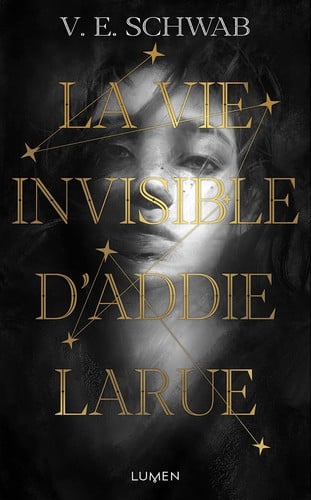
In France, 1714, a young woman named Addie LaRue makes a desperate bargain to live forever. But the deal comes with a terrible price: she is cursed to be forgotten by everyone she meets. This begins an extraordinary, solitary life that spans centuries and continents, as Addie moves like a ghost through history, unable to hold a home, build a relationship, or leave any trace of her own existence. For three hundred years, she is a fleeting muse for artists and thinkers, a whisper in the memory of lovers, stubbornly refusing to surrender her soul to the darkness that hunts her.
Her invisible life is forever changed when, in a small bookstore in modern-day New York, she meets a young man who says three words that should be impossible: "I remember you." Suddenly, the curse that has defined her existence is broken, raising dangerous questions about why this man is different and what his presence might cost her. For a woman who has been forgotten for so long, the chance to finally leave a mark on the world is a perilous and irresistible opportunity, forcing her to confront the true meaning of her bargain and the legacy of a life no one was ever supposed to remember.
In the summer of 1714, a girl named Adeline LaRue runs for her life, not from a mob, but from a future already written for her - a marriage, a village, a life small as a stone. She flees into the woods as dusk settles, her wedding dress snagging on the branches, and in her desperation, she breaks a rule she has always known. She prays to the gods that answer after dark. A shadow takes shape between the trees, coalescing into the form of a man she has only ever drawn in charcoal, a stranger conjured from her dreams. He offers her a deal for the freedom and time she craves, a life untethered. But the price is her soul, to be claimed only when she is done with it, when she is ready to surrender. “Done,” he whispers, sealing the bargain with a kiss that tastes of blood.
The cost reveals itself at once. Adeline is free, but she is also forgotten. She returns to her village to find her parents staring at her with the vacant eyes of strangers. Her name becomes a word she cannot speak, a stone in her throat. Every mark she tries to make - in dirt, in ink, in memory - is instantly erased. She is a ghost to the world, cursed to move through it without leaving a trace. The moment a door closes, the moment she is out of sight, she vanishes from the minds of everyone she meets. This becomes her life, a long, lonely road stretching across the centuries, a constant cycle of hellos and goodbyes where she is the only one who remembers either.
Three hundred years later, the girl who is no longer Adeline drifts through New York City. She has learned the contours of her curse, becoming a flawless thief of coats and meals and borrowed beds. She survives on the edges of other people's lives, a phantom in their stories. She spends a month with a musician named Toby, coaxing a song from his fingertips, only to wake each morning a stranger in his apartment. She knows the ache of it, the constant fall, the hope that this time, this person, will be different. It never is. “Don't forget me,” she says as she leaves, a superstition, a plea. But by the time the door closes, he already has.
Still, ideas are wilder than memories. They are like weeds, taking root in unseen places. Though she cannot leave her own mark, Addie learns to become an idea, a muse. Her face, with its seven freckles scattered like a constellation, becomes a ghost in the frame of history. She is a charcoal sketch of a lover in Italy, an Impressionist painting of a woman by the sea in France, the inspiration for a wooden sculpture in New York. She leaves these echoes of herself scattered across time, small acts of defiance against the darkness that claimed her. They are proof that she was here, that she existed, even if no one knows her name.
Then, one day in a dusty, half-hidden bookstore called The Last Word, everything changes. She tries to steal a book - a battered copy of *The Odyssey* in Greek - and is caught by a boy with kind eyes and dark, messy curls. His name is Henry. She expects him to forget her as soon as she walks out the door. But when she returns the next day, bracing for the familiar blankness in his gaze, he looks at her, annoyed and bewildered, and says three words that shatter her world. “I remember you.”
Henry Strauss is a boy with his own curse. He feels everything too much, a heart born broken and pieced back together, leaving it too open to the world. A year ago, on a rainy night, standing on the edge of a rooftop, he made a deal with the same green-eyed shadow. He was tired of being not enough, tired of the storms inside his head. He asked to be loved. And the darkness granted his wish: now, everyone who looks at Henry sees exactly what they want to see. A perfect son, a brilliant artist, the lover they've always dreamed of. But it is a hollow affection, an love for an illusion, not for him. And his deal has a time limit. He has one year, and the clock is ticking down.
For the first time, Addie is not alone. With Henry, she can build something. She can have a drawer in his apartment, a key that doesn't disappear. She can wake up in the morning and hear her name. She tells him her story, and he writes it down, his hand giving form to her words, her life. They fall in love in the quiet spaces - in the bookstore after hours, on a blanket in the park, in the silence of his bed. But their time is borrowed. Henry's deal is coming due, the single golden hand on the watch the shadow gave him creeping ever closer to midnight. And Addie realizes Luc didn't make a mistake; he set a trap. He gave her something to love, knowing he would be the one to take it away.
Over the centuries, the darkness - Luc - has been her only constant. He appears on the anniversary of their deal, a handsome tormentor, a possessive god, a bitter companion. He is the only one who remembers her, a fact he wields like a weapon. Theirs is a war of attrition, a long and toxic dance. He tempts her with surrender, and she answers with defiance. They become lovers for a time, a fraught and furious affair built on loneliness and hate and something dangerously close to love. But it ends in fire, in New Orleans, when she realizes he will never see her as an equal, only as a thing to be owned. He wants to be the one who breaks her.
As the last days of Henry's year drain away, Addie knows she cannot bear to lose him. She makes a final, desperate gambit. She summons Luc and offers a new deal, rewriting the terms of her own. She will surrender not her soul, but herself. She will be his, to stand by his side, for as long as he will have her. In exchange, Henry will live, his deal undone. He will be free, and he will be allowed to remember her. Luc, triumphant, accepts. He believes he has finally won.
In the aftermath, Henry wakes up, alive and alone. But he remembers. He remembers everything. He takes the story she gave him - the invisible life of Addie LaRue - and he writes it down, publishing it under her name alone, sending her story out into the world. Meanwhile, Addie stands at Luc's side, a beautiful prize for a fickle god. He thinks their game is over, but she is merely playing a different one now. He taught her that the power of a deal is in its wording. She did not promise to be his forever, only for as long as he wants her. And she, who has become a student of his cruelty and his pride, knows better than anyone how to make him stop wanting her. It may take a decade, or a century, but she will win her freedom. She will break his heart, and he will come to hate her once again. And then, he will let her go.
What other readers say
Liked
Many readers found "The Invisible Life of Addie LaRue" to be a profoundly moving and captivating story, frequently praising its unique and intriguing premise. The author's writing style is consistently highlighted as beautiful, lyrical, and poetic, drawing readers into the narrative with its eloquent prose and evocative descriptions. Reviewers often describe the book as an emotional journey, capable of eliciting strong feelings of yearning, loneliness, and resilience, with many calling it a "love letter to art" and the human experience. The complex characters, particularly Addie's enduring spirit and Henry's relatable struggles with mental health, resonated deeply with many. The book is also lauded for its exploration of powerful themes such as memory, identity, freedom, and the desire to leave a lasting mark on the world, with some declaring it the author's best work to date.
Disliked
Despite its strengths, the book received notable criticism, primarily concerning its pacing and plot. Many reviewers found the narrative to be slow, repetitive, and lacking a strong, propulsive plot, suggesting it could have been significantly shorter without losing essential content. The writing, while often beautiful, was sometimes perceived as overly ornate, repetitive in its descriptions, and occasionally pretentious, with certain phrases and character traits recurring to a distracting degree. Some readers also felt that Addie, despite living for centuries, lacked significant character development and remained naive or self-absorbed. A significant point of contention for several reviewers was the book's perceived Eurocentrism, with Addie's extensive life rarely engaging with non-Western cultures or major historical events like colonialism or civil rights, leading to a narrow perspective on universal themes. Additionally, some found the romantic relationships lacked chemistry, and the ending, while appreciated by others, was deemed predictable by some.
In short
Ultimately, "The Invisible Life of Addie LaRue" is a polarizing read, deeply loved by many for its emotional depth and lyrical prose, but criticized by others for its narrative choices and perceived thematic limitations. It is best suited for readers who appreciate character-driven, atmospheric stories that prioritize introspection and thematic exploration over fast-paced action or intricate plot twists. Those who enjoy reflective narratives about art, history, and the human condition, and who can connect with characters grappling with profound loneliness and the desire for remembrance, will likely find this book deeply impactful. However, readers seeking a more diverse global perspective, a strong, evolving plot, or direct engagement with historical events may find themselves wanting more.