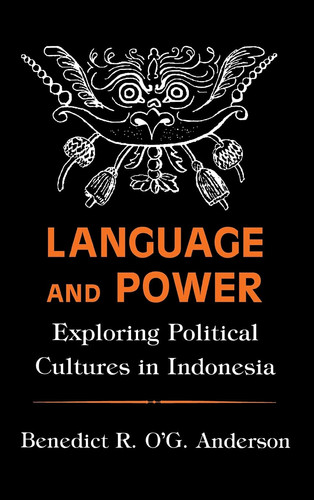
Benedict R. O'G. Anderson's Language and Power explores the complex interplay of cultural and political forces that have shaped Indonesia. The book delves into the contradictions arising from Indonesia's status as a young nation with an ancient state, tracing its origins to seventeenth-century Dutch conquests. It examines how contemporary Indonesian politics, conducted in Bahasa Indonesia, interact with the deeply rooted medieval cultures of its peoples, particularly the Javanese.
Through an analysis of diverse examples, from classical poetry to public monuments and cartoons, Anderson illuminates the dynamic relationship between modern and traditional conceptions of power. The collection of eight essays deepens understanding of how language mediates power and contributes to the evolution of national consciousness within Indonesia. This work offers insights into Javanese political culture, from the nineteenth century through the post-World War II independence era, revealing how historical imaginings of power continue to influence modern Indonesian politics.
Indonesia, a nation born of ancient lands, finds itself caught in a profound tension between a young, modern state and cultures steeped in the lore of medieval times. The very fabric of its political life, woven with the threads of the new national tongue, Bahasa Indonesia, confronts the deep-rooted traditions of its peoples, particularly the Javanese, whose understanding of power and society stretches back centuries before the Dutch conquests of the seventeenth century. This intricate dance of past and present, of the inherited and the invented, forms the core of its complex political identity.
One delves into the heart of this cultural paradox by tracing the evolution of Javanese political thought. Imagine a time in the early nineteenth century when the very concepts of "politics," "colonialism," "society," or "class" found no direct equivalent in the Javanese lexicon. How, then, was power conceived in such a world? It was envisioned through an ancient lens, one that shaped the contours of modern Indonesian governance in ways subtle yet undeniable. The essays within this exploration reveal how these traditional imaginings, passed down through generations, continue to cast long shadows over the present-day political landscape.
The advent of Bahasa Indonesia as the national language introduced a fascinating incongruity. Here was a tongue, consciously crafted and egalitarian in spirit, designed to forge a unified national consciousness. Yet, it often stood in stark contrast to the hierarchical and authoritarian nuances embedded within traditional Javanese official culture. This tension between the ironizing, unifying language of the modern nation and the deeply stratified implications of older cultural forms is a central theme, illustrating how language itself becomes a battleground for competing notions of authority and collective identity.
Consider the very origins of Bahasa Indonesia: an invented language, a vibrant tapestry woven from trade Malay, Javanese, Sanskrit, Chinese, Arabic, English, and Dutch loanwords. It is a language without ancient texts or native speakers predating the twentieth century, yet it became the vehicle for a new national narrative. Its emergence allowed for the articulation of a shared identity, distinct from the colonial past and the disparate regional loyalties, but it also necessitated a mediation between this fresh linguistic vessel and the profound historical consciousness of its speakers.
This journey through Indonesia's political cultures is not merely an academic exercise; it is an immersion into the very consciousness of a nation in formation. From the lyrical verses of classical poetry to the stark imagery of public monuments and the playful subversion of cartoons, every example serves to illuminate the intricate interplay between inherited power structures and the evolving concept of nationhood. It reveals how the meaning of power, the very essence of national identity, is constantly negotiated and reshaped through the languages people speak and the cultural narratives they embrace.
The exploration extends to pivotal moments in history, such as the period before and after the rise of Indonesia's nationalist movement. One sees the poignant efforts of Javanese intellectuals struggling to sustain an imagined "Java" even as colonial capitalism consumed their island, integrating it into the vast, heterogeneous Dutch East Indies. And then, the profound transition, a seismic shift from old cultures to new, culminating in the deep internal tensions and tragic massacres that followed independence after World War II. It is a testament to the enduring power of cultural memory and linguistic expression in shaping a nation's destiny.
Opening the reader…
What other readers say
Liked
The book is widely praised for its profound insights into Indonesian political culture, particularly concerning Java. Reviewers highlight Benedict Anderson's remarkable deep understanding of the region and his unique exploration of how power and language intricately relate to the nation's struggle for independence. The work is lauded for its multidisciplinary approach, drawing from anthropology, linguistics, history, and politics without sacrificing analytical rigor, offering a fresh perspective that moves beyond standard postcolonial analysis. Readers found it exceptional for illuminating how authority is performed through rituals, symbols, and language, and for its relevant historical reflections on traditional Javanese power systems and the evolving role of Bahasa Indonesia. Many consider its analysis of the nation-state concept foundational and universal, with particular strengths in tracing the genealogy of Bahasa Indonesia. The prose is described as clean, clear, and logically presented, making it an enlightening and thought-provoking read that serves as an excellent gateway to further academic sources.
Disliked
Despite its strengths, some reviewers found the book challenging to navigate. Common criticisms include its complexity and occasional obscurity, with some parts being difficult to follow due to subtle allusions. As a collection of essays written over several decades, it sometimes presents small inconsistencies or reversals across chapters. A few readers felt that the book's broad scope, encompassing a wide array of topics within a single volume, could be overwhelming and might have benefited from being separated into multiple, more focused works. Furthermore, the highly subtle nature of many subjects discussed may necessitate a second reading for full comprehension, and for those reading a translated version, the translation itself was noted as potentially verbose.
In short
Overall, "Language and Power" is considered an indispensable and valuable academic text for anyone seeking a comprehensive understanding of the deeper logics underpinning Indonesian politics, culture, and society, especially its Javanese cultural core. It provides a systematic and academically grounded framework for decoding the often-opaque operations of power in the region. This book is highly recommended for scholars, policy professionals, businesspeople, and any reader interested in postcolonial studies, anthropology, linguistics, or the formation of nation-states. It particularly appeals to those who appreciate rigorous academic analysis and are prepared to engage with complex, nuanced, and subtly presented ideas about the interplay of power, language, and identity.