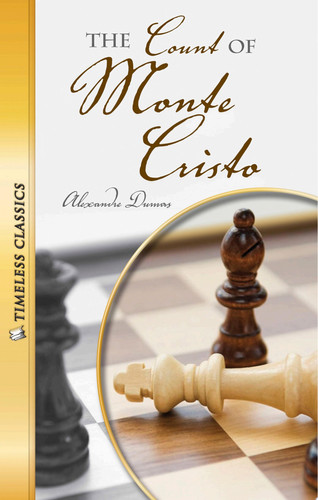
On the day he is to be married and promoted to captain of his own ship, the young sailor Edmond Dantès is arrested for treason. Framed by jealous rivals and condemned by a corrupt magistrate, he is imprisoned for life in the grim island fortress of Château d'If. In the depths of despair, a fellow inmate reveals the location of a hidden treasure on the island of Monte Cristo, inspiring a daring escape and a new purpose. After years of wrongful imprisonment, Dantès emerges, transformed into a man of immense wealth and mysterious power.
Now known as the Count of Monte Cristo, he moves with calculated precision through the highest circles of Parisian society, a world inhabited by the very men who orchestrated his downfall. A story of betrayal, hope, and retribution, the narrative follows the Count as he meticulously engineers the destruction of his enemies. It is an exploration of the consuming nature of vengeance and the profound consequences of taking justice into one's own hands, questioning whether the ultimate revenge can ever restore what was lost.
In the sun-drenched port of Marseilles, a young sailor named Edmond Dantès returns home, his heart full of promise. At nineteen, he is on the cusp of becoming captain of the ship *Pharaon* and marrying his beloved, the beautiful Catalan, Mercédès. But his good fortune casts long shadows of envy. Danglars, the ship's purser, covets his promotion; Fernand Mondego, his rival, desires Mercédès for himself. Overheard by a drunken, jealous neighbor named Caderousse, their resentments curdle into a plot born of wine and malice. On the very day of his wedding feast, amidst the joyous celebration, Dantès is arrested, accused of being a Bonapartist agent.
He is brought before the deputy procureur, Gérard de Villefort, an ambitious young man eager to advance his career. At first, Villefort is inclined to release the plainly innocent Dantès. But when he discovers the supposedly treasonous letter Dantès was carrying was addressed to his own father, a known Bonapartist, his ambition curdles into self-preservation. To bury his own family's secret and eliminate any connection to the conspiracy, he condemns the young sailor without a trial. Dantès is spirited away, swallowed by the sea-swept dungeons of the Château d'If. To the world, and to his weeping bride, he has simply vanished, leaving behind a name whispered only in sorrow until it is forgotten.
Years bleed into one another in the crushing darkness of the prison. Despair becomes Dantès's only companion, and he resolves to starve himself to death. But as he hovers on the edge of oblivion, a scratching sound from the adjoining cell awakens a flicker of hope. He begins to dig and soon makes contact with an old Italian abbé named Faria, a man of immense learning and wisdom who has been imprisoned for years. The abbé becomes his teacher, his confidant, his father. He pours into the young man's mind all his knowledge of science, history, and languages. Together, they piece together the puzzle of Dantès's betrayal, naming the men who sent him to his living tomb. Before he dies, the abbé bequeaths to Edmond the secret of a colossal treasure hidden on the deserted island of Monte Cristo. When Faria's body is sewn into a burial sack, Dantès seizes his one, desperate chance: he takes the abbé's place in the shroud, and is hurled from the battlements into the cold, raging sea.
Free and impossibly wealthy after unearthing the treasure of the Spada family, Dantès spends years traveling the East, honing his skills and hardening his heart. He is no longer the naive sailor but a new man, an instrument of Providence forged in suffering. He returns to the world as the enigmatic and fabulously wealthy Count of Monte Cristo, a living enigma with a specter from a forgotten past in his eyes. His betrayers have all prospered: Danglars is a powerful and respected baron of finance; Fernand, now the Count de Morcerf, is a celebrated general, a peer of France, and the husband of Mercédès; Villefort stands at the apex of the Parisian legal system. None of them recognize the pale, dark-eyed nobleman who enters their lives, dazzling them with his intellect and his seemingly limitless fortune.
The Count's vengeance begins like a quiet tide, pulling at the foundations of his enemies' lives. He reveals Fernand de Morcerf's treachery in Yanina, where he betrayed and sold into slavery the family of Ali Pasha, whose daughter, Haidee, the Count has rescued and now presents as the living proof of the crime. Publicly disgraced, Morcerf is abandoned by his wife and son. He confronts the Count, who reveals his true identity. "I am Edmond Dantès," he declares, and the general, shattered, goes home and takes his own life. Mercédès and her son, Albert, horrified by the source of their fortune, renounce their name and wealth and depart, leaving the Morcerf mansion to its ghosts.
For Danglars, the Count orchestrates a series of devastating financial blows, playing on the banker's greed. He manipulates the telegraph to create false market panics and introduces the charming young Andrea Cavalcanti - in truth an escaped convict named Benedetto - as a suitor for his daughter, Eugénie. After stripping Danglars of millions, the Count arranges for Benedetto to be exposed as a fraud at his own wedding contract signing. Ruined and fleeing his creditors, Danglars is captured by the bandit Luigi Vampa, an associate of the Count. There, in a cavern, his fortune is slowly starved from him, as he is forced to pay a hundred thousand francs for a simple piece of bread, a cruel echo of how Dantès's own father had died of hunger. When Danglars is broken, his hair turned white with terror, Monte Cristo reveals his identity and lets him go, a penniless madman.
Villefort's punishment is the most terrible of all. The Count, aware of Madame de Villefort's ambition for her own son, subtly introduces the knowledge of poisons into the household. The poison spreads like a plague, killing Valentine's maternal grandparents and a loyal servant. When Valentine herself is struck down, Villefort's world collapses. At the same moment, the trial of the murderer Benedetto begins, and the convict reveals his true identity: he is the illegitimate son of Villefort himself, whom the prosecutor tried to bury alive as an infant. Publicly destroyed, Villefort rushes home to confront his wife, only to find she has poisoned herself and their young son. Driven mad by the sight of the dead, he wanders his garden, digging in the earth, his mind lost forever.
But vengeance brings a bitter aftertaste. The death of Villefort's innocent son weighs heavily on the Count's soul, and he begins to question his right to act as Providence. His final act is one of mercy. He had saved Valentine from her stepmother's poison with a powerful narcotic that mimicked death, and he now reunites her with her beloved, Maximilian Morrel. Leaving the young couple a vast fortune, the Count visits Mercédès one last time in Marseilles, where she lives a life of lonely penance. There, he finds a measure of peace, forgiving her and himself. With Haidee, who has devoted her life to him, he sails away into the horizon, having at last learned that the sum of all human wisdom is contained in two words: "Wait and hope."
What other readers say
Liked
Readers widely celebrate "The Count of Monte Cristo" as a captivating and intricate classic, delivering a masterfully crafted and deeply engaging revenge narrative. Many found the extensive plot, despite its considerable length, to be enthralling and remarkably fast-paced, often describing it as a page-turner that consistently entertains. The protagonist is frequently praised as a compelling and well-developed character, evoking a wide range of emotions from readers. Reviewers appreciate the rich storytelling, which skillfully weaves together historical context, detailed settings, and a diverse cast of characters, creating an immersive world. The novel's profound exploration of themes such as justice, retribution, hope, and forgiveness, often with nuanced and thought-provoking depth, is also highly commended for its enduring relevance and powerful impact.
Disliked
Despite its widespread acclaim, some readers found the novel's immense length, often exceeding 1200 pages, to be a notable challenge, occasionally leading to slower pacing or a sense of being drawn out, particularly in certain middle sections and towards the conclusion. Critics also point to the story's inherent implausibility and convoluted plotlines, which, while often entertaining, can sometimes be difficult to follow or appear exaggerated. Certain characterizations are noted as being less developed, especially female characters, or overly simplistic in their portrayal of good versus evil. The protagonist's moral ambiguity and the author's apparent endorsement of his extreme actions, including the impact of his plans on seemingly innocent individuals and a problematic romantic subplot, caused discomfort for some. Additionally, a few reviewers observed that aspects of the writing style, such as repetitive dialogue and occasional inconsistencies, reflect its original serialized format and can feel dated to modern readers.
In short
Ultimately, "The Count of Monte Cristo" is widely regarded as an enduring literary classic and a masterpiece, highly recommended for its compelling narrative and profound emotional resonance. While its considerable length and occasional complexities might present a challenge, readers who appreciate intricate plots, rich historical settings, and a deep exploration of themes like justice, betrayal, and redemption will find it immensely rewarding. It is particularly recommended for those seeking an adventurous and emotionally charged story, individuals interested in a classic that defies typical "boring" stereotypes, and readers willing to invest time in a sprawling narrative that offers both thrilling entertainment and significant food for thought. Many reviewers consider it a must-read that leaves a lasting impression.