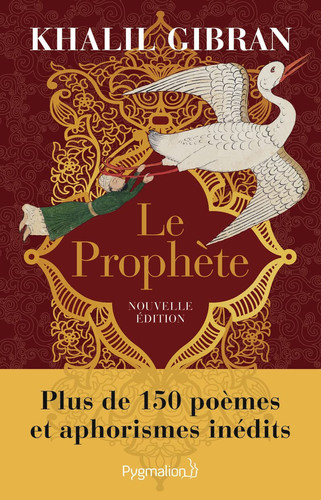
Le Prophète
7.64 / 10 240K ratings
- Language
- French
- Published
- 2021
- Publisher
- PYGMALION
- Pages
- 224
- ISBN
- 9782756433585
Before he departs the city of Orphalese after twelve years in exile, the prophet Almustafa is approached by the local people, who seek his wisdom one final time. As he waits for the ship that will carry him home, he delivers a series of discourses on the fundamental aspects of the human experience. Each poetic essay addresses a different dimension of life, from the intimacy of love and marriage to the public nature of laws, and the personal depths of joy and sorrow, pain, and self-knowledge.
The Prophet offers not answers, but a new perspective on the questions that define our lives. Through Almustafa's lyrical and profound responses, the book explores the interconnectedness of existence and the spiritual meaning woven into everyday life. It is a guide to understanding the relationship between the self and the world, presenting timeless spiritual wisdom that encourages readers to look within for truth and to find a deeper connection to humanity.
The Prophet offers not answers, but a new perspective on the questions that define our lives. Through Almustafa's lyrical and profound responses, the book explores the interconnectedness of existence and the spiritual meaning woven into everyday life. It is a guide to understanding the relationship between the self and the world, presenting timeless spiritual wisdom that encourages readers to look within for truth and to find a deeper connection to humanity.
Subjects
- Comics & Graphic Novels
- Reference
- Literature & Fiction
- Genre Fiction
- Arts & Photography
- Subjects
- Literary
- Self-Help
- Health, Fitness & Dieting
- Action & Adventure
- Fantasy
- Science Fiction & Fantasy
- Epic
- Historical
- Self Service
- Anthologies
- Arborist Merchandising Root
- Motivational
- Spiritual
- Body, Mind & Spirit
- New Age
- Poetry
- Coming of Age
- Family Life
- Religion & Spirituality
- Worship & Devotion
- Inspirational
- Contemporary
- United States
- Christian Books & Bibles
- Christian Living
- Essays
- New Age & Spirituality
- Emotions
- Parenting
- English & College Success
- English
- SPIRITUALITY
- Personal Transformation
- Politics & Social Sciences
- Philosophy
- Faith
- Consciousness & Thought
- POETRY (POETIC WORKS BY ONE AUTHOR)
- Magical Realism
- Specialty Boutique
- New, Used & Rental Textbooks
- Teen & Young Adult
- Dramas & Plays
- Foreign Language Study & Reference
- Art
- Humor & Entertainment
- Fiction
- Christianity
- Juvenile Fiction
- Religious
- Asian
- Alternative Medicine
- Healing
- Classics
- Mysticism
- Other Religions, Practices & Sacred Texts
- Literary Collections
- Fiction, general
- Psychology
- Erotica
- Adaptations
- Meditation
- Spiritualism
- History & Criticism
- Life Stages
- Religion
- Success
- Islam
- Divination
- Christian Life
- Ancient & Classical
- Fiction - General
- Regional & Cultural
- Eastern
- Spirituality
- Criticism & Theory
- Inspiration & Personal Growth
- Themes & Styles
- Values & Virtues
- Movements
- Occultism
- American
- Family
- Literary Criticism
- Subjects & Themes
- Devotional
- Meditations
- Personal & Practical Guides
- History & Schools of Thought
- Family & Relationships
- Motivational & Inspirational
- Christian
- Popular Culture
- Humanism
- Short Stories (single author)
- Criticism and interpretation
- Death
- Happiness
- World Literature
- Fairy Tales, Folk Tales, Legends & Mythology
- Physiological Psychology
- Medieval
- American literature
- Poetry (poetic works by one author)
- FICTION_VISIONARY & METAPHYSICAL
- Ethics & Moral Philosophy
- Middle Eastern
- Pop Culture
- Ethics & Morality
- Arabic poetry
- Baha'i
- History & Surveys
- Language readers
- Cults
- Metaphysical & Visionary
- Inspirational & Religious
- Ancient, Classical & Medieval
- Childbirth
- Literature & the Arts
- Translations into English
- Visionary & Metaphysical
- Graphic novels
- Sufi
- Love & Erotica
- Gaia & Earth Energies
- Existentialism
- Ancient Mysteries & Controversial Knowledge
- Fairy tales
- Philosophy and religion
- Indic
Original edition
The Prophet (German Edition)Originally published in 1900 German Patmos Verlag GmbH & Co KG
Other editions (271)

Listen to the summary Narrated summary
For twelve years, Almustafa, the chosen and beloved prophet, had sojourned in the city of Orphalese, his spirit often restless, watching from the hills, a silent observer of their lives. Now, the ship that would carry him back to the isle of his birth had appeared through the mists of the harbor, a sight that filled him with both joy and a profound sorrow, for he had scattered fragments of his spirit in these streets and among these people. As he made his way to the great square before the temple, the townspeople gathered, their hearts heavy with the knowledge of his impending departure, imploring him to stay.
It was Almitra, the seeress, the first to believe in him upon his arrival, who spoke for them all, asking that he first impart the wisdom he had gathered during his time among them. And so, Almustafa stood before them, his voice like a gentle breeze carrying ancient truths, and began to speak of the profound mysteries of life, answering their questions on matters that touched the very core of their existence.
He spoke of love, not as a possession, but as a boundless force that binds souls while allowing for individual freedom, a path that is both hard and steep, yet essential. He revealed that marriage, too, is an eternal bond of souls, yet it thrives only when there is ample space for each spirit to dance freely, like the winds of the heavens between the cypress and the oak. Children, he taught, are not truly theirs, but the sons and daughters of Life's longing for itself, coming through them but not from them, their souls belonging to tomorrow.
On giving, he proclaimed that one gives but little when offering only possessions; true giving comes from the heart, a testament to one's own abundance. Work, he said, is love made visible, a way to keep pace with the earth and the soul of the earth, and in laboring, one truly loves life. He guided them to understand joy and sorrow not as separate entities, but as intertwined forces, two sides of the same coin, where the deeper sorrow carves into one's being, the more joy one can contain. Pain, he explained, is but the breaking of the shell that conceals one's understanding, a spiritual awakening that, though painful, allows for growth.
He spoke of houses and clothes, urging them to maintain their spiritual connection with nature, to carry the earth's fragrance in their garments, and to remember that their souls dwell not in houses of stone, but in the boundless sky. He touched upon buying and selling, laws, and even crime and punishment, advocating for compassionate understanding and self-reflection over punitive justice. Freedom, he emphasized, is an internal state, not merely the absence of external chains, and reason and passion are not adversaries but partners, like the rudder and sails of a ship, both essential for navigating life's vast oceans.
Finally, Almustafa addressed the profound mystery of death, likening it not to an end, but to an entrance to the eternal, a rejoining of the divine order, as rivers join the sea. He urged them to embrace it with joy, not fear, for it liberates the soul to ascend unburdened by earthly constraints. His words, a tapestry of wisdom woven with poetic prose, resonated deeply, transforming complex life themes into spiritual reflections that offered a roadmap for navigating the human experience. As the sun began to set, casting long shadows across Orphalese, Almustafa offered his final farewell, stepping onto the ship that would carry him away, leaving behind a city forever touched by his profound insights.
It was Almitra, the seeress, the first to believe in him upon his arrival, who spoke for them all, asking that he first impart the wisdom he had gathered during his time among them. And so, Almustafa stood before them, his voice like a gentle breeze carrying ancient truths, and began to speak of the profound mysteries of life, answering their questions on matters that touched the very core of their existence.
He spoke of love, not as a possession, but as a boundless force that binds souls while allowing for individual freedom, a path that is both hard and steep, yet essential. He revealed that marriage, too, is an eternal bond of souls, yet it thrives only when there is ample space for each spirit to dance freely, like the winds of the heavens between the cypress and the oak. Children, he taught, are not truly theirs, but the sons and daughters of Life's longing for itself, coming through them but not from them, their souls belonging to tomorrow.
On giving, he proclaimed that one gives but little when offering only possessions; true giving comes from the heart, a testament to one's own abundance. Work, he said, is love made visible, a way to keep pace with the earth and the soul of the earth, and in laboring, one truly loves life. He guided them to understand joy and sorrow not as separate entities, but as intertwined forces, two sides of the same coin, where the deeper sorrow carves into one's being, the more joy one can contain. Pain, he explained, is but the breaking of the shell that conceals one's understanding, a spiritual awakening that, though painful, allows for growth.
He spoke of houses and clothes, urging them to maintain their spiritual connection with nature, to carry the earth's fragrance in their garments, and to remember that their souls dwell not in houses of stone, but in the boundless sky. He touched upon buying and selling, laws, and even crime and punishment, advocating for compassionate understanding and self-reflection over punitive justice. Freedom, he emphasized, is an internal state, not merely the absence of external chains, and reason and passion are not adversaries but partners, like the rudder and sails of a ship, both essential for navigating life's vast oceans.
Finally, Almustafa addressed the profound mystery of death, likening it not to an end, but to an entrance to the eternal, a rejoining of the divine order, as rivers join the sea. He urged them to embrace it with joy, not fear, for it liberates the soul to ascend unburdened by earthly constraints. His words, a tapestry of wisdom woven with poetic prose, resonated deeply, transforming complex life themes into spiritual reflections that offered a roadmap for navigating the human experience. As the sun began to set, casting long shadows across Orphalese, Almustafa offered his final farewell, stepping onto the ship that would carry him away, leaving behind a city forever touched by his profound insights.
What other readers say
Liked
The graphic novel adaptation of The Prophet is widely celebrated for its absolutely stunning artwork and illustrations. Reviewers consistently praise how the visuals beautifully complement Kahlil Gibran's classic text, transforming nearly every page into a piece of art and making the words come alive. Many highlight the gorgeous and meaningful images of animals, which effectively illustrate deeper philosophical concepts. A significant positive for many readers is the addition of a modern narrative, featuring a woman caring for her ailing parent. This new storyline is frequently lauded for grounding the original poetry, making it more relatable, accessible, and providing a contemporary framework that helps readers connect with the timeless questions explored in the book.
Disliked
However, some reviewers found aspects of the original text to be pretentious, overly flowery, or even "mumbo jumbo," with certain passages proving difficult to connect with due to a style reminiscent of religious scripture. While the new narrative was a strength for many, a minority of readers considered it unnecessary or even a manipulation of the original work, feeling it detracted from Gibran's words resonating independently. A few readers also expressed a lukewarm response to the artwork, describing it as inconsistent or merely "okay." Additionally, the contemplative nature of Gibran's poetry meant that some found the typical fast pace of graphic novels ill-suited, suggesting a slower, more deliberate reading approach.
In short
Overall, this graphic novel is largely presented as a beautiful and moving reinterpretation of Kahlil Gibran's classic work. It successfully blends the original poetic text with striking visuals and a relatable contemporary story, offering a fresh and engaging perspective. This adaptation is particularly recommended for readers who are new to The Prophet and might find the original text intimidating, serving as an excellent and accessible introduction. It also appeals to long-time fans looking to re-experience the work in a visually rich and emotionally resonant format, or anyone seeking a contemplative read that combines timeless wisdom with striking artistry.
No reviews yet. Be the first.