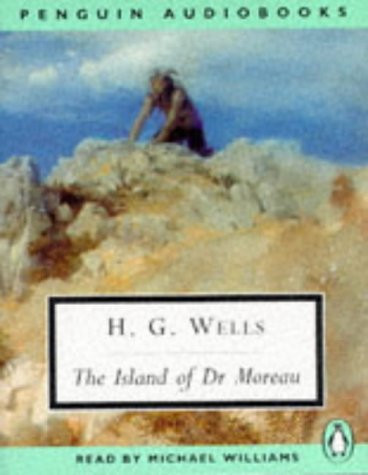
Stranded after a shipwreck, Edward Prendick finds himself rescued and then abandoned on a remote, uncharted island in the Pacific. He quickly discovers it is the domain of the infamous Dr. Moreau, a brilliant yet unsettling scientist whose past experiments in vivisection forced him to flee civilization. The island is populated by strange, half-human, half-animal creatures, known as the Beast Folk, whose unsettling forms and behaviors hint at a dark, unnatural origin.
As Prendick navigates this unsettling new world, he grapples with the blurred lines between humanity and savagery, questioning the very essence of identity and the terrifying consequences of scientific hubris. This tale invites readers to confront the moral boundaries of creation and the primal instincts that lie beneath the veneer of civilization.
The churning, indifferent sea had claimed the Lady Vain, leaving Edward Prendick, a gentleman of scientific bent, adrift and alone in a small dinghy for days, witnessing the grim descent of his companions into madness and death. When rescue finally arrived in the form of the schooner Ipecacuanha, it brought not solace, but a peculiar dread. Aboard, he met Montgomery, a former medical student with a haunted gaze, and his servant, M'ling, a creature of unsettling, almost animalistic features. Prendick's relief at being saved quickly curdled into apprehension as he observed the ship's cargo: a menagerie of wild animals destined for a remote, uncharted island.
Upon reaching the island, the brutish captain of the Ipecacuanha, weary of Prendick, cast him off with Montgomery. Prendick found himself reluctantly drawn into the strange household of Montgomery and his master, the infamous Doctor Moreau, a brilliant but disgraced physiologist who had vanished from London years ago under a cloud of scandal surrounding his vivisection experiments. The island itself hummed with an unnatural silence, broken only by the distant, horrifying screams that emanated from a fenced enclosure Moreau called his "House of Pain." Prendick's scientific curiosity warred with a growing sense of revulsion as he pieced together the fragments of Moreau's grotesque work.
One night, the screams of a puma undergoing Moreau's surgical ministrations drove Prendick into the oppressive jungle, convinced he was next to be subjected to the doctor's cruel scalpel. There, in the dense undergrowth, he encountered the island's true inhabitants: the Beast Folk. These were not mere animals, but grotesque parodies of humanity, creatures born of Moreau's vivisections, surgically altered animals given rudimentary human form, speech, and a strict code of conduct known as "the Law." Chased by a particularly menacing Leopard-Man, Prendick stumbled into their crude village, guided by an Ape-Man, and witnessed their fervent, fearful adherence to "the Law," recited by the Sayer of the Law, a grey-haired, ancient Beast Man. They worshipped Moreau as a god, fearing his "House of Pain" and repeating his prohibitions: "Not to go on all-fours; that is the Law. Is it not so?"
Moreau, discovering Prendick's flight, confronted him and, with a chilling detachment, revealed the full extent of his experiments. He was not vivisecting humans, but animals, striving to uplift them, to scour away their bestial instincts and impose humanity upon them through agonizing surgical transformation. He spoke of the "plasticity of living forms" and dismissed pain as irrelevant to the pursuit of knowledge. Prendick, horrified yet fascinated, was forced to accept his grim reality on the island, witnessing the constant struggle of the Beast Folk to maintain their imposed humanity against the pull of their primal instincts. Montgomery, Moreau's alcoholic assistant, harbored a strange, melancholic affection for the Beast Folk, a fleeting spark of sympathy in the island's moral void.
The fragile order of the island began to unravel with the escape of the puma Moreau had been operating on. In a desperate chase through the jungle, the puma turned on its tormentor, and both Moreau and the creature met their end in a brutal, final struggle. With Moreau gone, Montgomery, unmoored and increasingly drunk, lost control. He perished in a chaotic confrontation with the Beast Folk, leaving Prendick utterly alone amidst the rapidly regressing creatures.
Prendick remained on the island for months, a solitary figure haunted by the memory of Moreau's experiments. He watched with growing despair as the Beast Folk, freed from the fear of the "House of Pain" and the strictures of "the Law," slowly, inevitably reverted to their original animal forms. They began to walk on all fours, to hunt, to abandon their communal dwellings, their human-like speech fading into guttural growls. His loyal companion, a Dog-Man, was savagely killed by the Hyena-Swine, a monstrous hybrid that had become Prendick's relentless enemy. In a desperate act of self-preservation, Prendick killed the Hyena-Swine.
Deliverance came unexpectedly when a boat, bearing two dead sailors, drifted onto the beach. Seizing the chance, Prendick embarked on a perilous journey, eventually being rescued by a passing ship. He returned to England, but the horrors of the island had irrevocably scarred his soul. The faces of his fellow humans seemed subtly changed, infused with a hint of the bestial, and the sounds of ordinary life became grating. He sought solace in solitude, finding a fragile peace in the contemplation of the stars, forever marked by the grotesque truths he had witnessed on the Island of Doctor Moreau.
What other readers say
Liked
This graphic novel adaptation of The Island of Doctor Moreau receives praise for its striking visual presentation. Reviewers frequently highlight the impressive, detailed, and often dark artwork, noting how the illustrations effectively convey a sense of dread, mystery, and the macabre. Many found the adaptation to be a gripping and fast-paced read, making the classic story more accessible and enjoyable, especially for those who might find the original novel challenging. The visual storytelling is commended for bringing the horrors and suspense of the island to life, with some readers stating it effectively recalled the terror of the original work and even inspired them to seek out the novel.
Disliked
However, the adaptation also draws significant criticism, primarily concerning its narrative completeness and faithfulness to the original text. Several reviewers felt the story was overly condensed, leading to a sense that crucial elements were missing or that the plot felt rushed and hard to follow without prior knowledge of the novel. There are specific concerns about plot alterations, particularly regarding the ending, which some found to be significantly changed and more pessimistic than H.G. Wells's original vision. Some considered the adaptation merely passable or unmemorable, suggesting that the book is better and that the graphic novel serves as only a "snippet" rather than a comprehensive retelling.
In short
Overall, this graphic novel appears to be a visually compelling but narratively condensed take on The Island of Doctor Moreau. It would likely appeal to readers who appreciate dark, atmospheric artwork and are looking for a quick, visually driven introduction to the classic tale, or those who have already read the novel and wish to experience it in a new, artistic format. However, readers expecting a faithful, in-depth adaptation that stands alone without prior knowledge of the original novel, or those who dislike significant plot deviations, might find it less satisfying.