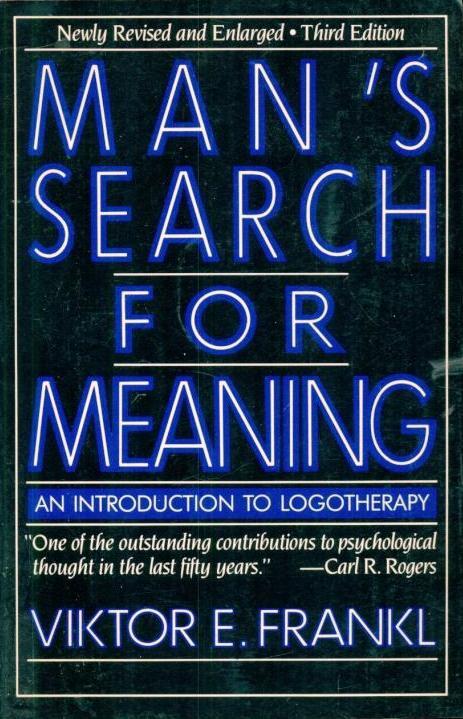
Based on his own experiences as a prisoner in Nazi concentration camps during World War II, psychiatrist Viktor Frankl's memoir argues that while we cannot avoid suffering, we can choose how to cope with it, find meaning in it, and move forward with renewed purpose. Frankl observed that the prisoners who were most likely to survive were not the physically strongest, but those who held on to a sense of meaning and purpose. This profound realization led to his development of logotherapy, a school of psychotherapy based on the conviction that the primary human drive is the pursuit of what we find meaningful.
Part memoir of his spiritual survival and part exploration of his groundbreaking psychotherapeutic theory, this book is a testament to the human spirit's capacity to endure in the face of unimaginable adversity. It offers a universal lesson on finding significance in the very act of living. Frankl's insights provide a path to discovering meaning through creating work, experiencing love, and displaying courage in the face of hardship, ultimately suggesting that life holds potential meaning under any conditions.
The gates of Auschwitz opened, not to freedom, but to a reality far more chilling than any nightmare. Stripped of everything – possessions, identity, family – the new prisoners entered a world where existence was reduced to its most brutal essentials. The initial shock, a delusion of reprieve, quickly gave way to a cold, stark apathy, a defense mechanism against the constant threat of death and the ceaseless indignities. Yet, even in this abyss, a profound question began to stir: what allows some to cling to life, to a shred of dignity, while others simply surrender?
Life in the concentration camp was a continuous struggle against dehumanization. The body, emaciated and ravaged by hunger and disease, became almost incidental. The true battle was waged within the mind, a fight to preserve an inner life, a spiritual freedom that even the guards could not penetrate. We learned that everything can be taken from a person but one thing: the last of the human freedoms - to choose one's attitude in any given set of circumstances, to choose one's own way.
Amidst the forced labor, the bitter cold, and the ever-present stench of death, moments of profound insight would pierce the gloom. A shared crust of bread, a fleeting glimpse of a sunset, a whispered word of encouragement – these small acts of humanity became beacons, reminding us that meaning could still be found. It was often in contemplating a loved one, a spouse, or a child, that the will to endure found its strongest roots. Love, we discovered, transcends the physical presence of the beloved, finding its deepest meaning in their spiritual being, their inner self.
The suffering was immense, unavoidable, and often seemingly senseless. Yet, it became clear that suffering itself is not meaningless; rather, it is how one responds to it that imbues it with purpose. When a man finds that it is his destiny to suffer, he will have to accept his suffering as his task, a unique opportunity to grow. This realization became a cornerstone, a way to transform despair into a testament of human spirit. For those who could envision a future goal, a task to fulfill, or a message to deliver, survival often became a possibility.
This profound experience led to the understanding that the primary motivational force in human beings is a "will to meaning," not a "will to pleasure" or "will to power." Life is not about what we expect from it, but rather what it expects from us. Each person is questioned by life, and they can only answer by being responsible for their own life, by finding and fulfilling their unique tasks.
Meaning can be found in three principal ways: through creating a work or doing a deed, through experiencing something or encountering someone (such as love), and through the attitude we take toward unavoidable suffering. It is in the conscious choice of our response to circumstances, even the most dire, that we exercise our ultimate freedom and find our deepest purpose.
The "existential vacuum," a pervasive feeling of meaninglessness, is a fundamental challenge in the modern world. However, by shifting perspective from asking what the meaning of life is to recognizing that it is life that is asking the questions, individuals can find their way. Each situation in life presents a challenge, a problem to solve, and by taking responsibility to find the right answers, one embraces the very essence of human existence.
What other readers say
Liked
This book is widely praised for its powerful and deeply moving first section, which vividly recounts the author's harrowing experiences as a prisoner in Nazi concentration camps. Reviewers consistently highlight the profound impact of this narrative, noting its ability to convey the horrors of those times with a dispassionate yet incredibly distressing intensity. Many describe it as a life-changing read, offering profound insights into human resilience and the capacity to find meaning even amidst unimaginable suffering. The central idea that one can choose their attitude and find purpose in any given circumstance resonates strongly with readers, providing an empowering message of hope and inner freedom that has inspired many to consciously live more meaningful lives.
Disliked
However, the book's second half, dedicated to Frankl's psychotherapeutic method called logotherapy, receives a more mixed reception. Numerous readers found this section to be academic, dry, technical, and at times repetitive, likening it to a psychiatric journal or textbook rather than a continuation of the personal narrative. Some reviewers struggled to stay engaged with the theoretical explanations and psychological jargon, feeling it lacked the compelling, linear structure of the first part. A few express disappointment that the book did not offer more of Frankl's personal journey in developing his theories, or felt that its core message, while powerful, might not present entirely new insights for contemporary self-help readers.
In short
Overall, "Man's Search for Meaning" is regarded as a significant and impactful work, particularly for its unique fusion of personal testimony and psychological inquiry. While the academic nature of the logotherapy section may not appeal to all, the profound wisdom gleaned from the author's experiences and his central philosophy of finding meaning in life are widely appreciated. This book is highly recommended for readers interested in psychology, philosophy, human resilience, and those seeking inspiration or a new perspective on coping with adversity and existential questions.