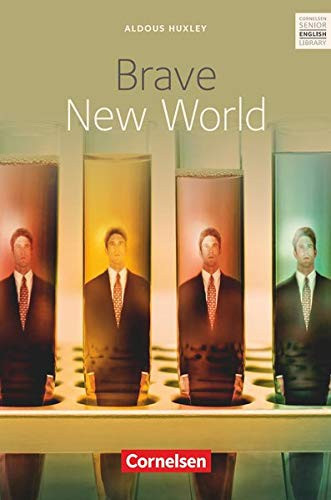
Step into a future where humanity has engineered a world free from suffering, war, and poverty. In the World State, citizens are genetically predetermined and conditioned from birth to fit into a rigid caste system, ensuring social stability and universal contentment. Emotions, individuality, art, and lasting relationships are sacrificed for a meticulously managed happiness, maintained through psychological manipulation and the widespread use of a tranquilizing drug called soma.
This technologically advanced society presents a chilling vision where progress has come at the cost of freedom and authentic human experience. Aldous Huxley's landmark novel invites readers to consider the profound implications of trading individual liberty and critical thought for a seemingly perfect, yet ultimately dehumanizing, existence.
The World State, in the year 632 AF - After Ford - is a place of immaculate order and manufactured contentment. Humanity is no longer born, but decanted from bottles in the Central London Hatchery and Conditioning Centre, each individual predestined and genetically engineered into a rigid caste system, from the intellectual Alphas to the laboring Epsilons. From the moment of decanting, infants are conditioned through hypnopaedia and electric shocks, their minds molded to embrace their assigned roles, to love consumption, and to desire the constant, easy pleasure offered by soma, the perfect pacifier. "Every one belongs to every one else," is a cardinal truth, ensuring promiscuity and preventing the formation of deep, unsettling bonds.
Among the Alphas, however, exists a man named Bernard Marx, who feels an unsettling difference. He is physically smaller than other Alphas, a perceived defect that fosters in him a yearning for something more profound than the World State's ubiquitous happiness. He finds himself drawn to Lenina Crowne, a beautiful Beta who perfectly embodies the World State's ideals of casual sexuality and superficial joy, yet even she seems to stir a flicker of unease within him. Bernard's discontent leads him to seek permission to visit one of the Savage Reservations, isolated pockets of the old world where life is lived without the World State's control, a place of dirt, disease, and - most alarmingly - natural birth and family.
Their journey to the New Mexico Savage Reservation opens a chasm between their conditioned reality and a raw, untamed existence. Here, they encounter John, a young man born naturally to Linda, a World State citizen who was accidentally abandoned on the Reservation years ago. John, raised among the "savages" but deeply immersed in the forbidden words of Shakespeare, represents a world of passion, pain, and profound individuality - a stark contrast to the sterile, emotionless perfection of the World State. His mother, Linda, having been deprived of soma for years, is a grotesque figure, clinging to the only comfort she knows, the memories of her past.
Bernard, seeing an opportunity to assert his own individuality and gain a measure of notoriety, brings John and Linda back to London. John, labeled "the Savage," becomes an instant sensation, a living exhibit of the primitive past. He is initially fascinated by the World State's technology and cleanliness, but quickly recoils from its superficiality, its manufactured happiness, and its casual disregard for genuine emotion. He is horrified by the casual promiscuity, the lack of family, and the constant reliance on soma to escape any discomfort. His Shakespearean sensibilities clash violently with the World State's shallow mantras, particularly the idea that "every one belongs to every one else."
The World State's stability, maintained through genetic engineering, conditioning, and soma, is predicated on the suppression of strong emotions, personal attachments, and individual freedom. John's presence, however, disrupts this delicate balance. He yearns for beauty, for poetry, for danger, for sin, for true love, and even for suffering - all the things the World State has meticulously eradicated in its quest for universal contentment. His attempts to awaken genuine feeling in others, particularly Lenina, are met with incomprehension and revulsion.
The conflict escalates when John witnesses the degradation of his mother, Linda, as she dies in a hospital, surrounded by conditioned children who view death with detached amusement. Overwhelmed by grief and rage, John attempts to spark a rebellion among a group of Delta workers, throwing their soma rations out a window and urging them to be free. The uprising is swiftly quelled by the arrival of the police, who subdue the crowd with soma vapor and sonic blasts.
John is brought before Mustapha Mond, the Resident World Controller for Western Europe, who reveals himself to be a man of immense intellect and forbidden knowledge, privy to the world's true history and literature. Mond calmly explains the World State's philosophy, arguing that happiness and stability are paramount, and that the price of art, religion, and profound emotion is too high. He acknowledges the beauty of the old world but insists that its passions lead only to suffering and instability. John argues for the right to unhappiness, to choose, to feel. Unable to reconcile his ideals with the World State's reality, John retreats to a lighthouse, seeking solitude and attempting to purify himself through self-flagellation. But even there, the omnipresent curiosity of the World State's citizens, drawn by sensational news reports, invades his sanctuary. The constant intrusion, the relentless flashes of cameras, and the unbearable pressure of a world that cannot understand his longing for authentic life, drive him to a desperate, final act of despair.
What other readers say
Liked
Many reviewers praise Brave New World for its visionary and prophetic qualities, noting how its themes of genetic engineering, consumerism, mass production, and control through pleasure remain strikingly relevant today. The novel's initial chapters, which introduce its unique societal structure and devalued morality, are frequently highlighted as masterful exposition that effectively immerses the reader in its compelling world of enforced hedonism. Readers also appreciate the book's intellectual depth and moral critique, finding it provokes profound thought about the balance between freedom and happiness, the nature of humanity, and the potential pitfalls of unchecked technological and social "progress." The character of the "Savage" is often singled out as a compelling figure who provides an essential outsider's perspective, challenging the established norms, and the philosophical debate at the story's climax is described as exceptional and masterful.
Disliked
However, a significant number of critics found certain parts of the book, particularly the middle sections detailing a trip to a "reservation" and the "Savage's" initial experiences in the civilized world, to be dry, slow, and disconnected from the main narrative, with some likening them to a "sleeping pill." Several reviewers felt the execution was lacking, citing characters that were often flat or unsympathetic, and a narrative that sometimes struggled to maintain a clear protagonist. The extensive use of Shakespearean quotes was occasionally perceived as rambling. Philosophically, some readers expressed dissatisfaction, feeling that Huxley did not adequately explain *why* the depicted world of controlled contentment is inherently wrong, instead relying too heavily on the reader's intuitive understanding. Additionally, the portrayal of women and certain character interactions, particularly those involving the "Savage," were noted as offensive or problematic by some, reflecting outdated social attitudes.
In short
Despite these criticisms, Brave New World is widely regarded as an immensely important and enduring classic of dystopian literature, frequently compared to and sometimes preferred over other seminal works in the genre. Its power to disturb, challenge, and provoke deep reflection on humanity's future is consistently cited as a testament to its lasting impact. This book is highly recommended for readers interested in speculative fiction, philosophical inquiry, and social satire, particularly those who are prepared to engage with complex ideas about societal control, the cost of happiness, and the potential dangers of technological advancement. It appeals to individuals who appreciate a novel that stimulates profound thought, even if the reading experience can be challenging or emotionally unsettling at times.