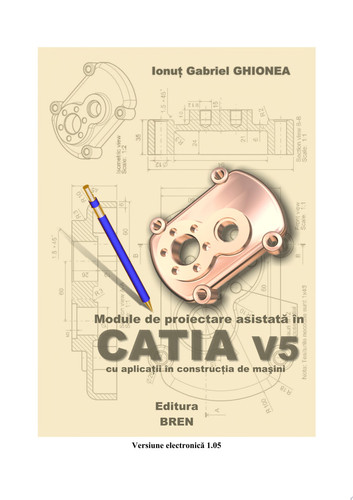
Embark on a journey into the heart of computer-aided design, where the formidable power of CATIA V5 is harnessed for the intricate world of mechanical engineering. This exploration begins by laying a robust foundation, introducing the core objectives and vast capabilities of assisted design, revealing how it transforms the conception and development phases of a product. You will discover the profound advantages of the virtual prototype, a revolutionary concept that streamlines design processes and elevates precision.
The initial steps lead you directly into the CATIA Sketcher module, the very canvas for your design ideas. Here, you become intimately familiar with its interface, learning to navigate the essential toolbars for sketching and constraining. You'll master instruments for creating profiles, predefined shapes, circles, conics, and splines, understanding how to apply both geometrical and dimensional constraints to breathe accuracy into your initial two-dimensional representations. Every line and curve is a deliberate step towards a complex mechanical component.
Moving beyond the sketch, the path unfolds into the realm of three-dimensional modeling within the Part Design module. You are guided through the myriad methods for shaping individual mechanical parts, transforming flat sketches into solid forms through extrusion, revolution, and advanced surfacing techniques. The focus remains steadfast on modern parametric design, allowing for intelligent, adaptable models where changes ripple through the design with seamless efficiency. This is where components take on their true form, ready for integration.
The next crucial stage involves bringing these individual parts together within the Assembly Design module. Here, you learn the art of constructing complex mechanical assemblies, understanding how to define relationships and constraints between components. The principles of relative movement, contact, and precise linear and angular distances are explored through practical examples, culminating in the ability to generate comprehensive bills of materials. This module reveals the dynamic interplay of parts, ensuring functionality and fit.
With the components designed and assembled, attention turns to the meticulous creation of technical drawings using the Drafting module. You are introduced to the tools and techniques for generating detailed execution drawings from your 3D models. The emphasis is on clarity and industrial standards, ensuring that every dimension, tolerance, and annotation accurately communicates the design intent for manufacturing. Orthogonal and isometric representations become your language, offering a complete spatial understanding of your creations.
Beyond the fundamental modules, the journey may extend into more advanced territories, touching upon modules like Generative Structural Analysis. This introduces the basics of finite element methods, guiding you through the process of setting up analyses, applying loads, defining restraints, and interpreting results to predict component behavior under various conditions. You learn to virtually test the strength and durability of your designs, optimizing them before physical prototyping.
Through a series of practical applications rooted in industrial technical drawing, each theoretical concept is solidified. You are encouraged to follow each step diligently, engaging with the software directly to internalize the techniques. This hands-on approach, supported by numerous figures and concise exercises, ensures a progressive mastery of CATIA V5's capabilities. Whether you possess prior CAD experience or are new to this powerful platform, the systematic guidance empowers you to confidently design, analyze, and prepare mechanical components and assemblies for real-world application.