Add to library
You don't have any lists yet. Create one in My Library.
Go to My LibraryAdd to library
You don't have any lists yet. Create one in My Library.
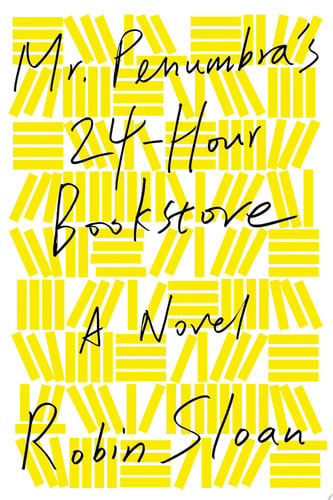
Go to My LibraryMr. Penumbra's 24-Hour Bookstore A Novel
- Language
- English
- Published in
- Publisher
- Macmillan
- Pages
- 288
- ISBN
- 9780374214913
Driven by curiosity, Clay and his friends - a data-visualization expert from Google and a successful tech entrepreneur - begin to analyze the secrets hidden within the dusty bookstore. Their quest takes them from the heart of Silicon Valley to the hidden corners of an ancient library, pitting the power of modern technology against the mysteries of the past. This novel is an adventure for book lovers, a puzzle for tech enthusiasts, and a story that explores the enduring power of the written word in a digital age.
Subjects
I soon learned the store was really two businesses in one. Up front were the normal, if sparse, shelves of used books that almost no one ever bought. But behind and above that, stretching up three stories into the gloom, was what I called the Waybacklist: unique volumes that, as far as Google knew, didn't exist. These were for a second set of customers, a strange club of single-minded members who would stumble in at all hours, breathless and vibrating with need. “Kingslake! I need Kingslake!” Mr. Tyndall would shout. My job was to retrieve the book, which I was forbidden to read, and log the transaction in an oversized leather-bound tome called NARRATIO, noting everything from the time to the customer's state of mind to the material of his coat buttons.
My friends were drawn into the mystery. My roommate Mat, a special-effects artist, scaled the ladder one night and discovered the books of the Waybacklist were filled not with words, but with a solid matrix of jumbled, coded letters. My best friend Neel, a tech CEO, saw it for what it was. “You're sitting on a Rockets & Warlocks scenario here, I swear,” he said, his eyes alight with the promise of a real-life quest. He was right. This was more than a strange book club; it was a puzzle, and I had a strange feeling I was meant to help solve it.
The key arrived in the form of a girl. After a mysterious courier delivered a new volume for the Waybacklist, confirming the bookstore was part of a larger organization, my hyper-targeted Google ad campaign finally snagged a customer. Kat Potente was a data visualization expert from Google, and she was captivated by the 3D model of the store I was building on my laptop. She fixed a bug in my code in five minutes flat and told me, “I love data like this. Real-world data. Old data.” It was Kat who suggested we could find a pattern in the members' borrowing habits if we could only digitize the old logbooks.
With Mat's help, I created a perfect replica of a retired logbook and smuggled the real one out to Google's campus. We fed its handwritten pages into a high-speed book scanner, a spidery machine that plucked the words from the page like an exorcism. Back at my desk, I animated the data. The members' borrowing patterns weren't random; they were following one another through the shelves. When I spun the 3D model just right, their paths snapped together to form a portrait - the face of a man Penumbra called “the Founder.” I had solved a puzzle that had vexed members for years, but I had cheated. “Google,” Penumbra breathed, a strange look on his face. “How curious.”
The next night, the bookstore was dark. Penumbra was gone, summoned to New York by his superior, a man named Corvina. I knew this was my fault. With Kat and Neel, I flew east, using Google Street View and an army of online workers to find the fellowship's headquarters, a stone fortress on Fifth Avenue. Penumbra met me at the door, explaining this was the home of the Unbroken Spine, a 500-year-old society dedicated to decoding the final work of its founder, the great printer Aldus Manutius. His book, the *Codex Vitae*, was said to hold the secret to eternal life. Penumbra had come not for punishment, but to argue that my digital methods could finally unlock their prize.
We descended into the Reading Room, a secret library deep beneath the streets of Manhattan. It was a book-lined Batcave where black-robed members studied massive, chained tomes. It was there we met Corvina, the fellowship's First Reader. He was cold and severe, a man who believed only in the old ways of chalk and slate. He dismissed my friends and me as unworthy, and then he delivered his ultimatum: he was cutting off the bookstore's funding. “You have spent too long in the wilderness, Ajax,” he told Penumbra. “Come back to us.”
Our small band formed a rebel alliance. We would steal the data from Manutius's *Codex Vitae* and decode it ourselves. I returned to the Reading Room alone in the dead of night, armed with a key from a sympathetic member and a portable, collapsible scanner made of cardboard - the GrumbleGear 3000. In the freezing, pitch-black vault, I scanned the Founder's book, page by painstaking page. I also scanned another, slimmer volume bound in a shimmering pale blue: Penumbra's own *Codex Vitae*, my insurance policy for a friend. At Google, Kat unleashed the full power of the company's global network on the data. For three seconds, every computer Google owned was dedicated to our task. The result was a blank screen. Nothing. The code was unbreakable. Devastated, Penumbra vanished.
Defeated, I returned to my apartment. I was digitizing an old audiobook of *The Dragon-Song Chronicles* when I heard the author, Clark Moffat - a former member of the Unbroken Spine - read a line that wasn't in the printed text. It was a clue that led me on a new quest, this time for the original metal punches used to create the typeface Gerritszoon, the very font Manutius and his fellowship used. I found them in a high-tech storage facility in the Nevada desert. Under a magnifying glass, I saw it: the code wasn't in the sequence of letters, but in their shape. Tiny, gear-like notches were carved into the metal of each character. Gerritszoon himself was the key.
At a gathering of my friends and the fellowship, I revealed the truth. The message hidden in the typeface wasn't a formula for immortality; it was a simple, beautiful tribute from one man to another: *Thank you, Teobaldo. You are my greatest friend. This has been the key to everything.* The Unbroken Spine was transformed. Corvina was ousted, and Penumbra and I started a new company, a consultancy at the intersection of books and technology. The bookstore became a climbing gym. All the secrets worth knowing, I learned, are hiding in plain sight. Your life must be an open city, with all sorts of ways to wander in.
No discussions yet for this book.
Delete Discussion
Are you sure you want to delete this discussion? This action cannot be undone.
Rating Sources
Many readers found "Mr. Penumbra's 24-Hour Bookstore" to be a charming, fun, and highly enjoyable page-turner that skillfully blends elements of ancient mystery with modern technology. Reviewers frequently praised its unique premise, which centers on a quirky San Francisco bookstore, secret societies, and intricate puzzles, all explored through the lens of internet-savvy characters and cutting-edge data visualization. The book was celebrated as a "love letter" to both traditional books and the digital age, offering a fresh take on the "literary mystery" genre. Readers were drawn in by the likeable, often funny narrator and a cast of eccentric friends, each contributing unique skills to the adventure. The narrative's ability to capture familiar emotions and its distinct, captivating style resonated with many, making it a quick and satisfying read for those who appreciate stories about books and the power of human connection.
Despite its appealing concept, a significant number of reviewers expressed disappointment, finding the book to be juvenile, shallow, and ultimately a letdown. Common criticisms included the lack of character depth, with many protagonists feeling two-dimensional or stereotypical, and a plot that often relied on overly convenient solutions, diminishing any sense of tension or peril. Several readers found the narrative voice too familiar, drawing strong comparisons to other contemporary novels, and noted a perceived lack of originality in its themes. The frequent and extensive references to modern technology, particularly one prominent tech company, were often cited as distracting, feeling like advertisements, and likely to quickly date the book. Some also felt the author attempted to cram too many ideas into a short space, resulting in underdeveloped concepts and an underwhelming climax. Additionally, some critics observed a sense of entitlement and privilege among the characters, which detracted from their enjoyment of the story.
Ultimately, "Mr. Penumbra's 24-Hour Bookstore" elicits a highly polarized response, with some hailing it as a brilliant and unique adventure, while others dismiss it as amateurish and overhyped. It is generally regarded as a quick and easy read, but its impact varies greatly depending on individual reader preferences. This book would likely appeal to those who enjoy light, quirky mysteries, stories that celebrate both traditional book culture and the digital world, and narratives focused on puzzles and friendship. Fans of "books about books," or those looking for a charming, fantastical blend of old and new technology in a contemporary setting are most likely to appreciate it. However, readers seeking deep literary prose, complex character development, high-stakes thrillers, or a story free from extensive brand references may find themselves less captivated.
No reviews yet. Be the first to review this book!
Delete Review
Are you sure you want to delete this review? This action cannot be undone.


