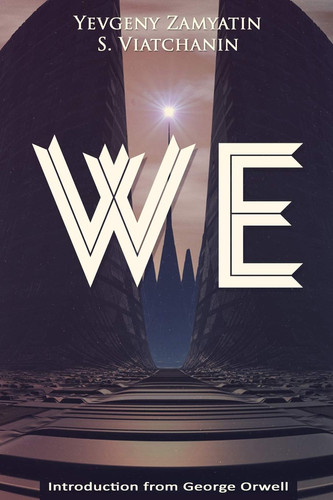
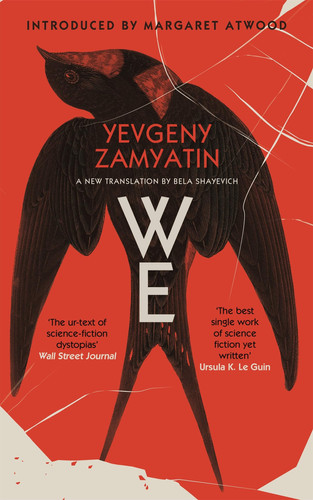
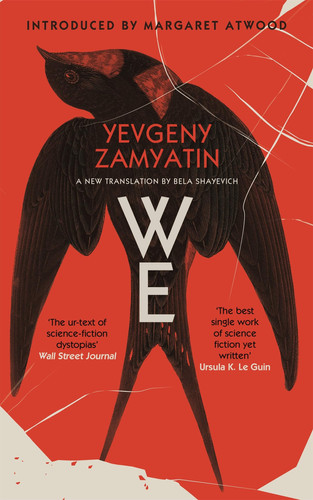
Step into the chilling, mathematically precise world of the One State, a glass-enclosed city in the 26th century where every aspect of life is meticulously controlled for the collective good. Citizens, known only by numbers, live in transparent homes, adhere to the rigid "Table of Hours," and experience state-sanctioned encounters, all under the watchful eye of the Benefactor. D-503, the lead engineer of the Integral, a spaceship designed to spread this "mathematically infallible happiness" to other planets, initially embraces this perfect order.
However, his encounter with the enigmatic I-330 introduces him to a forbidden realm of individuality, passion, and rebellion. As D-503 grapples with emerging feelings of love, jealousy, and doubt, he confronts the stark choice between a life of enforced contentment and the perilous, yet exhilarating, path of personal freedom. This foundational work of dystopian fiction challenges the very notion of happiness without liberty, inviting readers to question the true cost of a perfectly ordered society.
My most cherished records begin with an ode to the One State, to our mathematically infallible happiness, to the Benefactor whose wisdom guides our every second. I, D-503, builder of the Integral, the vessel that will carry our perfect reason to the furthest reaches of the cosmos, found profound joy in the precise rhythm of our lives. We lived in glass houses, our schedules synchronized, our movements a harmonious, visible ballet. Individuality was a disease, emotion a chaotic variable, and privacy an archaic concept banished by the radiant transparency of our city. We were Numbers, each a cog in the grand, frictionless machine of the One State, and I believed this was the ultimate freedom - freedom from error, from desire, from the wretched state of "us" that preceded our enlightened "We."
Then came I-330. Her unsettling, angular beauty, the way she smoked cigarettes, the way she looked at me with an ironic, knowing gaze that seemed to pierce through my glass walls. She was a dissonance in our perfect symphony, a √-1 in the flawless equations of my existence. She lured me to the Ancient House, a relic of the chaotic past, filled with dust and shadows and the cacophony of forgotten objects. There, she offered me alcohol, a forbidden liquid that burned and awakened something primitive within me, something illogical and dangerous. I felt a tremor in my perfectly calibrated soul, a terrifying, exhilarating deviation from the norm.
My records, once a testament to the One State's glory, began to betray me. They became fragmented, filled with unsettling dreams and irrational thoughts. I found myself late for mandatory walks, my hand trembling as I tried to write. This burgeoning chaos within was diagnosed by the Bureau of Medicine as having a "soul," a grave illness that threatened my mathematical precision. But even as I feared this affliction, I was drawn deeper into I-330's orbit. She became my assigned sexual partner, a formality of the State's pink coupon system, yet with her, even that became an act of profound, forbidden intimacy.
I-330 revealed herself to be a member of the Mephi, an underground organization dedicated to overthrowing the One State and restoring the wild, untamed world beyond the Green Wall. She spoke of revolution not as a past event, but as an infinite process, a constant breaking of boundaries. She showed me the world outside our glass city - a vibrant, chaotic wilderness teeming with untamed humans, their bodies covered in hair, their lives unbound by the Table. It was terrifying, yet undeniably alive, a stark contrast to our sterile, ordered existence. My allegiance, once absolute, began to fracture.
The Mephi's plan was audacious: to seize the Integral during its maiden test flight and turn its immense power against the One State itself. I-330 demanded my help, leveraging my position as the chief builder. The thought of betraying the Benefactor, of shattering the mathematical perfection I had dedicated my life to, filled me with an agonizing conflict. My "soul" raged, tearing me between the security of the One State and the terrifying, alluring freedom I-330 represented. I found myself complicit, locking away the assigned crew, my hands shaking with a mixture of fear and a strange, nascent hope.
The revolution erupted. The Green Wall was breached, and the wild, primal world spilled into our ordered city. Chaos, beautiful and terrifying, swept through the streets. But the One State, in its infinite wisdom, had a final solution. The Great Operation, a compulsory fantasiectomy, was announced - a surgical procedure to remove the center of imagination from every Number. I, D-503, underwent the operation. The unsettling dreams, the illogical desires, the agonizing conflict, all vanished.
Now, I write with perfect clarity, my thoughts as straight and unwavering as the lines of our city. The world is once again mathematically perfect. I-330 and her co-conspirators were apprehended, their foolish rebellion crushed. She refused to confess, even under the Benefactor's machine, her face still twisted by that strange, defiant smile. But it doesn't matter. The absurd notion of an individual soul, of freedom without happiness, has been excised. Reason will triumph. There is no "I" anymore, only "We."
What other readers say
Liked
The collection is lauded for its unexpectedly high quality, consistently exceeding typical expectations for such a work. Reviewers highlight the extensive scope of essays meticulously assembled by Gary Kern, noting the wide range of topics and perspectives offered on Zamyatin. Each individual essay is described as a "miniature delight," suggesting they are well-crafted, engaging, and enjoyable to read.
Disliked
Based on the provided feedback, there are no explicit criticisms or negative aspects mentioned. The sole review offers unanimous praise, focusing entirely on the book's superior quality and the engaging nature of its individual components, without indicating any drawbacks.
In short
Overall, this book appears to be a highly commendable and well-received collection. It would particularly appeal to readers interested in in-depth literary analysis, especially those with a focus on Zamyatin. Individuals who appreciate meticulously assembled essay collections that offer both breadth and individual brilliance will likely find this book a rewarding experience.
![Cover of Nosotros [Hardcover]](https://images.isbndb.com/covers/3957593485511.jpg)