
Add to library
You don't have any lists yet. Create one in My Library.
Go to My LibraryAdd to library
You don't have any lists yet. Create one in My Library.
Go to My LibraryOne Day (Movie Tie-in Edition)
- Language
- English
- Published in
- Publisher
- Knopf Doubleday Publishing Group
- Pages
- 448
- ISBN
- 9780307946713
As their lives diverge and intersect, a powerful connection endures through squabbles, missed opportunities, laughter, and tears. Emma, idealistic and witty, hopes to make the world a better place, while the charming and affluent Dexter seeks a life of fame and pleasure. This novel charts the course of their friendship and the unspoken feelings that lie beneath, exploring how the person who knows you best can be the one you are least able to be with. It is a story about the nature of love and life itself, revealing how the passage of time can transform everything except what is truly meant to be.
Subjects
Original edition details
Other editions (8)
Other editions
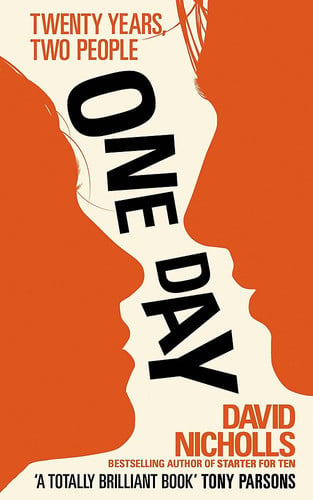
One Day
2009 • Hodder & Stoughton
English

One Day A Novel
2010 • Knopf Doubleday Publishing Group
English
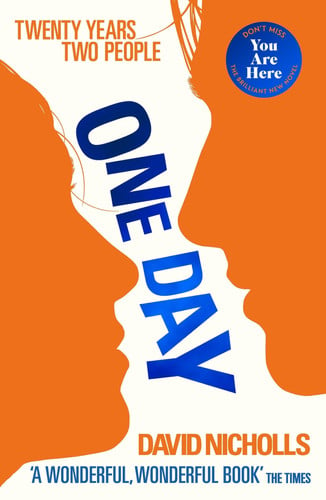
One Day
2010 • Hodder
English

Zwei an einem Tag Roman
2009 • Kein & Aber
German

Un día
2010 • Vintage Español
Spanish

One Day
2009 • Hachette Uk
English

De eerste dag
2010 • Boekerij
Dutch

Один день
2017 • RIPOL klassik
Russian
Their twenties unfold in a series of letters and postcards, their lives diverging as if to prove their initial predictions correct. Emma trudges through the grim realities of post-graduate life, first touring schools in the West Midlands with a radical theatre troupe performing a play about slavery through “some pretty shocking mime.” Later, she finds herself in London, waitressing at a ghastly Tex-Mex restaurant, the graveyard of ambition, pouring her frustrations into poems and unfinished plays. Her letters to Dexter are long, funny, and saturated with a barely concealed longing. Dexter, meanwhile, drifts through the world's party towns - Amsterdam, Barcelona, Bombay - broadening his mind, as he puts it. His postcards are brief, buoyant, and tell her almost nothing, yet she treasures them, slips of cardboard that tether her to the life she sometimes feels she should be living.
As the years pass, Dexter stumbles into a television career, his louche charm finding a natural home in the loud, ephemeral world of youth TV. He becomes a face, a minor celebrity on a show called *larging it*, his life a blur of parties, complimentary drinks, and a revolving door of beautiful, interchangeable women. Emma, now a teacher in London, watches him from a distance, their friendship strained by his fame and frantic lifestyle. They take a holiday to Greece, a trip governed by “The Rules of Engagement” - no flirting, no nudity, separate rooms - all of which are broken or bent within days. Amid the sun and sea, the old intimacy flickers, but so does the friction. In the water one night, he offers her a fling, “just while we're away,” and she pushes his head under the water, half in anger, half in jest. Their moment, it seems, has passed.
The friendship finally fractures on a hot summer night in a cavernous Soho restaurant. Dexter, arrogant and coked-up, condescends to her about her career. “Those who can, do,” he begins, “those who can't, teach…” The cruelty of it is a physical blow, and Emma walks out. In the street outside, their years of unspoken feelings erupt in a storm of accusations and regret. He is selfish, drunk, and boring. She is judgmental and dreary. It is a fight born of love and disappointment. “Dexter, I love you so much,” she tells him, her voice breaking. “I just don't like you anymore. I'm sorry.” And with that, she walks away, leaving him alone in a back alley, the connection that has defined his adult life severed.
Years of silence follow. Dexter's career implodes. He marries Sylvie, a serene, severe beauty from a family of winners, and has a daughter, Jasmine. But the marriage is a mismatch, and his life unravels into divorce and unemployment. Emma, meanwhile, finds her voice. She quits teaching and writes a series of successful novels for young adults. One day, Dexter arrives in Paris, where she has been living. He is broken, lonely, and lost. She is poised, successful, and living a life of Parisian sophistication with a French musician. “I thought I'd finally got rid of you,” she says, her arms around him, and in that small attic flat, after more than a decade of near-misses and bad timing, they finally find their way back to each other.
They build a life together in London. It is not the grand, passionate affair she might have once imagined, but something quieter, deeper, and more real. They are a couple, navigating the gentle currents of domesticity. He runs a small, stylish café-deli; she writes her books. They argue about politics and house prices, share a bed, and try, with a quiet desperation, to have a child. The years of yearning and drama have been replaced by a steady, comforting rhythm of love and companionship. They are, for the first time, simply and profoundly happy.
On the morning of July 15th, 2004, they have a small, sharp argument about the war in Iraq. The tension of another failed month of trying for a baby hangs between them. He leaves for work, and she calls him a little later, leaving a message. “I'm sorry for being so snappy today,” she says. “The important thing is I love you very much.” She works for a few hours, then goes for her afternoon swim. Cycling home, the sky darkens and a sudden summer shower begins to fall. She pedals faster through the wet North London streets, thinking of the house they are meant to view that evening, of Dexter waiting for her. She is so preoccupied with the future that she doesn't see the vehicle turning. In an instant of screeching brakes and shattered glass, she is thrown from her bicycle. Her last thought is of him. Then Emma Mayhew dies, and everything she was, and everything they were, is gone.
The years that follow are a wilderness of grief for Dexter. He drinks, lets himself go, and becomes a ghost in his own life, haunted by her absence. He sees her everywhere - in the faces of strangers, in the margins of old photographs, on the streets of cities they visited. He is a father without a partner, a man without his anchor. “I think the best thing you could do,” his own father tells him, “is try and live your life as if Emma were still here.”
On the third anniversary of her death, he takes his daughter, Jasmine, to Edinburgh. He shows her the flat on Rankeillor Street where it all began, and then they climb Arthur's Seat, just as he and Emma did nineteen years before. He lies on the grass in the sun while his daughter plays beside him. He closes his eyes and thinks of that first day, of all the days that followed, the chain of moments, of thorns and flowers, that bound them together. He thinks of her laugh, her principles, her terrible haircuts, her kindness, her love. He misses her, of course, with an ache that will never fully subside. But as he lies there, with his daughter's hand in his, he feels not just the pain of her loss, but the enduring warmth of her life. And for the first time in a long time, he feels alright.
No discussions yet for this book.
Delete Discussion
Are you sure you want to delete this discussion? This action cannot be undone.
Rating Sources
The book is widely praised for its unique and intelligent narrative structure, which follows the main characters, Emma and Dexter, on the same day each year for two decades. This "snapshot" approach is lauded for offering insightful glimpses into their evolving lives, highlighting moments of rapid change or stubborn stagnation. Many reviewers found the characterization exceptionally strong, making Emma and Dexter feel genuine and deeply relatable, almost like real friends whose journals readers are peeking into. The author's ability to authentically portray a woman's perspective was particularly noted. For numerous readers, the novel deeply resonated on an emotional level, evoking strong feelings of nostalgia, frustration, yearning, and often leading to tears, marking it as a profoundly moving and impactful read that truly touches the heart. The writing is frequently described as crisp, vivid, witty, and perceptive, with engaging dialogue.
Despite its strengths, the book garnered significant criticism, particularly regarding its characters and pacing. Many reviewers found both Emma and Dexter to be unlikable, with Dexter often described as arrogant, self-centered, and superficial, while Emma was sometimes seen as overly pining, whiny, or insecure. Some struggled to understand the basis of their connection, feeling there was no compelling reason for them to care for each other. The narrative, while unique, was also criticized by some for being dull, slow-paced, or feeling like a "waste of time," with important developments sometimes occurring off-stage. A considerable number of readers expressed strong dissatisfaction with the story's conclusion, feeling it was manipulative, a "cop-out," or did not provide a satisfying resolution after investing in the characters' journey. This contentious ending left many feeling cheated or angry, viewing it as a contrived attempt to evoke emotion rather than a natural progression of the plot.
Ultimately, this is a polarizing book that readers tend to either deeply love or strongly dislike, with little middle ground. It is lauded for its emotional depth, realistic portrayal of a complex, long-term relationship, and innovative structure, but also criticized for unlikable characters, slow pacing, and a controversial ending. The book would appeal to readers who appreciate a profound character study and are drawn to stories that explore the messy, imperfect realities of life, love, and friendship over many years. It is best suited for those who are open to an emotionally challenging experience and do not require a conventional happy ending, embracing narratives that reflect the bittersweet complexities and missed opportunities inherent in human connections.
No reviews yet. Be the first to review this book!
Delete Review
Are you sure you want to delete this review? This action cannot be undone.