Add to library
You don't have any lists yet. Create one in My Library.
Go to My LibraryAdd to library
You don't have any lists yet. Create one in My Library.
Go to My LibraryOuran High School Host Club
- Language
- English
- Published in
- Publisher
- VIZ Media LLC
- Pages
- 184
- ISBN
- 9781591169154
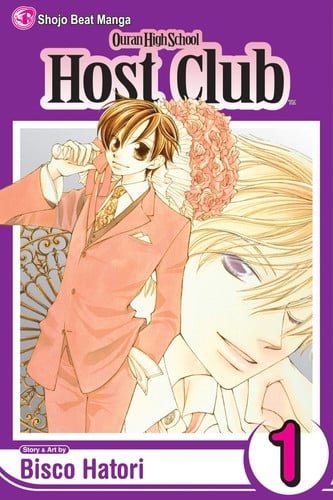
Thrust into a world of extravagant theme parties, elaborate schemes, and blossoming romances, the pragmatic Haruhi finds her quiet life completely upended by the flamboyant club king, the calculating vice president, the mischievous twins, and their inseparable companions. This romantic comedy satirizes the clichés of high society and high school romance, exploring themes of friendship, family, and the absurdity of judging others by appearances. It is a story that reveals how an accidental debt can lead to finding the people who will change your life forever.
Subjects
The Host Club panics in their usual dramatic fashion, but Hunny remains unnervingly calm. He sees not a villain, but a lonely girl who only knows how to communicate through curses. When Reiko steals his beloved stuffed rabbit, Usa-chan, to complete her spell, he confronts her not with anger, but with startling insight. “Being cursed by someone who doesn't consider other people's feelings will have no effect on me at all,” he tells her, his small voice steady. “You've got to share your feelings to be understood.” He offers her a path forward, a chance to talk and eat cake together, admitting, “I like girls who fight to overcome their weaknesses.” Struck by his kindness, Reiko's dark resolve crumbles, and soon she is a tentative, blushing guest in Music Room 3.
Just as one storm passes, another gathers, this time in Haruhi's tiny apartment. Her father, Ranka, is beside himself. His dear friend Misuzu's daughter, Mei, has run away from home after a bitter fight. A stylish, sharp-tongued girl with a deep tan and heavier makeup than anyone at Ouran, Mei is furious with her father, a kind-hearted man who, like Ranka, lives as a woman. “Do you even call yourself a father?” she screams, before storming out. Haruhi finds herself reluctantly roped into mediating, a task made infinitely more complicated when the Host Club arrives, with Tamaki declaring it their solemn duty to mend this broken family.
The club descends upon Mei's all-girls high school, a whirlwind of princely charm that leaves Mei's classmates swooning and Mei herself mortified. Tamaki, ever the sentimental hero, feels Misuzu's paternal sorrow as if it were his own and devises a grand plan. With summer break beginning, Mei is forced to stay at Haruhi's place. There, Tamaki orchestrates a secret mission: Haruhi will cook for Mei using Misuzu's own recipes, delivering a father's love through food without Mei ever knowing its source.
Slowly, the ice around Mei's heart begins to thaw. She complains about the food, yet eats every bite. She finds herself in grudging conversations with Tamaki, whose earnestness is impossible to fully deflect. The plan culminates in a trip to a local summer festival, a place Misuzu once took Mei when she was a small child. Dressed in a yukata, wandering through the lantern-lit stalls, Mei watches the easy, unspoken affection between Haruhi and Tamaki. For a moment, a fragile peace settles over them.
But the peace is shattered by the arrival of Hikaru and Kaoru. Hikaru, seeing Haruhi at Tamaki's side, is consumed by a sharp, unfamiliar jealousy. His possessiveness sparks an argument, which draws Misuzu - who was waiting nearby as part of Tamaki's overwrought plan - into the open. The confrontation explodes. Mei finally unleashes the true source of her pain: not that her father is different, but that he chose his lifestyle over her and her mother. “You should live it to the fullest!” she cries, a plea for him to be unapologetically himself, even if it means leaving her behind. It is a painful, messy reconciliation, but a reconciliation nonetheless.
As summer dwindles, the Host Club gathers at the Hitachiin twins' cavernous, modern home to finish their homework. There, they meet the twins' mother, a famous and eccentric fashion designer who is just as oblivious to social cues as her sons once were. The visit exposes the deep fissures forming in the twins' private world. Kaoru, ever the more observant of the two, watches his brother's growing obsession with Haruhi. In a quiet moment, away from the others, he asks the question that hangs between them. “Are you in love with Haruhi?” Hikaru's silence is answer enough. Later, when presented with cookies, Kaoru wordlessly gives the single cherry one - their shared favorite - to his brother, a small, heartbreaking gesture of surrender.
With the return to school comes a new season and new tensions. A petty squabble between Kyoya and a rival from the football club over the merits of dragon fruit spirals into a school-wide affair when Tamaki enthusiastically proposes Ouran's first-ever Sports Festival. The school is divided into two teams, Red and White. By a twist of fate, Tamaki and Haruhi are placed on the Red Team, while Kyoya and Kaoru are on the White. Feeling betrayed that his best friend would so eagerly embrace a competition against him, Kyoya's cool demeanor cracks. He accepts the position of General for the White Team, his eyes glinting with a cold fire. “This is merely a way to vent my anger,” he informs a stunned Tamaki. “Victory belongs to the White Team.” The lines have been drawn, and the games are about to begin.
No discussions yet for this book.
Delete Discussion
Are you sure you want to delete this discussion? This action cannot be undone.
Rating Sources
Many readers enthusiastically praise Ouran High School Host Club for its outstanding humor and endearing characters. The series is frequently described as a laugh riot, full of quirky situations, witty dialogue, and excellent comedic timing, often parodying common shojo tropes while still respecting the genre. Reviewers consistently highlight the depth and development of the cast, noting how their unique personalities, backstories, and interactions make them much more than their initial archetypes. The protagonist, Haruhi, is particularly appreciated as a relatable voice of reason amidst the absurdity, while other club members are celebrated for their distinct charm and comedic contributions. The relationships between characters are frequently described as cute, sweet, and well-developed, contributing significantly to the overall enjoyment. Additionally, many who read the entire series commend the story for its consistent quality, character growth, and a satisfying conclusion that extends beyond the anime adaptation.
While largely positive, some reviews point out specific areas of concern. A recurring critique, especially from those familiar with the anime first, is the initial artwork in the manga. Some found the early art style less appealing or "uglier" than its animated counterpart, with crowded panels and a less polished look. However, it is noted that the artwork significantly improves and becomes more consistent in later volumes. Another point of contention for some readers is the pacing, particularly in the later parts of the series, where it is felt that the comedy sometimes gives way to more drama or that certain arcs feel stretched out or unnecessary. A few found the plot light or the narrative occasionally difficult to follow, especially for those new to manga or the series' specific edition. The mistaken identity premise, while central, also drew a comment about making the early story feel a bit prolonged for one reviewer.
Overall, Ouran High School Host Club is highly recommended by most readers as a fun, high-energy, and genuinely funny romantic comedy. Despite initial art concerns that tend to resolve in later volumes and occasional pacing issues, the series consistently delivers strong character development and engaging humor. It is particularly well-suited for fans of shojo manga, romantic comedies, and those who appreciate witty genre parodies. Readers who enjoyed the anime adaptation are encouraged to delve into the manga for new material and a complete story, as it expands significantly beyond where the show concluded. It is a beloved series for those seeking a heartwarming, humorous, and character-driven narrative.
No reviews yet. Be the first to review this book!
Delete Review
Are you sure you want to delete this review? This action cannot be undone.


