Add to library
You don't have any lists yet. Create one in My Library.
Go to My LibraryAdd to library
You don't have any lists yet. Create one in My Library.
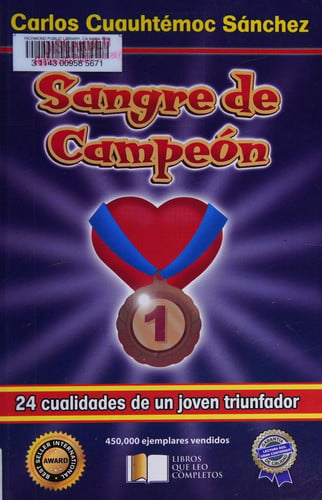
Go to My LibrarySANGRE DE CAMPEÓN (Sangre de Campeon) (Spanish Edition)
- Language
- Spanish
- Published in
- Publisher
- Editorial Diamante
- Pages
- 176
- ISBN
- 9789687277431
This story is an exploration of the path to becoming a winner in life, not in the sense of trophies or accolades, but in the development of integrity, courage, and inner strength. The narrative offers a look into the conflicts and feelings that define youth, presenting a guide for navigating the complexities of family relationships and personal responsibility. It is a story that shows how our most difficult moments can become the foundation for our greatest triumphs, teaching that the heart of a champion is forged through adversity.
Subjects
My punishment was to spend the last week of vacation painting the facade of our house. It was meant to be a time for reflection, a consequence for my actions. “Every act is a seed for a fruit that will sprout sooner or later,” my father had written in a letter he gave me. But my bitterness only grew, watered by the taunts of a rebellious new friend, Lobelo, who reveled in his own broken home. “If your parents were dead, you'd be happier,” he'd sneer. The dark thoughts took root in my mind. Then, true disaster struck. Riky, trying to secretly help me paint while I was inside, fell from the ladder on the roof. The sight of his unconscious, bloody form on the ground sent a strange shock through me; in the crimson pool, I saw a vision of weak, starving soldiers being torn apart by snarling monsters. The accident was a terrible twist of fate, for it was at the hospital that the doctors discovered the real reason for his months of fevers and pains: Riky had cancer in his blood.
My world became a blur of fear and confusion. While my parents spent their days at the hospital, I fell deeper under Lobelo's influence, getting into trouble at the sports club and a party where his dog viciously attacked me. My father, seeing my torn clothes and bruised spirit, sat me down. “Your problem, Felipe,” he said, “is that you bet too much in the game of self-esteem.” He explained that my self-worth was like a bank account of one hundred coins. I was betting all one hundred on every challenge, so every failure left me bankrupt and feeling like a total loser. “Take life more lightly,” he urged. “Your bank of self-esteem should always remain full, even when things go wrong.” His words were a lifeline, but Lobelo's cruelty was relentless. He and his friend cornered me at school, threw my papers down a grate, and locked me in the dark, musty basement to be forgotten over the weekend.
Trapped in the suffocating darkness, I screamed until my throat was raw. Just as I resigned myself to my fate, a soft voice called down to me from a grate. She guided me through a narrow, foul-smelling passage, past the flutter of unseen wings, to another exit. When I finally crawled out into the cool night air, she was there - a beautiful young woman with a radiant calm. She introduced herself as Ivi. I told her everything, and she listened with a deep, knowing sympathy. Before leaving me to sleep on the office floor, she gave me a small, polished wooden box. “Someone I love very much gave this to me,” she said. “It's full of valuable advice. I'm lending it to you.” The next morning, she was gone, and the school janitor had no idea who I was talking about. His own niece, he said, was the only young woman who lived there, and she was reclusive and unwell.
The small box became my guide. Inside were dozens of cards, each with a message that seemed written for the exact moment I read it. As my family faced the terrifying news that Riky needed a bone marrow transplant to survive, I drew a card about understanding and forgiving one's parents. The doctors tested everyone, including Lobelo's stepfather, Mr. Izquierdo, a menacing man my father had inexplicably hired as a temporary driver. When the nurse drew Mr. Izquierdo's blood, I had another vision, more terrifying than before. His blood was a writhing mass of demonic creatures, a portrait of pure evil. My own blood, I noticed, was changing; my inner soldiers were growing stronger, my monsters weaker. The fear that this corrupt man could be my brother's only hope was a chilling weight in my heart.
My life was a war fought on two fronts. At school, I had to contend with Lobelo's constant bullying. He framed me for writing a vulgar and threatening note, and I was nearly expelled. At home, I wrestled with the fear for Riky's life and the dark presence of Mr. Izquierdo. I was accused of being a liar when I reported Lobelo and his stepfather for a robbery, only to have the elderly victim fail to identify them in a lineup. In my darkest moment of accusation at school, I remembered Ivi's voice. She had appeared to me again, a vision of light and peace in the waiting room. “You have an enormous army of kind forces that defend you,” she told me. “Don't try to solve all your problems alone. Ask for help.” Following her advice, I wrote a letter to the principal, explaining everything. My raw honesty saved me. In that same hour, the clouds parted with a stunning revelation: after all the tests, a perfect bone marrow match had been found for Riky. It was me.
In the operating room, I lay on the table, ready to give my brother the marrow from my own bones. I thought of a story from Ivi's box, about a brother who ruined his hands working in a mine so his younger brother could become a great artist. I understood what it meant to sacrifice, to let yourself be broken so another could be made whole. When a complication with the anesthesia sent a blinding pain through my head, I thought I was dying. In that moment, I told the doctors I accepted it, if it meant Riky would live. I had traveled from a boy who would kill his brother out of envy to one who would die for him out of love.
The transplant was a success, but our ordeal wasn't over. One night, as my mother drove us home from the hospital, Mr. Izquierdo and his gang pursued us in a terrifying car chase through dark, unfamiliar streets. They cornered us, and we crashed, the car flipping onto its roof. As the four men approached with weapons, I thought we were finished. But then, an impossible thing happened. Lights flickered on in a dilapidated, abandoned building nearby, and dozens of large, silent men poured out, forming a protective wall around us. The thugs fled in terror. In the eerie silence that followed, I saw her one last time. Ivi stood bathed in an ethereal glow, no longer pretending to be human. She was an angel. “God loves children more than anyone,” she explained. “You can always be a child in your heart. Never stop believing.”
With the criminals captured and Riky on the slow road to recovery, life began to find its new rhythm. The magical box disappeared from its hiding place in the garden, but its lessons remained etched in my heart. For Riky's welcome-home party, my father and I, along with several of our friends and cousins, shaved our heads in solidarity with his hairless chemo-crown. Seeing his tearful smile, surrounded by family, I understood. Life is a beautiful, brutal, glorious fight. I had been given the weapons to face it: integrity, courage, and a family united by love. Standing in the yard under a brilliant sunset, I raised my hands in victory. I finally knew, deep in my bones, that I had the blood of a champion.
No discussions yet for this book.
Delete Discussion
Are you sure you want to delete this discussion? This action cannot be undone.
Rating Sources
Many readers recall this book having a profound and positive impact during their childhood or adolescence, often encountered during difficult family times or moments of confusion. It is frequently credited with providing valuable life lessons, morals, and teachings that inspired personal growth and encouraged readers to become better individuals. Reviewers highlight its ability to foster important values such as family love, honesty, self-belief, respect, and solidarity. The narrative style is often described as agile, light, and easy to read, making it an accessible entry point into literature for young people and those new to reading. For many, it sparked a love for reading and helped them appreciate their family and the people around them, leaving a lasting emotional impression.
However, adult re-readings or initial encounters by older audiences often reveal significant criticisms. Many reviewers find the teachings to be overly simplistic, preachy, and even "toxic" or "cheap," lacking subtlety and depth. A common complaint is the strong and often overt religious bias, with some feeling it imposes beliefs rather than encouraging genuine reflection, framing morality in a black-and-white manner where good deeds are rewarded and bad ones punished. The plot is frequently described as implausible, melodramatic, and lacking psychological development for its characters, drawing comparisons to formulaic television dramas. Critics also point to forced sentimentality, a perceived abuse of sadness, and lessons that are difficult to apply realistically, leading some to deem the book mediocre or even "horrible" due to its perceived flaws and lack of nuance.
Ultimately, this book generates highly polarized opinions, largely depending on the reader's age and life stage. While it is widely acknowledged as a book primarily aimed at children and pre-teens, where it can genuinely resonate and offer meaningful guidance during formative years, its reception by adult readers is often far less favorable. Those who appreciated it in their youth frequently find its impact diminished upon re-reading, noting its simplistic narrative and overt moralizing. Therefore, this book is best suited for young readers seeking straightforward life lessons, guidance on values, or an accessible introduction to reading, particularly if they are open to its strong moral and religious undertones. Readers who prefer complex narratives, nuanced character development, or secular self-help will likely find it falls short of their expectations.
No reviews yet. Be the first to review this book!
Delete Review
Are you sure you want to delete this review? This action cannot be undone.