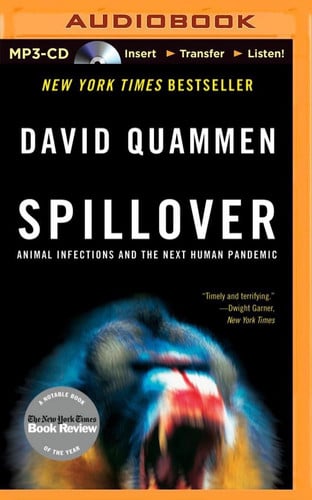
Spillover
8.84 / 10 21K ratings
- Language
- English
- Published
- 2014
- Publisher
- Brilliance Audio
- ISBN
- 9781491545089
David Quammen's Spillover embarks on a global investigation into zoonotic diseases, the infections that jump from animals to humans, and explores how the next human pandemic is likely to emerge. The book traces the origins of deadly pathogens like Ebola, SARS, Hendra, and HIV, detailing the scientific detective work involved in understanding their biology and spread.
Through immersive journeys with scientists into remote forests, bustling markets, and high-security laboratories, Quammen reveals how human encroachment into natural habitats and our interconnected world are increasing the frequency and danger of these "spillover" events. It offers an urgent, factual examination of humanity's role in the emergence of new diseases and provides a deep understanding of the ecological balance that shapes our shared biological future.
Through immersive journeys with scientists into remote forests, bustling markets, and high-security laboratories, Quammen reveals how human encroachment into natural habitats and our interconnected world are increasing the frequency and danger of these "spillover" events. It offers an urgent, factual examination of humanity's role in the emergence of new diseases and provides a deep understanding of the ecological balance that shapes our shared biological future.
Subjects
- Literature & Fiction
- Subjects
- Self Service
- History
- Arborist Merchandising Root
- Science & Math
- Earth Sciences
- Animals
- Medical Books
- Essays & Correspondence
- Biological Sciences
- Biology
- Medical
- Zoology
- Sociology
- Science
- Nature
- Medicine
- Internal Medicine
- Social Science
- Life Sciences
- Political Science
- Globalization
- Health & Fitness
- Disease & Health Issues
- Public Health
- Diseases & Conditions
- Diseases
- Anatomy
- Microbiology
- Bacteriology
- Ecology
- Future Studies
- Infectious Diseases
- Epidemiology
- Virology
- Contagious (incl. Pandemics)
Original edition
Spillover Animal Infections and the Next Human PandemicOriginally published in 2012 English W. W. Norton & Company
Other editions (10)



Listen to the summary Narrated summary
A whisper from the wild, a tremor in the delicate balance of life - this is how the story of spillover begins, the moment a pathogen leaps from its animal host into the human realm. It is a journey into the heart of emerging diseases, a stark exploration of how the world's deadliest viruses, those unseen architects of global catastrophe, originate not from some alien source, but from within the vibrant, often chaotic, tapestry of Earth's ecosystems. The quest for understanding takes one across continents, from the humid jungles of Central Africa to the bustling wet markets of Asia, to the quiet laboratories where dedicated scientists unravel the genetic secrets of these microscopic invaders.
The narrative plunges into the unsettling case of the Hendra virus, an obscure equine disease in Australia that suddenly, lethally, crossed species lines, felling horses and then a man. It is a detective story, tracking the elusive reservoir host - the species that harbors the virus without succumbing to its wrath - to fruit bats, their nocturnal existence inadvertently bringing them into contact with domestic animals and, ultimately, humanity. This initial foray sets the stage, revealing the intricate web of ecological relationships that, when disturbed, can unleash unforeseen biological threats.
From there, the trail leads to the chilling saga of Ebola, a virus that erupts with terrifying ferocity in remote African villages, leaving behind a grim tally of the dead. The search for its origins takes one deep into the forests, among the silent carcasses of gorillas and chimpanzees, hinting at a shared vulnerability across primate species. Here, the raw realities of bushmeat hunting and close human-animal contact become starkly apparent, painting a vivid picture of the precarious interface where new diseases are born and amplified.
The invisible enemy takes many forms, and the investigation broadens to encompass a spectrum of zoonotic threats. One encounters the baffling spread of SARS, a coronavirus that raced across the globe from a single point of origin, exposing the fragility of modern interconnectedness. The story delves into bacterial zoonoses like Q Fever, psittacosis, and Lyme disease, each a testament to the myriad ways our lives intersect with the microbial world hidden within other creatures. Even the seemingly benign, like bats, are revealed as vital, ancient reservoirs for a multitude of viruses, their unique biology making them perfect, unwitting incubators.
Perhaps the most profound and sobering chapter unfolds with the history of AIDS, the deadliest spillover event known to date. It is a journey back in time, tracing the insidious creep of HIV from a single chimpanzee in Cameroon, through a series of human transmissions, to its eventual devastating global spread. This meticulous reconstruction underscores a crucial, discomfiting truth: humanity is not separate from nature, but an integral part of it, and our actions - deforestation, urbanization, global travel, the disruption of natural habitats - are increasingly creating the conditions for these pathogens to emerge and thrive.
The journey concludes with a stark, unsettling realization. The "Next Big One," the pandemic that lurks on the horizon, is not a matter of if, but when. It will likely be a virus, jumping from an animal, perhaps a rodent in China, a monkey in West Africa, or a bat above a Malaysian pig farm. The relentless march of human population, our ever-expanding footprint on the planet, and the speed of modern travel have transformed localized outbreaks into potential global catastrophes. The urgent call is for vigilance, for scientific collaboration, and for a profound re-evaluation of humanity's place within the intricate, wild systems that govern life on Earth, before the next invisible killer makes its inevitable leap.
The narrative plunges into the unsettling case of the Hendra virus, an obscure equine disease in Australia that suddenly, lethally, crossed species lines, felling horses and then a man. It is a detective story, tracking the elusive reservoir host - the species that harbors the virus without succumbing to its wrath - to fruit bats, their nocturnal existence inadvertently bringing them into contact with domestic animals and, ultimately, humanity. This initial foray sets the stage, revealing the intricate web of ecological relationships that, when disturbed, can unleash unforeseen biological threats.
From there, the trail leads to the chilling saga of Ebola, a virus that erupts with terrifying ferocity in remote African villages, leaving behind a grim tally of the dead. The search for its origins takes one deep into the forests, among the silent carcasses of gorillas and chimpanzees, hinting at a shared vulnerability across primate species. Here, the raw realities of bushmeat hunting and close human-animal contact become starkly apparent, painting a vivid picture of the precarious interface where new diseases are born and amplified.
The invisible enemy takes many forms, and the investigation broadens to encompass a spectrum of zoonotic threats. One encounters the baffling spread of SARS, a coronavirus that raced across the globe from a single point of origin, exposing the fragility of modern interconnectedness. The story delves into bacterial zoonoses like Q Fever, psittacosis, and Lyme disease, each a testament to the myriad ways our lives intersect with the microbial world hidden within other creatures. Even the seemingly benign, like bats, are revealed as vital, ancient reservoirs for a multitude of viruses, their unique biology making them perfect, unwitting incubators.
Perhaps the most profound and sobering chapter unfolds with the history of AIDS, the deadliest spillover event known to date. It is a journey back in time, tracing the insidious creep of HIV from a single chimpanzee in Cameroon, through a series of human transmissions, to its eventual devastating global spread. This meticulous reconstruction underscores a crucial, discomfiting truth: humanity is not separate from nature, but an integral part of it, and our actions - deforestation, urbanization, global travel, the disruption of natural habitats - are increasingly creating the conditions for these pathogens to emerge and thrive.
The journey concludes with a stark, unsettling realization. The "Next Big One," the pandemic that lurks on the horizon, is not a matter of if, but when. It will likely be a virus, jumping from an animal, perhaps a rodent in China, a monkey in West Africa, or a bat above a Malaysian pig farm. The relentless march of human population, our ever-expanding footprint on the planet, and the speed of modern travel have transformed localized outbreaks into potential global catastrophes. The urgent call is for vigilance, for scientific collaboration, and for a profound re-evaluation of humanity's place within the intricate, wild systems that govern life on Earth, before the next invisible killer makes its inevitable leap.
What other readers say
Liked
David Quammen's book is widely praised for its remarkable foresight and timely relevance, with many reviewers noting its prescience regarding global health crises. Readers consistently commend the author's exceptional writing style, which is described as vivid, engaging, and well-researched. Quammen skillfully conveys complex biological and ecological concepts without oversimplifying, making the material accessible and informative for both novices and those with scientific backgrounds. A significant strength highlighted is Quammen's immersive approach, as he ventures into the field to interview scientists and observe their work firsthand, adding a compelling human dimension and a sense of adventure to the scientific investigations. The book is lauded for its ability to educate deeply, offering a panoramic view of infectious diseases and their origins that leaves readers much more knowledgeable.
Disliked
Despite its many strengths, some readers found the book to be quite detailed and occasionally repetitive, with certain sections feeling more like a textbook. A few reviewers also expressed reservations about Quammen's journalistic style, particularly his frequent insertion of personal anecdotes and an informal tone that some found distracting or even flippant. One critique specifically pointed out the book's omission of discussions regarding the potential for laboratory-modified viruses, a topic some felt was relevant to contemporary concerns about disease origins. Additionally, one reviewer disliked a brief fictionalized account of a patient's journey, feeling it deviated from the book's otherwise factual narrative. Other minor criticisms included a perceived lack of humor by one reader, while another wished for more visual aids such as maps and diagrams.
In short
Overall, the consensus is that this book is a crucial and compelling read, offering a sobering yet not alarmist perspective on the interconnectedness of human health and the natural world. It is highly recommended for intellectually curious readers interested in science, biology, epidemiology, public health, and ecology, as well as those who appreciate engaging narrative non-fiction. The book's detective-story approach to unraveling disease origins makes it captivating for anyone seeking to understand how animal infections spill over to humans and the broader implications for global pandemics. While it delves into serious topics, the book ultimately aims to inform and empower readers to make intelligent choices, underscoring humanity's responsibility in shaping future health outcomes.
No reviews yet. Be the first.