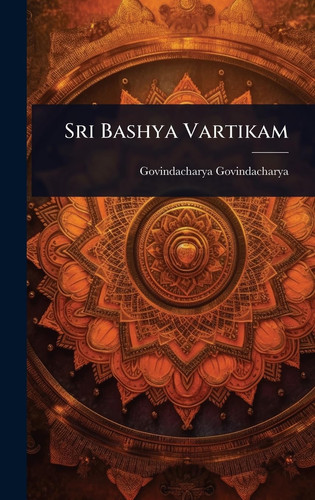
Within the profound expanse of Vedanta, where the currents of ancient wisdom converge and diverge, there emerges a meticulous illumination, a scholarly lamp guiding seekers through intricate philosophical terrains. This is the Sri Bashya Vartikam, a work that does not merely echo but deepens the resonant truths first expounded. It takes as its very foundation the venerable Sri Bhashya, Ramanujacharya's monumental commentary on the Brahma Sutras, and through its pages, unravels the profound tapestry of thought woven by that revered master.
One delves into its Sanskrit verses and prose to find a rigorous examination, a 'Vartikam' in its truest sense, meticulously scrutinizing what has been stated, addressing what might have been left unsaid, and refining that which could be expressed with greater precision. It is a journey into the very heart of the Vaishnava tradition, where the nuances of devotion and the nature of the Ultimate Reality are debated, dissected, and ultimately, made clearer through a lens of unparalleled intellectual rigor.
Each chapter unfolds as a detailed exposition, a philosophical dialogue spanning centuries, where the intricate arguments of the Brahma Sutras, as interpreted through the Vishishtadvaita philosophy of Ramanuja, are brought to the forefront. The reader is invited to witness the careful construction of arguments, the subtle distinctions drawn between various schools of thought, and the robust defense of the tenets central to the Vaishnava understanding of existence, consciousness, and bliss.
The text serves as an indispensable guide for those who seek to comprehend the subtle interplay of concepts such as Brahman, Jiva, and Jagat - the Supreme Being, the individual soul, and the material world. It meticulously lays bare the relationship between these entities, asserting the qualified non-dualism where the individual souls and the universe are seen as attributes of Brahman, distinct yet inseparable, forming a unified whole.
Here, the philosophical debates are not dry academic exercises, but vibrant encounters of intellect and intuition. One witnesses the detailed analysis of scriptural passages, the logical inferences drawn, and the refutations of opposing views, all presented with a profound reverence for the source texts and an unwavering commitment to truth. It is a work that demands contemplation, offering not just information but a pathway to a deeper, more nuanced understanding of the ultimate spiritual quest.