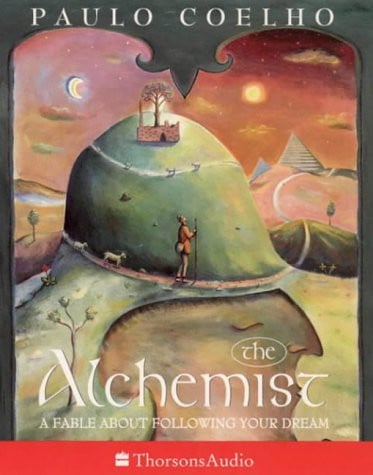
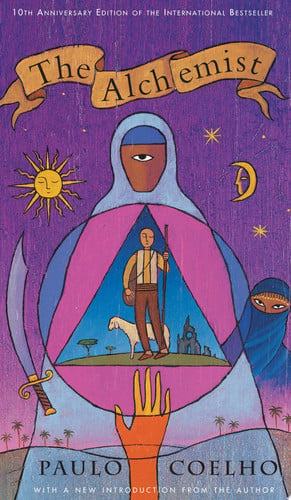
This story follows Santiago, an Andalusian shepherd boy who dares to journey from his home in Spain to the Egyptian desert in search of a treasure he has dreamed of. What begins as a quest for worldly riches evolves into a discovery of the treasures found within. The path to the pyramids is not straightforward; it is a course filled with omens, tests of faith, and encounters with a cast of characters who either guide or challenge him, including a mysterious man who calls himself a king and a wise alchemist.
Lush, evocative, and deeply humane, the journey of Santiago is an eternal testament to the transforming power of our dreams and the importance of listening to our hearts. It is a fable that explores the concepts of a Personal Legend, the wisdom of listening to one's heart, and the idea that the universe conspires to help those who pursue their dreams. The narrative serves as an inspirational tale of self-discovery, reminding the reader that the journey to fulfillment is as valuable, if not more so, than the destination itself.
Young Santiago, an Andalusian shepherd boy, found contentment in his flock and the open road, yet a recurring dream stirred a deeper longing within him. Each time he slept beneath a sycamore tree growing from the ruins of a church, a child would appear, urging him to seek treasure at the foot of the Egyptian pyramids. Though initially dismissive, a wise gypsy woman and then an enigmatic old man, Melchizedek, who claimed to be the King of Salem, affirmed the dream's prophecy, calling it his Personal Legend – his life's true purpose. Melchizedek, with his profound wisdom, convinced Santiago to sell his beloved sheep, reminding him that when one truly desires something, the entire universe conspires to help achieve it.
With newfound determination, Santiago set off for Tangier, Africa, only to be swiftly robbed of all his money, a cruel twist that left him desolate and forced to find work. He spent a year toiling for a kind crystal merchant, whose stagnant business Santiago revitalized with his innovative ideas. During this time, he learned valuable lessons about patience, perseverance, and the universal language of omens. Despite accumulating wealth, the call of his Personal Legend remained undeniable, and he cashed in his earnings, joining a caravan bound for Egypt, across the vast and unforgiving Sahara Desert.
On this arduous journey, Santiago encountered an Englishman, a scholarly man obsessed with the pursuit of alchemy and the legendary Philosopher's Stone and Elixir of Life. While the Englishman delved into ancient texts, Santiago learned to observe the subtle signs of the desert, listening to the wind and understanding the silent language of the world around him, a more intuitive path to knowledge. Their paths diverged at the oasis of Al-Fayoum, a verdant haven in the midst of the desert, where Santiago's heart was captured by Fatima, a woman of the desert.
His love for Fatima was immediate and profound, tempting him to abandon his quest and remain at the oasis. Yet, Fatima, understanding the true nature of love and destiny, urged him to continue his journey, promising to wait for his return. It was then that Santiago met the Alchemist, a powerful and ancient figure living at the oasis, who would become his ultimate mentor. The Alchemist, with his falcon perched on his shoulder, taught Santiago that true alchemy was not merely about transforming base metals into gold, but about personal transformation and understanding the Soul of the World. He challenged Santiago to listen to his heart, to face his fears, and to recognize that the universe constantly guides those who pursue their Personal Legend.
The Alchemist guided Santiago through the perilous, war-torn stretches of the desert, pushing him to confront his deepest fears and truly connect with the universe. In a moment of ultimate challenge, captured by warring tribesmen, Santiago was forced to demonstrate his understanding of the Soul of the World by transforming himself into the wind. This profound act of faith and connection proved his mastery of the Universal Language.
Finally, Santiago arrived at the pyramids, the destination of his recurring dream. He dug tirelessly, but found no treasure. Instead, he was accosted by thieves who, in a cruel twist of fate, revealed the true location of his treasure: back in Andalusia, beneath the very sycamore tree where his journey began. Returning home, Santiago dug beneath the ancient tree and unearthed a chest filled with gold and jewels, far richer than he could have imagined. He had traversed continents, faced countless trials, and learned the deepest secrets of the universe, only to find that the material treasure had been waiting for him all along. Yet, the true wealth lay not in the gold, but in the wisdom, courage, and profound self-discovery gained through the journey itself, a journey that had transformed him into an alchemist of his own soul.
What other readers say
Liked
The book is widely praised for its inspiring and uplifting message, often described as a modern fable. Reviewers appreciate its ability to ignite passion and encourage readers to pursue their dreams, or "Personal Legend," as a path to happiness and fulfillment. Many find the narrative rich with symbolism, wisdom, and philosophical insights, presented in a simple and accessible language that makes it enchanting. The story is seen as a journey of self-discovery, emphasizing courage, overcoming fear, and trusting one's heart, with a core theme that the universe conspires to help those who truly desire something. It is celebrated for being motivational, thought-provoking, and for offering a spiritually uplifting experience that resonates with many readers worldwide.
Disliked
However, the book also garners significant criticism. Some readers find its central messages, such as "the universe conspires to help you," to be simplistic, hokey, or even detrimental, arguing they lack nuance and responsibility. Critics accuse it of being trite inspirational literature disguised as an adventure, poorly written, didactic, and overly preachy. Specific points of contention include the perceived sexism, where female characters are seen as lacking their own "Personal Legends" and primarily existing to support the male protagonist's journey. Additionally, some reviewers find the philosophical depth superficial, the characters two-dimensional, and the plot predictable, suggesting it offers easily digestible but ultimately unfulfilling wisdom akin to a self-help book.
In short
Ultimately, "The Alchemist" elicits strong, often polarized, reactions. It is a book that appeals deeply to readers seeking an encouraging narrative about following one's aspirations, personal growth, and spiritual awakening. Those who appreciate allegorical tales, simple yet profound wisdom, and a hopeful outlook on life are likely to find it a memorable and inspiring read. Conversely, readers who prefer complex narratives, nuanced philosophical exploration, or are wary of what they perceive as simplistic self-help platitudes may find it underwhelming, cliché, and even frustrating.