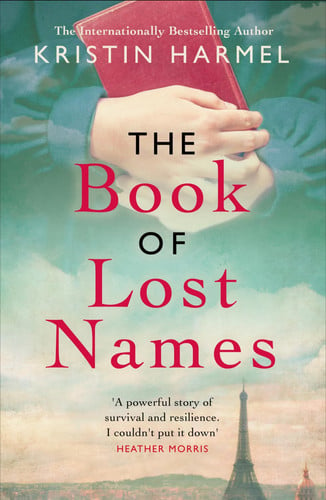
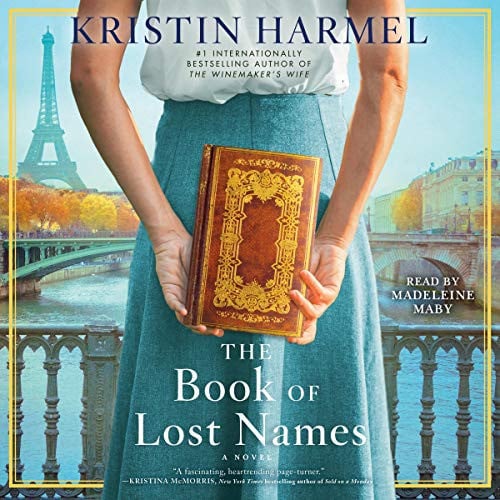
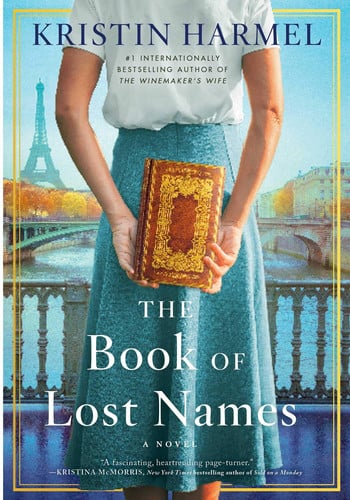
Inspired by the true stories of document forgers who aided the French Resistance, this novel follows a young Jewish woman whose artistic talents become a lifeline for hundreds of children fleeing the Nazis. In 1942, after her father's arrest, Eva Traube and her mother flee Paris for a small town in the Free Zone. There, she is recruited into a secret network that creates forged documents. Her mission is to give the children new identities, but she fears their real names will be lost to history forever. She begins to record their true names in a coded system within an old religious text, which becomes known as The Book of Lost Names.
Decades later, in Florida, the book reappears in a news article about looted Nazi artifacts. Now a semi-retired librarian, Eva is confronted with a past she has long kept hidden. The sight of the book, and the secrets it contains, forces her to decide whether to remain silent or to finally reveal the truth of her past, confront old memories, and potentially reunite those separated by the war. This story explores the resilience of the human spirit and the courage of ordinary people in the face of extraordinary evil.
It's a Saturday morning in May 2005 when I see it, the book I last held more than sixty years ago. My hand trembles as I reach for the newspaper left on the library returns desk. The headline reads, “Sixty Years After End of World War II, German Librarian Seeks to Reunite Looted Books with Rightful Owners.” And there, in the hands of a man named Otto Kühn, is the faded leather volume with the peeling corner: *Epitres et Evangiles*. My book. It belongs to me, and to Rémy, a man I vowed to forget but whose memory rushes back with the force of a tidal wave. The article says the book contains a mysterious code. “These are the questions that haunt me,” the librarian is quoted as saying. I whisper to his photograph, “How nice it must be to be haunted by questions rather than ghosts.” Before my meddling assistant manager can suggest I retire, I grab the newspaper and walk out. At home, I book a flight. There is something poetic in knowing I will arrive in Berlin sixty years to the day after the Germans surrendered in that very city. It's time for my son, Ben, to learn that his simple, quiet mother isn't the person he has always believed her to be.
The sky over Paris in July of 1942 was gray and pregnant with rain. Eva Traube stood outside the Sorbonne Library, cursing the humidity but more so the six-pointed yellow star stitched to her cardigan. It erased all other parts of her. A deep voice startled her. “Ah, mon petit rat de bibliothèque.” It was Joseph Pelletier, handsome and confident, one of the few other students in her department who wore the star. He leaned in close. “To warn you,” he whispered, his breath warm on her ear. “There are rumors that something is brewing. A massive roundup, before Friday.” He spoke of twenty thousand foreign-born Jews, a number so vast it seemed impossible. At home in their small apartment, her father, a typewriter repairman, dismissed the warning. “The Germans rule with fear as much as they do with their weapons,” Tatuś said. “If we cower… they will have won.” But later that night, he pulled her aside. If they came for him and her mother, he made her promise to flee, to find his old boss, Monsieur Goujon, who would provide false papers. “I cannot survive if I don't believe you are doing all you can to do the same,” he pleaded, and she gave him her word.
Two nights later, just after four in the morning, a knock came. It wasn't the Germans, but their neighbor, Madame Fontain, whose mother had fallen ill. She begged Eva and her mother, Mamusia, to watch her two small daughters. They went to the neighbor's apartment down the hall, an act of kindness that saved their lives. Two hours later, a banging from the hall startled Eva awake. Peering through the peephole, she watched in horror as three French policemen pounded on her family's door. Her father stepped out, dressed in his best suit. “Where is your wife?” an officer demanded. “And your daughter? Eva Traube?” Her father's tone was icy. “She's with her mother. But she was born here in France. You have no need to bother her.” Eva watched, her hand over her mouth to muffle her sobs, as they struck her father and shoved him toward a truck filled with their neighbors. Just before he disappeared inside, he glanced up, and Eva was sure he saw her, sure he knew her silent wave was a promise. When she turned to her mother, Mamusia collapsed. “Why, Eva? Why didn't you stop them?”
With her mother catatonic with grief, Eva knew they had to disappear. She stole back into their apartment, now a ghost of the life they once lived, and packed a suitcase. Armed with a typewriter as a pretense, she walked into the belly of the beast - the préfecture de police - and found Monsieur Goujon. He was terrified. “I promised him only that I would help you, not your mother,” he stammered, refusing to forge the documents himself. Instead, he gave her blank identity cards, travel permits, and a few art pens. “What is it your father used to tell you?” he said, pushing her out the door. “That God gave you the gift of artistic skills? Well, now is your chance to use that gift.” Back in the neighbor's kitchen, Eva's hands, slick with sweat, began the painstaking work of creating new lives. For her mother, she became Sabine Fontain, a Russian émigrée. For herself, Colette Fontain. She forged handwriting, signatures, and the intricate official stamps, her hope growing with every stroke of the pen. By the time Madame Fontain returned and venomously ordered them out, the documents were ready. Their escape from Paris was a blur of terror and adrenaline, a train journey south into the Free Zone, toward a small mountain town Monsieur Goujon had mentioned: Aurignon.
Aurignon was a town whose heart hadn't yet been trampled. Tucked into the hills, it was a place of stone paths and overflowing window boxes. But their relief was short-lived. Madame Barbier, the portly, suspicious proprietress of the boardinghouse, knew instantly that Mamusia was not Russian. “Vy na samom dele ne russkaya, ne tak li?” she'd asked. *You're not really Russian, are you? You're a fraud?* The next morning, Eva was followed through the winding streets by a limping man in a trench coat who introduced himself as le Père Clément, the local priest. He had seen her ink-stained fingers. “Madame Barbier was very impressed with your papers,” he said. “I think perhaps you and I could assist each other.” He led her to a secret library behind the altar, a room lined with ancient, leather-bound books. It was a forgery workshop. Here, she met Rémy, a brilliant, maddeningly handsome forger with hazel eyes and a cocky grin. He was an artist, he claimed, or sometimes simply a genius. Together, they began their work, erasing the identities of Jewish children and creating new ones that would allow them safe passage to Switzerland.
The work was a constant, aching reminder of all that was being lost. One day, holding a beautiful eighteenth-century religious text, Eva felt a pang of sorrow for the children too young to remember their own names. “Someone should remember,” she told Rémy. “How else will they find their way home?” That night, Rémy devised a plan. Using the book, *Epitres et Evangiles*, and the Fibonacci sequence, they created a code. They marked letters on specific pages, spelling out the children's real names, a secret record so that they would not be erased forever. They called it the Book of Lost Names. As they worked side-by-side, their elbows brushing, their lives became intertwined. In the small, hidden room that smelled of chemicals and old paper, surrounded by the ghosts of disappearing children, Eva fell in love.
Their fragile world shattered in the winter of 1944. Their network was betrayed. Eva's former classmate, Joseph Pelletier, now a high-ranking Resistance leader called Faucon, was the traitor. He had been feeding information to the Germans. He murdered Eva's fellow forger, Geneviève, and cornered Eva in the secret library, demanding she reveal the network's secrets. “Tell me about the forgeries, Eva, or I'll torture you myself,” he snarled, raising his gun. As he counted down the seconds to her death, a shot rang out. Joseph fell, and standing over him was Erich, a young German soldier who had been secretly feeding information to Père Clément. “You must go, Eva,” Erich said, as German voices echoed outside. “Run for your life.” Before she could protest, he put the gun to his own head, his sacrifice creating the chaos she needed to escape.
Eva fled Aurignon, believing she was on her way to Switzerland. But she learned that her mother had been captured and executed after refusing to reveal her whereabouts. “She was proud to be the mother of someone so brave,” a cruel gendarme told her. Devastated, Eva learned that Rémy had been killed in an ambush. With everyone she loved gone, she made her way back to a liberated Paris. After the war, she met Louis Abrams, a kind American, and sailed away to a new life, burying the woman she had been, erasing herself just as she had erased the children. She locked away the memories of the forger, the fighter, the woman who had loved a man named Rémy with her whole heart.
Now, in Berlin, I hold the Book of Lost Names once more. My hands shake as I open it to the first page, my page, searching for a sign, a final message from Rémy that was never sent. There is nothing. He died without knowing how much I loved him, that my answer would have been yes. With a broken heart, I explain the code to Otto Kühn, telling him the story of the children whose names fill the book's pages. We are deep into our work when a security guard interrupts us. A man is outside, she says, an American who flew in tonight. He is insisting the book belongs to him.
I follow Kühn outside to confront the collector. A white-haired man stands with his back to us, gazing over the city. When he turns, the world stops spinning. The years fall away. It's a face I thought I'd see only in my dreams. “You got the library wrong, Eva,” he says, his voice cracking. It's Rémy. He wasn't killed; he was gravely wounded and taken to England to recover. By the time he returned, I was gone. He waited on the steps of the Mazarine Library, but I had already given up hope and left for America. All these years, we have both been alive, an ocean away from France but a country apart, each believing the other was a ghost. “I left you a message,” I whisper, tears streaming down my face. “In the book.” He holds my gaze, his eyes as warm and familiar as they were a lifetime ago. “What was it, my Eva?” I tell him the words I encoded on his page, the answer I was too afraid to give him then. *Marry me. I love you.* “If the offer is still open,” he says, his own tears falling, “my answer is yes.” He closes the distance between us, and as his lips meet mine, I am twenty-five again, all the chapters of our lives still unwritten.
What other readers say
Liked
Many readers found the book's premise, centered on a Jewish forger creating false documents for children during WWII and recording their true identities, to be highly intriguing and captivating. Reviewers often praised the author's engaging writing style, describing it as smooth and easy to follow. The main character, Eva, was frequently highlighted as a strong, tenacious, and resilient protagonist whose journey resonated with many. The dual timeline structure was generally well-received, effectively weaving together past and present. Furthermore, the book was commended for shedding light on the intricate work of the French Resistance, particularly the art of forgery and the desperate efforts to save Jewish children, which many found informative and eye-opening. For many, the story delivered a powerful emotional impact, leading to tears and a lasting impression.
Disliked
However, the book received significant criticism for its perceived lack of originality within the WWII historical fiction genre, with some reviewers finding the plot predictable and lacking the depth or grit they expected from the subject matter. A recurring and strong point of contention was the characterization of Eva's mother, who was widely described as annoying, bitter, selfish, and an unrealistic caricature that detracted from the narrative. Concerns were also raised about Eva's own character, with some finding her inconsistent in her Jewish identity or at times overly naive. Many felt the romantic subplot was too central to the story, overshadowing the more compelling aspects of the Resistance work and the children's plight. Additionally, some critics pointed to implausible plot points, such as Eva's swift mastery of forgery or convenient "close calls," which strained belief. A few reviewers also questioned the book's historical accuracy and cultural sensitivity, particularly regarding its portrayal of Jewish characters and its underlying themes.
In short
Overall, "The Book of Lost Names" evokes a polarized response, appealing strongly to some while disappointing others. It is likely to be enjoyed by readers who are new to WWII historical fiction or those who appreciate a more emotional and character-driven narrative with a focus on personal bravery and relationships, even if it includes romantic elements. However, seasoned readers of the genre seeking fresh perspectives, deep historical accuracy, or a grittier portrayal of wartime realities may find it lacks originality and depth. Despite its flaws, many reviewers conceded that the book was entertaining and captivating, making it a potentially worthwhile read for those interested in the specific efforts of the Resistance and the theme of preserving identity.