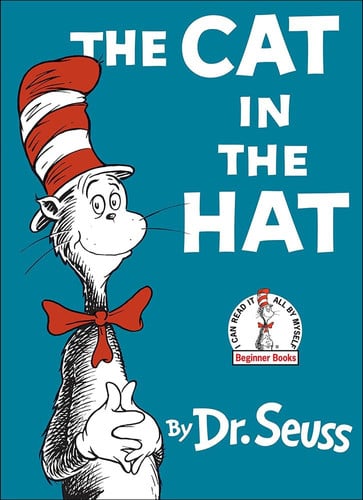
The Cat in the Hat
by Dr. Seuss
8.4 / 10 599K ratings
- Language
- English
- Published
- 1957
- Publisher
- Turtleback
- Pages
- 61
- ISBN
- 9780881034202
On a cold, wet day, two children find themselves stuck in the house with nothing to do. Their dreary afternoon is interrupted by the arrival of a tall, mischievous cat in a red and white striped hat. Against the wishes of the family fish, the Cat in the Hat begins a series of tricks and games designed to entertain the children, Sally and her brother. What starts as playful fun quickly escalates into chaos, especially with the appearance of two companions, Thing One and Thing Two.
The house is turned upside down, and the children are faced with a growing mess and the impending return of their mother. The story, told with simple rhymes and whimsical illustrations, captures the tension between spontaneous fun and household rules. It explores the excitement of the unexpected while leaving the reader to ponder what happens when the lines of right and wrong are blurred by a charismatic stranger, ultimately questioning what one would do in the face of such delightful mayhem.
The house is turned upside down, and the children are faced with a growing mess and the impending return of their mother. The story, told with simple rhymes and whimsical illustrations, captures the tension between spontaneous fun and household rules. It explores the excitement of the unexpected while leaving the reader to ponder what happens when the lines of right and wrong are blurred by a charismatic stranger, ultimately questioning what one would do in the face of such delightful mayhem.
Subjects
- Literature & Fiction
- Subjects
- Literary
- Fantasy
- Folklore
- Anthologies
- Children's Books
- Activities, Crafts & Games
- Activity Books
- Non-Classifiable
- CHILDREN'S FICTION
- Animals
- Poetry
- Humor
- Politics & Social Sciences
- Fiction
- Juvenile Fiction
- Fantasy & Magic
- Classics
- Education
- Children's fiction
- Pictorial works
- Juvenile fiction
- Juvenile literature
- Early Learning
- Romans, nouvelles, etc. pour la jeunesse
- Brothers and sisters
- LARGE TYPE BOOKS
- Foreign Language Study
- School & Education
- Regional & Cultural
- People & Places
- Juvenile Nonfiction
- Interactive Adventures
- Nonfiction - General
- Fairy Tales, Folk Tales & Myths
- Stories in Verse
- American
- Concepts
- Family & Relationships
- Cats
- Spanish
- French
- STORIES IN RHYME
- Spanish language
- Large type books
- Readers
- Humorous Stories
- Fantasy fiction
- Activities
- Intermediate
- Imagination & Play
- Words
- CATS_FICTION
- Beginner
- Stories in rhyme
- Opposites
- Humorous stories
- Interactive Adventure
- Children's stories
- English language readers
- Children's Books/All Ages
- Ficción juvenil
- Literary Criticism & Collections
- Latin language
- Clothing & Dress
- Spanish literature
- Children's literature
Original edition
The Cat in the HatOriginally published in 1957 English Random House Children's Books
Other editions (47)


Listen to the summary Narrated summary
The rain fell with a relentless, drumming rhythm against the windowpane, trapping two children, Sally and her brother, indoors. Boredom hung heavy in the air, thick as the gray clouds outside, as they sat, watching the drops race down the glass, wishing for something, anything, to break the monotonous spell of the dreary afternoon. Their mother was out, and the house, usually bustling, felt quiet and still, save for the patter of the rain and the soft gurgle of their pet fish in its bowl.
Suddenly, a most unexpected visitor appeared at their door. Standing tall and proud, a Cat, adorned in a magnificent red-and-white striped hat and a jaunty red bow tie, stepped into their lives. He was a creature of boundless energy and mischievous charm, and he declared, with a grin that stretched wide, that he knew many good tricks, promising to fill their dull day with fun. The children, wide-eyed and a little stunned, could only watch as the Cat began his performance.
Their sensible pet fish, however, was not amused. From his bowl, he chirped warnings, a tiny voice of reason amidst the growing excitement, insisting that their mother would not approve of such antics while she was away. But the Cat, with a flick of his tail and a twinkle in his eye, merely incorporated the fish into his next trick, balancing him precariously atop an ever-growing stack of household items, all while standing on a ball. The children gasped, a mix of delight and apprehension bubbling within them.
The chaos escalated when the Cat, with a flourish, produced a big red box. From within sprang Thing One and Thing Two, two small, blue-haired impish creatures in red jumpsuits, eager to cause even more delightful havoc. They zipped through the house, flying kites and scattering everything in their path, turning the once-orderly living room into a whirlwind of disarray. The fish grew increasingly frantic, pleading with the children to make the Cat and his Things leave before their mother returned and discovered the spectacular mess.
A wave of panic began to set in. The children imagined their mother's face, stern and disapproving, as she walked into their wrecked home. They knew this wild fun, exhilarating as it was, had gone too far. Gathering their courage, the boy finally caught Thing One and Thing Two with a net, and the Cat, seeing the children's distress and the extent of the disarray, seemed to understand.
With a surprising shift, the Cat gathered his Things and, just as quickly as he had appeared, began to clean. He produced a most extraordinary machine, a contraption that whirred and hummed, sweeping up every last bit of the mess, restoring the house to its pristine state in mere moments. As the front door creaked open and their mother stepped inside, the Cat tipped his hat, gave a final, knowing smile, and vanished without a trace.
Now, the house was quiet once more, clean and tidy, as if no whimsical, striped-hatted Cat had ever visited. Sally and her brother sat in their chairs, looking out at the still-falling rain, the memory of the whirlwind adventure vivid in their minds. Their mother, oblivious to the day's extraordinary events, asked about their time. The children exchanged a glance, a silent question passing between them: What should they tell her? And then, a thought surfaced, directed at no one and everyone: What would *you* do if your mother asked *you*?.
Suddenly, a most unexpected visitor appeared at their door. Standing tall and proud, a Cat, adorned in a magnificent red-and-white striped hat and a jaunty red bow tie, stepped into their lives. He was a creature of boundless energy and mischievous charm, and he declared, with a grin that stretched wide, that he knew many good tricks, promising to fill their dull day with fun. The children, wide-eyed and a little stunned, could only watch as the Cat began his performance.
Their sensible pet fish, however, was not amused. From his bowl, he chirped warnings, a tiny voice of reason amidst the growing excitement, insisting that their mother would not approve of such antics while she was away. But the Cat, with a flick of his tail and a twinkle in his eye, merely incorporated the fish into his next trick, balancing him precariously atop an ever-growing stack of household items, all while standing on a ball. The children gasped, a mix of delight and apprehension bubbling within them.
The chaos escalated when the Cat, with a flourish, produced a big red box. From within sprang Thing One and Thing Two, two small, blue-haired impish creatures in red jumpsuits, eager to cause even more delightful havoc. They zipped through the house, flying kites and scattering everything in their path, turning the once-orderly living room into a whirlwind of disarray. The fish grew increasingly frantic, pleading with the children to make the Cat and his Things leave before their mother returned and discovered the spectacular mess.
A wave of panic began to set in. The children imagined their mother's face, stern and disapproving, as she walked into their wrecked home. They knew this wild fun, exhilarating as it was, had gone too far. Gathering their courage, the boy finally caught Thing One and Thing Two with a net, and the Cat, seeing the children's distress and the extent of the disarray, seemed to understand.
With a surprising shift, the Cat gathered his Things and, just as quickly as he had appeared, began to clean. He produced a most extraordinary machine, a contraption that whirred and hummed, sweeping up every last bit of the mess, restoring the house to its pristine state in mere moments. As the front door creaked open and their mother stepped inside, the Cat tipped his hat, gave a final, knowing smile, and vanished without a trace.
Now, the house was quiet once more, clean and tidy, as if no whimsical, striped-hatted Cat had ever visited. Sally and her brother sat in their chairs, looking out at the still-falling rain, the memory of the whirlwind adventure vivid in their minds. Their mother, oblivious to the day's extraordinary events, asked about their time. The children exchanged a glance, a silent question passing between them: What should they tell her? And then, a thought surfaced, directed at no one and everyone: What would *you* do if your mother asked *you*?.
What other readers say
Liked
This classic children's book is widely celebrated for its ability to captivate young readers and foster a love for literature. Many reviewers praise its engaging, silly, and whimsical nature, highlighting the enjoyment derived from its distinct rhythm, playful rhymes, and vibrant illustrations. It is frequently lauded as an excellent tool for early readers, utilizing simple vocabulary and repetition that makes it accessible and fun to read aloud. Readers, both children and adults, often describe feeling giddy and uplifted by the book's unique charm and the imaginative world it creates. Its iconic status is consistently recognized, with many considering it a signature work that has positively impacted generations of children learning to read.
Disliked
However, the book also elicits strong negative reactions and deeper, sometimes unsettling, interpretations from some readers. A significant number of adults perceive the story as a "nightmare-quality horror," citing themes of a strange, intrusive character entering an unsupervised home, causing chaos, and potentially encouraging children to conceal events from their parents. Concerns are raised about the Cat's disruptive behavior and the potential moral implications of the narrative. Critiques also extend to the writing style itself, with some finding the rhyming and monosyllabic language to be "lazy" or "subpar," and the overuse of exclamation points distracting. For these readers, particularly those sensitive to themes of strangers or unchecked mischief, the book can be disturbing rather than amusing.
In short
Ultimately, "The Cat in the Hat" remains a foundational work in children's literature, celebrated for its historical role in making reading enjoyable for countless children. While it can be enjoyed as a straightforward, fun adventure, its narrative also lends itself to diverse, often contrasting, adult interpretations, ranging from a lighthearted tale to a cautionary one. It is highly recommended for young children, especially those aged four to eight, who benefit from its engaging rhymes and illustrations for developing reading skills and imagination. Adults who appreciate Dr. Seuss's unique artistic and linguistic style, or those interested in literary analysis, will also find value in this enduring classic, provided they approach it with an openness to its inherent absurdity and the wide spectrum of emotions it can evoke.
No reviews yet. Be the first.